China’s AI is catching up even as governments move to block it
AI makers from China are capitalizing on what other countries appear to lack – a stable electricity supply and infrastructure that support large-scale AI development. While AI models from the US rival those from Beijing, other countries seem to take on a more pious approach to China-made AI.

Image by Cybernews

 Follow us
AI makers from China are capitalizing on what other countries appear to lack – a stable electricity supply and infrastructure that support large-scale AI development. While AI models from the US rival those from Beijing, other countries seem to take on a more pious approach to China-made AI.
Although China currently lacks the necessary resources and expertise to produce advanced AI chips, the technological gap between Beijing and the US is getting smaller by the day. At the moment, American AI models tend to dominate the LLM market. However, China is seeking to overtake the US in AI user platforms, and this might occur sooner than you might think.
Yao Shunyu, a former senior researcher at ChatGPT maker OpenAI who was named Chinese technology giant Tencent's chief AI scientist in December, said there was a high likelihood of a Chinese firm becoming the world's leading AI company in the next three to five years, provided the country finds a way to produce more advanced chipmaking machines.
"Currently, we have a significant advantage in electricity and infrastructure. The main bottlenecks are production capacity, including lithography machines, and the software ecosystem," Yao said at an AI conference in Beijing.
That being said, Beijing is intensifying its efforts to develop domestic alternatives to US technology. China has reportedly completed a working prototype of an extreme-ultraviolet lithography machine that’s capable of producing advanced semiconductor chips.





However, Reuters reports that the machine may not begin to produce chips until the end of 2030.
Why is China’s AI-development progress so concerning to some?
It’s China’s legislation on AI companies.
In countries such as France, India, and South Korea, China-made AI, especially one of its flagship products, Deepseek, has come under scrutiny for its security policies and privacy practices.
For instance, the AI firm, according to its own privacy policy, stores its users’ personal data, including requests to its AI platform or uploaded files, device and network details, log information, and location data, on computers in China.
For many countries, this raises a red flag, as the collected information falls under Chinese jurisdiction, meaning it could be accessed by the state, which countries such as South Korea, Germany, and France view as a hostile, or at least a “strategic competitor.”
“If a US government agency needs my information, they have to serve me a subpoena, which I can challenge in a court of law,” says Matthew R. Clark, owner and lead attorney of The Clark Law Office in Michigan.
“However, the Chinese state is allowed to request my data from me without either a judge or my ability to contest the request to court pursuant to the 2017 Chinese Intelligence Law,” he explains.
Several countries have already decided not to take chances with DeepSeek, and as early as last year, have taken action to either block or limit the use of the Chinese-made AI.

For example, in July 2025, the Czech government banned the use of services and products from DeepSeek across its public administration due to concerns about data security and national security. Australia did the same in January and the Netherlands in July.
In comparison, Russia's President Vladimir Putin instructed Sberbank to collaborate with Chinese researchers on joint AI projects in early February, a top executive at Russia's largest bank told Reuters.
Aren’t other countries trying to take matters into their own hands?
The race among countries to develop the best national AI isn’t much of a race. With the US dominating the market with OpenAI, Perplexity, and China responding with DeepSeek and Qwen, other countries seem to have barely moved from the start line. It all comes down to cost.
For example, the French Mistral AI, the largest non-US and non-Chinese contender, poses only a minor risk to the previously mentioned companies, despite being often referred to as Europe’s best shot at tech sovereignty.
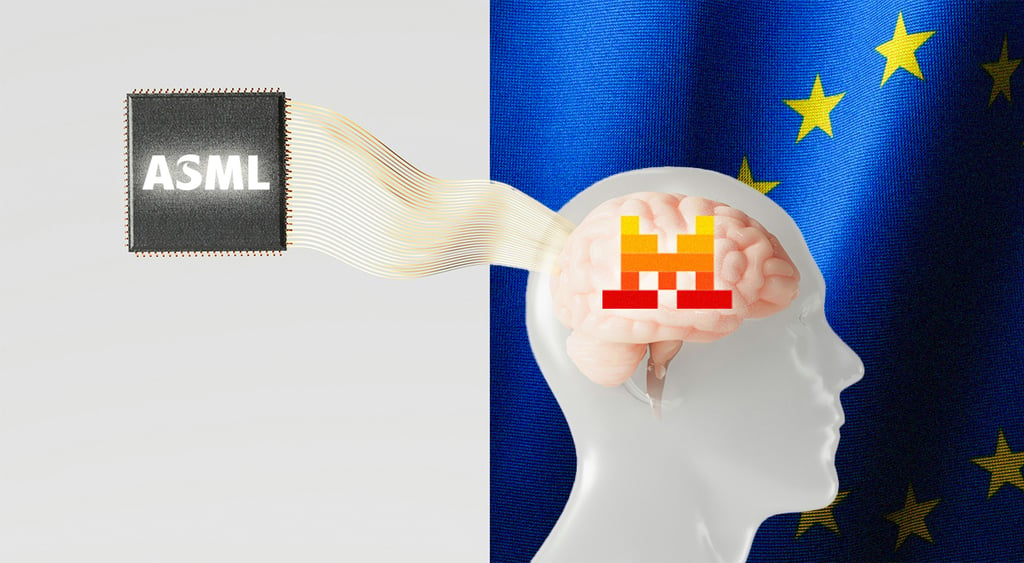
The company has raised roughly €1 billion in total funding, and its value is now about €11.7 billion. In comparison, just last May, Microsoft (one single company from the US) invested over $13 billion in OpenAI to support its AI efforts.
It’s not just France. Other countries seem to have a similar approach to China’s AI as they appear to prioritize defense against the Chinese AI approach, rather than trying to outperform what has already been developed by Beijing.
Germany tends to have a more business-like approach, as in June, the country asked Apple and Google to remove DeepSeek from their stores due to concerns about data safety.
South Korea's data industry minister had temporarily blocked employee access to DeepSeek due to security concerns, although the service became available again at the end of April.
Is it only DeepSeek that the world fears and China invests in?
No. While certain technologies, such as the previously mentioned lithography machine, are in development, China continues to invest in other AI companies.
Today, shares in OmniVision Integrated Circuits jumped 16.2% in their Hong Kong debut after the Chinese semiconductor design company raised HK$4.8 billion ($616 million) from a second listing.
Just last week, so-called “AI tiger” startups such as MiniMax and Zhipu AI made strong debuts on the Hong Kong Stock Exchange, showing that investors believe that China’s AI ecosystem could become stronger despite export limits.






Unlock more exclusive Cybernews content on YouTube.