Trump and Xi have Europe’s cybersec caught in the middle: the old continent turns to open-source
A new survey reveals that European companies are increasingly seeking to safeguard their data by opting for open-source tools over proprietary technology. This is also a global trend, with national security and defence sectors leading the way.

 Follow us
A new survey reveals that European companies are increasingly seeking to safeguard their data by opting for open-source tools over proprietary technology. This is also a global trend, with national security and defence sectors leading the way.
As geopolitical tensions between China and the US reach an all-time high, news on high-tech exports and their limitations has become a matter of national interest.
Export restrictions on advanced AI chips, such as Nvidia’s Blackwell GPUs, serve as a good illustration of how foreign policy can directly either limit access to critical technology or put another party at an advantage. At the same time, state-backed cyberattacks, including campaigns targeting European diplomats and critical infrastructure, underscore the risks of relying on digital platforms that are externally controlled, in Europe’s case, by the US.
Just today, the International Criminal Court (ICC) in The Hague announced its switch from the Microsoft Office Suite to the German office software, OpenDesk.
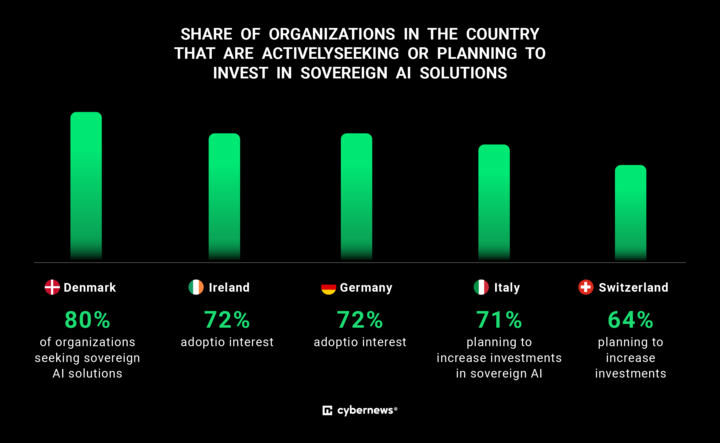
A new survey has shown that the ICC is among the 62% of European organizations seeking to keep their AI systems' data, models, and infrastructure within local borders.






The interest is high in Denmark (80%), Ireland (72%), and Germany (72%). The sectors that show the most pressing motivation for digital sovereignty are banking, utilities, and public services. These sectors are also the ones that lead the open-source tool adoption.
“Europe is facing an AI paradox. Leaders know they need to accelerate AI to drive innovation and growth, but because most AI technologies originate from outside the region, they also see it as a risk,” said Mauro Macchi, Accenture’s chief executive for Europe, the Middle East, and Africa.
The company was the one that conducted the survey.
Companies have to balance global innovation and data protection
The survey also shows that two out of three European organizations believe they cannot stay competitive without using at least some non-European technology providers. For example, on average, 36% of AI projects require the company to be fully “sovereign” in tech due to regulatory concerns and the sensitive data involved in their projects.
Therefore, many companies are adopting hybrid approaches where they combine local data storage platforms with global cloud services.
According to Mauro Capo, Accenture’s digital sovereignty lead for EMEA, the goal is “not to hold everything in one place,” but to allow organizations to make “technology choices according to the degree of control they need.”
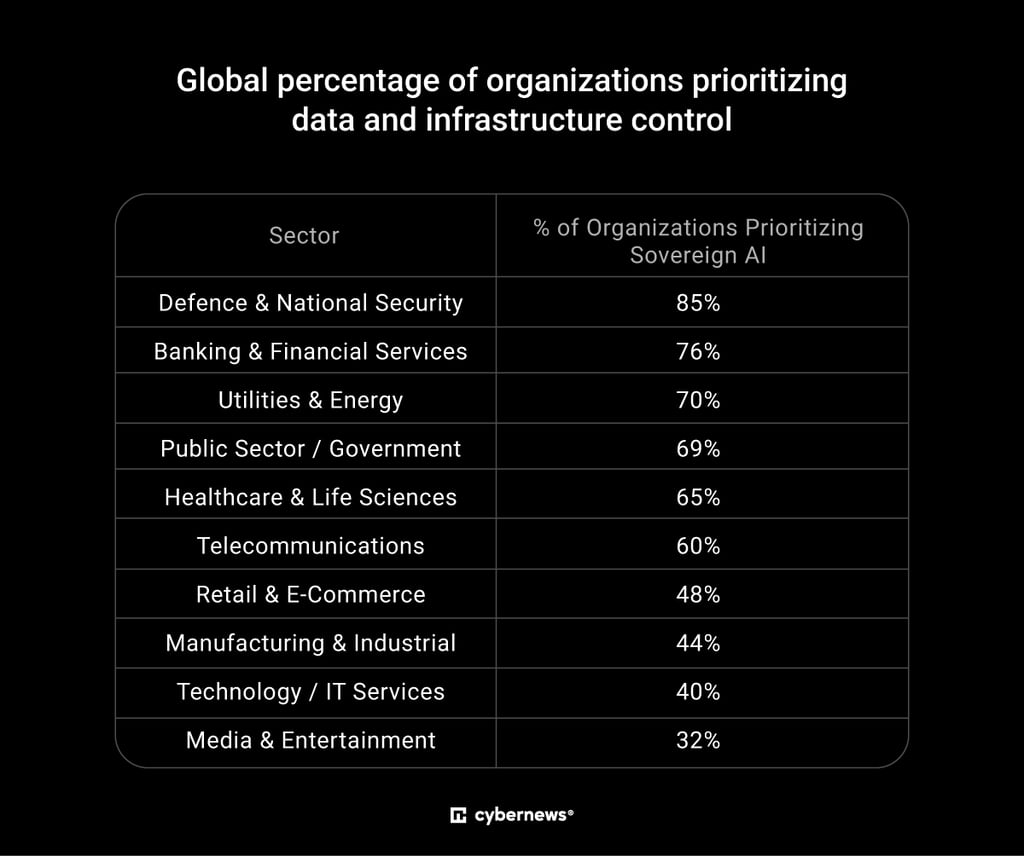
Even though this data is not specific to Europe, globally, the sectors that prioritize data and infrastructure control the most are defense and national security, banking and financial services, utilities and energy, and the public sector and governance.
For now, most organizations see digital sovereignty as a regulatory necessity rather than a strategic opportunity. Only 19% view sovereign AI as a competitive advantage – the majority do so because they are required to comply with certain policies.
Accenture surveyed 2,000 organizations in 28 countries and 18 industries. The survey was conducted in July and August of this year. It included organizations from both the public and private sectors.






Unlock more exclusive Cybernews content on YouTube.