Trump signs Executive Order establishing singular federal AI policy
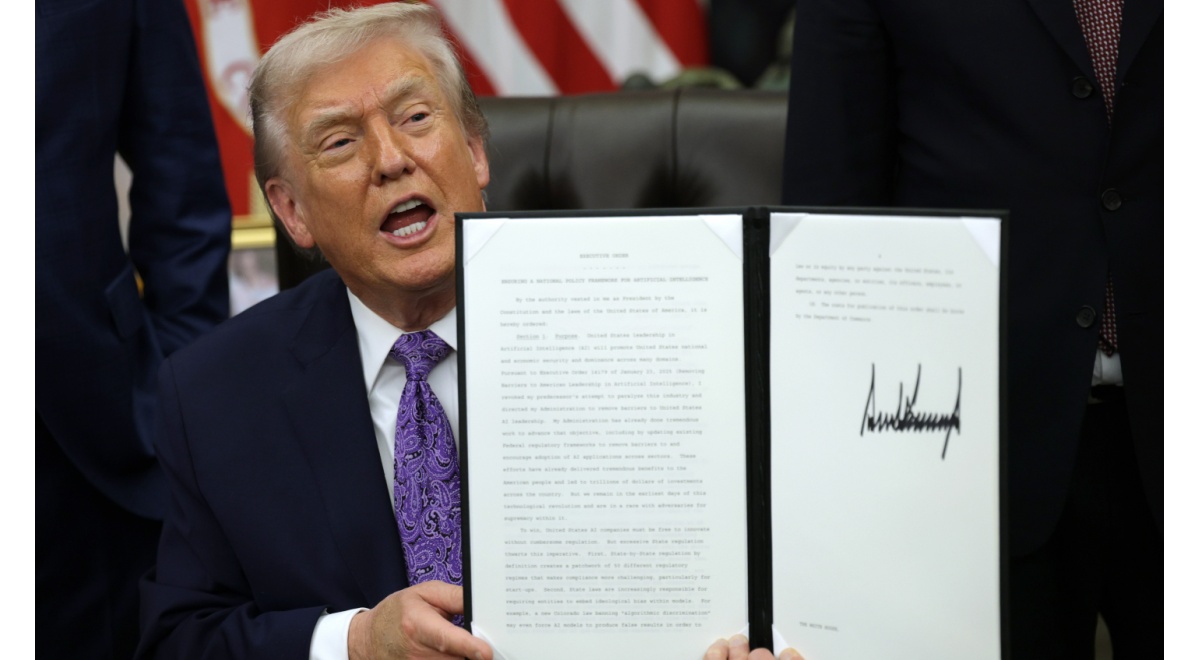
US President Donald Trump has followed through on his promise, signing an Executive Order (EO) on Thursday that creates a single national AI law to supersede the current patchwork of state regulations. Cybernews breaks it down.
Alex Wong/Getty Images

 Follow us
US President Donald Trump has followed through on his promise, signing an Executive Order (EO) on Thursday that creates a single national AI law to supersede the current patchwork of state regulations. Cybernews breaks it down.
- President Donald Trump signs an Executive Order establishing a single federal AI framework to override conflicting state regulations
- Key agencies, including the FCC, FTC, and Commerce Department, must implement reporting standards, clarify enforcement, and review state AI laws within 90 days.
- Protections for children, AI infrastructure, and how states use AI remain intact, with other exemptions determined case by case.
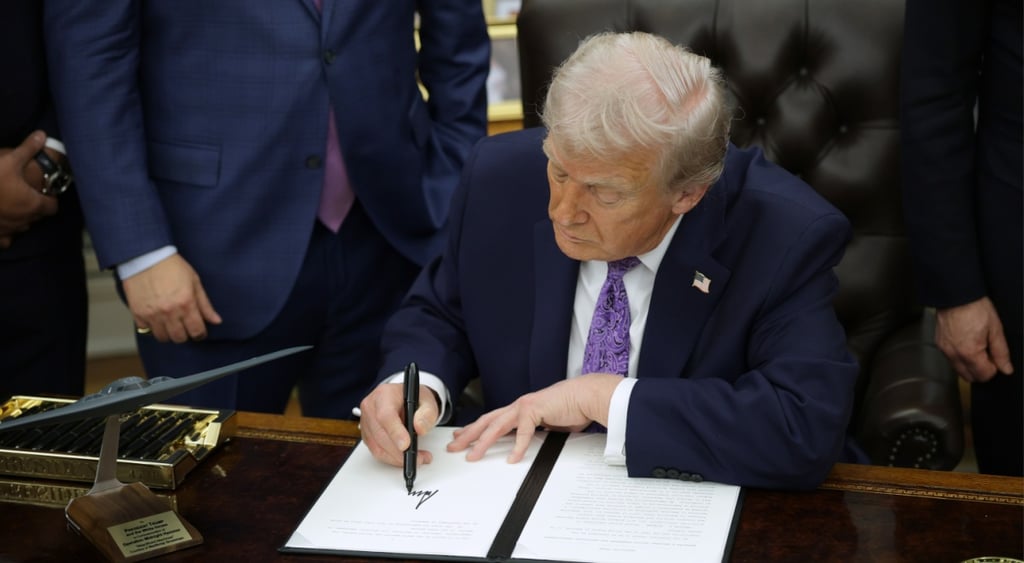
The new Executive Order, Ensuring a National Policy Framework for Artificial Intelligence, was signed by Trump in the Oval Office on Thursday afternoon, in the presence of a host of guests and Cabinet members, including US Treasury Secretary Scott Bessent.
“United States leadership in Artificial Intelligence (AI) will promote United States national and economic security and dominance across many domains,” Trump starts off the order.
Since taking the presidential oath in January, Trump has been calling for a federal standard to regulate AI, arguing that the hodgepodge of state regulations has hindered AI-driven economic growth.





Prominent tech leaders have echoed the sentiment – including major AI players OpenAI, Google, Meta, and venture capital firm Andreessen Horowitz – expressing concern that the US will fall behind China in AI development if states are allowed to regulate the technology.
“I revoke my predecessor’s attempt to paralyze this industry,” Trump states, taking a typical swipe at former President Joe Biden and the Democratic Party in the process.
Acknowledging that the technology revolution is still in its infancy, Trump's new framework aims to position the United States to “win the AI race” against its adversaries, “as we must,” to achieve “global AI dominance.”
“To win, United States AI companies must be free to innovate without cumbersome regulation,“ he said.
Changes to happen in 30/90 days
Trump has called on two advisory positions – the Special Advisor for AI and Crypto and the Assistant to the President for Science and Technology – to collaborate and draft a legislative recommendation for a uniform federal AI policy that will preempt any state laws conflicting with the policy, with some exceptions (listed further below).
While working on creating and implementing the "minimally burdensome national standard” AI policy framework, the White House has laid out several changes to take place over the next 90 days, “to check the most onerous and excessive state laws that threaten to stymie innovation."
In 30 days, the US Attorney General’s (AG) Office will establish an AI Litigation Task Force to challenge State AI laws considered inconsistent with the EO, such as laws that unlawfully restrict interstate commerce, are preempted by federal rules, or are otherwise invalid in the judgment of the AG.
In 90 days, Commerce Secretary AI Crypto Advisor will be tasked with evaluating state AI laws that “require AI models to alter their truthful outputs, or compel AI developers or deployers to disclose or report information in a manner that would violate the First Amendment or any other provision of the Constitution.”
Within the same 90-day window, the Federal Communications Commission (FCC) must consider creating a nationwide reporting and disclosure standard for AI models that preempts conflicting state laws, while the Federal Trade Commission (FTC) must clarify how its rules against unfair or deceptive acts apply to AI, including situations where state laws might require altering truthful outputs.

Mixed support for singular AI rule
Announcing his intentions on Monday, the president has been met with both praise and condemnation, depending on the stakeholder.
A recent 20i AI Impact survey taken on December 4th shows that 84% of Americans working in the web industry (i.e., web designers, developers) support government regulation of AI.
State leaders from both sides of the aisle fear they will lose the ability to impose their own AI safeguards, given Congress’s ongoing failure to enact federal tech regulations.






Democratic Representative Don Beyer, co-chair of the Congressional AI, said the new order will suppress safety reforms already enacted by the states, creating “a lawless Wild West environment for AI companies that puts Americans at risk."
Florida Governor Ron DeSantis, a Republican, who has since introduced his own AI Bill of Rights, argues the federal rule will remove states' ability to rein in big tech, and prevent prosecuting cases involving AI hotbed issues, such as “online censorship of political speech, predatory platforms that target children, and intellectual property rights violations.”
Trump, after signing the EO, announced that states attempting to thwart the new AI policy would be threatened with cuts to federal broadband funding.
The Commerce Department must also set the parameters under which broadband funding will be restricted by the 90-day deadline.
In a possible attempt to appease lawmakers, the EO laid out several exemptions to the new framework – meaning under no circumstance will federal law preempt certain designated state law, to include the following,
- Child safety protections – State rules to protect children from harmful AI use remain valid.
- AI compute and data center infrastructure – States can regulate, other than generally applicable permitting reforms.
- State government AI procurement and use – States control how they buy and use AI.
- Other topics – exceptions to be determined.
Trump also hailed his administration for (under his direction) updating existing Federal regulatory frameworks, which he says have not only “encouraged the adoption of AI applications across sectors” but have also resulted in “trillions of dollars in investments.”
Unlock more exclusive Cybernews content on YouTube.