n8n vs Relevance AI: which automation platform fits your tTeam?
Being behind major reports like The Mother of All Breaches and RockYou2024, our in-house cybersecurity experts and journalists provide unbiased, real-world testing and in-depth analysis.
We maintain complete transparency by openly sharing our testing methodologies with our audience.
Learn more
n8n is an open-source, self-hostable workflow automation tool built for technical teams that want full control over their workflow logic, data, and infrastructure. Relevance AI, on the other hand, caters to teams who want to deploy AI agents in a low-code environment.
You may be wondering what that actually entails. In this article, I cut through the marketing fluff to give you answers to the basic questions about n8n and Relevance. With the help of the Cybernews research team, I thoroughly tested both products to determine which is easier to set up a workflow in, evaluate their hosting and agentic approaches, and assess which scales better.
After reviewing n8n vs Relevance AI, I found that while both tools can be used for similar use cases, they take radically different approaches to handling these tasks. Relevance AI focuses on ease of use and a simple implementation. n8n gives your team power over the finer details. This is similar to the difference between n8n and Make.com, with both tools picking vastly different approaches.
n8n vs Relevance AI at a glance
Let's start by taking a quick look at how the two products compare to each other:
| n8n | Relevance AI | |
| Rating | ||
| Key features | Node-based visual workflow builder, 1,500+ native API integrations, LangChain orchestration for AI agents, granular HTTP request and webhook nodes, advanced data routing and mapping | Natural language prompt-to-build interface, multi-agent collaborative Workforces, autonomous tool selection by the LLM, native agent traces and performance Evals, deep integrations for CRM and messaging |
| Who's this for? | Developers, IT departments, and technical teams are looking to build strict, complex, and reliable backend data pipelines. | Sales, RevOps, and marketing teams looking to deploy autonomous AI digital employees for outreach and research. |
| Free/ Ttrial version criteria | The self-hosted Community Edition is completely free forever with unlimited workflow executions (you just pay for your own server). | The free cloud-based plan includes 200 agent actions per month and a 1,000-credit bonus for testing. |
| Price | $24.00/month to $800.00/month | $29.00/month to $349.00/month (plus usage overages for extra actions/credits) |

n8n pros and cons
Relevance AI pros and cons
Head-to-head: core differences that matter
While similar at first glance, n8n and Relevance AI have vastly different approaches to AI orchestration.
| Feature | n8n | Relevance AI |
| Workflow style | Node graph (visual pipeline builder) | Agent builder (prompt-driven environment) |
| AI approach | Manual wiring (LangChain orchestration) | Native LLM agents (autonomous tool selection) |
| Hosting model | Self-hosted or managed cloud | Cloud-only (enterprise instances available) |
| Open source | Yes (fair-code / source available) | No (proprietary cloud software) |
| Integrations | 1,700+ native nodes | 1,800+ native integrations + 4,000+ via Zapier |
| BYO API key | Yes (standard for all LLM nodes) | Yes (allows bypassing vendor credits) |
| Multi-agent support | Handled via sub-workflows and strict routing | Native collaborative "Workforces" |
| Data control | Absolute sovereignty (if self-hosted) | Enterprise cloud governance (zero-training policies) |
| Learning curve | Steep (requires understanding of APIs and JSON) | Low to medium (natural language and no-code) |
| Pricing model | Workflow -execution based | Actions + Vendor Credits based |
| Target user | Developers, IT departments, and technical builders | Sales, marketing, RevOps, and non-technical users |
Where n8n wins: Self-hosting, cost predictability at scale, workflow logic control, and a strong open-source community.
Where Relevance AI wins: AI agent depth, time-to-first-agent, GTM-specific templates, and no-server setup.
Builder experience: how it feels to create workflows
n8n and Relevance differ in the depth of their workflow builders. To compare them, I decided to create a basic AI workflow and see how each product compares in terms of approach.
n8n’s workflow creator was very intuitive and easy to set up. Its builder features a canvas of connected nodes that can be used in a simplified drag-and-drop format or via JavaScript. While the basic functionality works well, I felt that building a truly efficient workflow requires proficiency in JavaScript. Without coding experience, I was limited in how I could customize my flow and adjust each node to my needs.
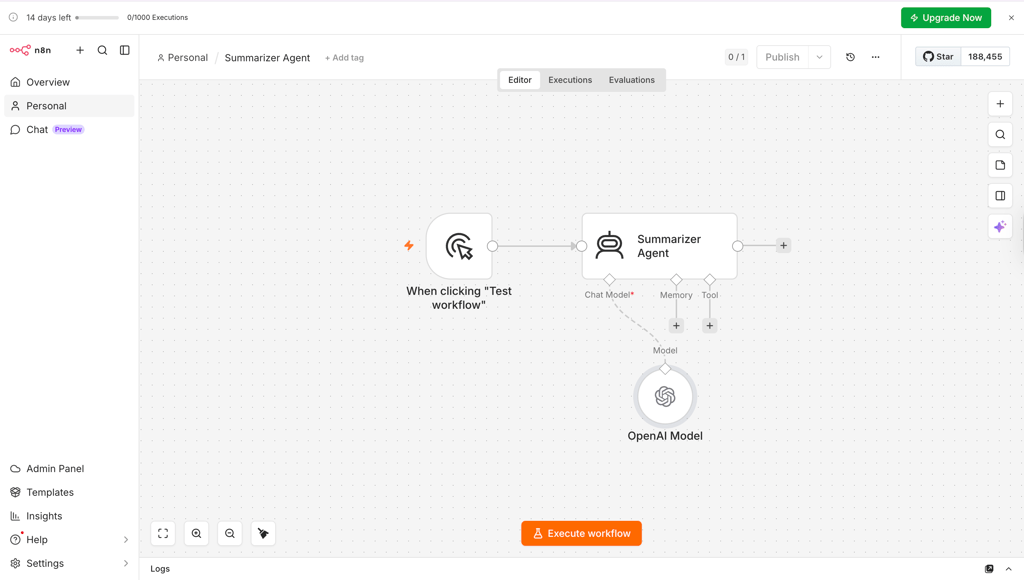
The way the workflow is displayed works really well with both small and large systems. It’s very easy to pinpoint exactly where each element of a system is located in the workflow. This is handy for finding and fixing errors in your system.
Relevance AI focuses more on creating and deploying agents. It doesn’t offer a canvas overview; instead, it lets you customize each agent in detail. It also doesn’t require any coding knowledge, as the AI agents are designed via prompts.
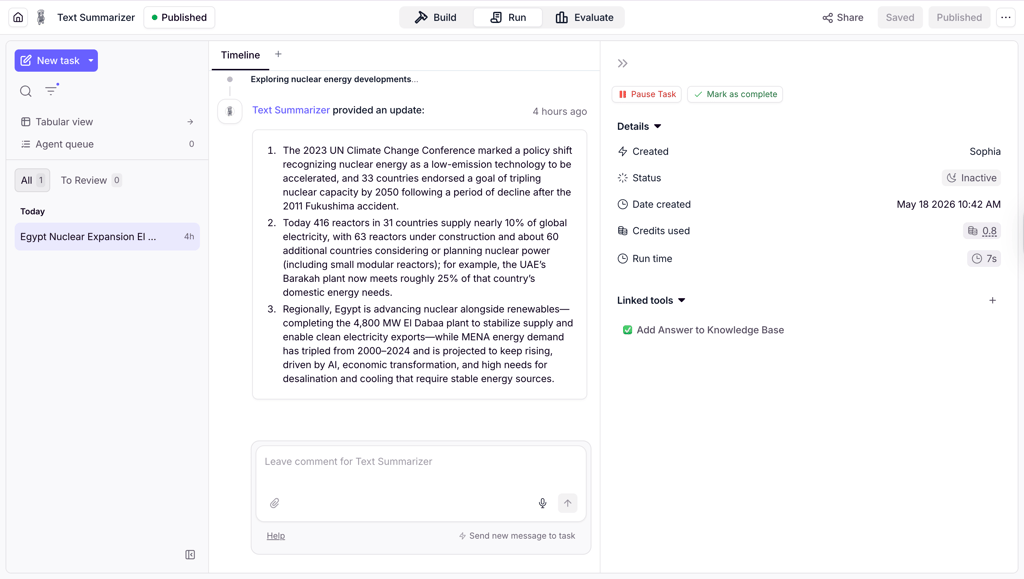
This makes Relevance a far better choice for teams that don’t require heavy coding and have simpler workflows that need more detail for their agents. You can customize the way it performs specific tasks and build the exact structures of each agent. There are limited ways to customize the flow with code, however.
Overall, I would recommend the following approach:
- If you need a highly technical setup – choose n8n
- If you have a no-code/low-code approach – pick Relevance AI
- If you have a complex system with a lot of moving parts – go with n8n
- If you want to go in-depth on building agents – use Relevance AI
First 30 minutes: sign up for the first working automation
To start testing n8n and Relevance, I decided to evaluate their onboarding experience and see how quickly I can build my first automation and how intuitive the process is. To test both, I created basic workflows.
Getting started with n8n on the cloud was easy. I quickly created an account and got a 14-day free trial without entering any credit card details. I was then asked to choose between building a workflow myself or building with AI. The AI option was extremely easy to start with, as all I had to do was provide my AI key to a provider like OpenAI or Anthropic.
The AI builder then created a visual workflow. While impressive, I found it also struggled to flag errors, with my initial workflow failing to produce any outputs even though n8n didn't detect any issues. This is because I created a text summarizer, and when it detected no input, rather than flagging the lack of input, n8n would just run through with no signal.
For self-hosting, the process was more difficult, as it required installing Docker and setting up your own instance. I recommend this for advanced users, as this will give you further control over n8n.
Relevance only offers a cloud option. I didn’t need to give any payment information, but I did have to decide where my data would be stored between the US, EU, or Australia, which is important for companies with strict governance rules.
The platform itself is heavily AI-driven. My first agent was automatically generated from an initial description of my needs. This really shortens the time needed to launch the first agent. I was also able to use existing templates to create additional agents, and Relevance gave me helpful suggestions, such as connecting my account to Slack.
The main downside for Relevance is just how crowded its Agents screen is. It’s hard to glean information at a glance, especially when compared to n8n’s canvas view. The clutter makes learning harder.

AI and agent capabilities: where the intelligence actually lives
Looking at each company’s approach towards AI and how they implement agents, I found a vastly different picture. n8n is focused on repeatability and predictability, while Relevance gives agents space to reason and create.
With n8n you get an AI set up, where you configure every step of an agent’s interaction. There’s no agentic AI orchestrating your subtasks – each agent does precisely what you want it to do. While this makes n8n excellent for detailed control, it also means you need sufficient knowledge to manage your workflow effectively, and it won’t work instantly.
On the other hand, Relevance AI focuses on building your workflow through agent reasoning. This means that, unlike n8n, your agents will select tools without human input based on the prompts you provided. This allows Relevance to work autonomously, but also gives you far less control over the specific steps in the process.
Overall, while the products are similar on the surface, their approaches towards AI are vastly different. n8n focuses on deterministic workflows. The agents will do exactly what you ask them to do, step-by-step. Relevance, meanwhile, will create its own workflows, requiring less work from you, but giving you far less control.
Winner - n8n
n8n's approach is simply more versatile. Essentially, there are flows that you can build in n8n you can't build in Relevance, while you can build most of the flows from Relevance in n8n.
Debugging and reliability: when things break
I've described how each tool operates when everything works – but how do they operate when things break? With the help of the Cybernews research team, I looked over each provider's debugging tools to evaluate how easy it is to fix errors in your workflow.
n8n's canvas provides an excellent basis for debugging. When a node fails, it's flagged and displayed on your workflow screen immediately. You can then open a given node to see exactly what went wrong in its execution. However, n8n sometimes struggles to find more abstract errors, such as a lack of input.
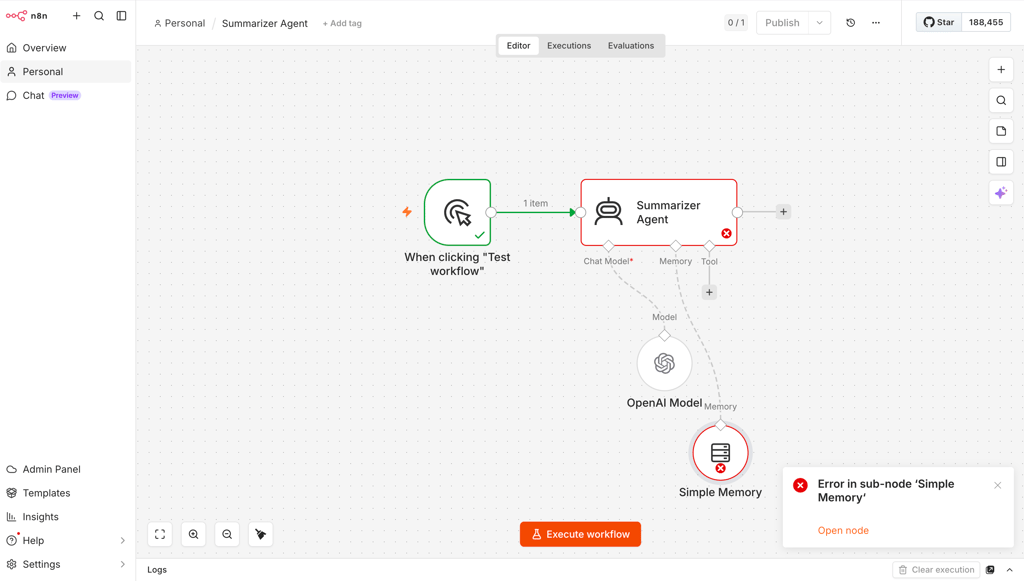
Relevance has an approach that you may know better from AI chatbots. Troubleshooting is performed automatically by Relevance as it evaluates its own code. If the user observes the software not working, fixes are prompted. While this works most of the time, you can also sometimes get stuck in loops of constant fix requests, which is frustrating.
WINNER - n8n
Integrations and data connections
Any workflow tool isn't complete without connecting to other tools and data sources. I compared n8n and Relevance's integrations and data connections to determine which offers greater stability and versatility.
n8n offers over 1,700 integrations that can be used as nodes in your workflow. These include connections to AI chatbots, CRM software such as HubSpot, data storage such as Google Drive and PostgreSQL, communication apps such as Slack and Gmail, and social media such as Instagram and X.
n8n's wide array of integrations allows users to create workflows that, for example, receive commands from Slack to generate a social media post through Gemini, fact-check it with Claude, post it on X, and then add it to a tracking spreadsheet.
Relevance has over 1,800 integrations, similar to n8n, covering everything from databases to social media and image-generation apps, though it doesn't offer separate integrations for chatbots. The integrations are essentially agents in your workflow, and if I felt an integration was missing, I worked around it with Zapier. The big difference for me is that Relevance often requires "middle-men” apps for tools like SQL databases, while n8n can be hooked up directly with your DB.
It's a draw.
Both tools offer thousands of integrations in various categories. Which one you use will depend on your particular needs and
Pricing and cost at scale
Pricing with AI tools can be complex, as they often require third-party tokens and may charge based on usage or a prepaid plan. To help you understand the pricing between the two products, I decided to compare their base prices – note that these prices will vary based on whether you use third-party AI API keys in your process.
| Price | What you get | Best for | |
| n8n Community edition (Self-hosted) | Free | Unlimited workflow executions and all integrations. (You provide the server, which usually costs from $5.00/month to $20.00/month). | Developers and technical tinkerers who want total data privacy and server control. |
| n8n Starter (Cloud) | $24.00/month | 2,500 workflow executions per month, up to 5 concurrent executions, and managed hosting. | Freelancers and solo founders can automate basic personal tasks or test the platform. |
| n8n Pro (Cloud) | $60.00/month | 10,000 workflow executions per month, up to 20 concurrent executions, and advanced features. | Small teams, growing startups, and agencies building reliable workflows for clients. |
| n8n Business (Cloud) | $800.00/month | 40,000 workflow executions per month, SSO (SAML/LDAP), and granular administrator roles. | Mid-size companies and IT departments that need high-volume data processing. |
| n8n Enterprise | Custom pricing | Unlimited executions, dedicated single-tenant infrastructure, and advanced compliance. | Large organizations managing mission-critical data that require strict enterprise SLAs. |
| Relevance AI Free plan | Free | 200 actions per month, a one-time bonus of 1,000 vendor credits, and 1 builder seat. | Trying out the builder interface and setting up a basic proof-of-concept agent. |
| Relevance AI Pro plan | $29.00/month | 2,500 actions per month, 2 builder seats, scheduled tasks, and the ability to use your own API keys. | Solo operators looking to deploy a reliable, always-on AI agent for daily tasks. |
| Relevance AI Team plan | $349.00/month | 7,000 actions per month, multiple builder/end-user seats, and performance analytics. | Marketing, sales, and RevOps teams that need to deploy collaborative workforces. |
| Relevance AI Enterprise plan | Custom pricing | Custom action limits, enterprise-grade SSO/RBAC, and white-glove onboarding. | Large enterprise deployments require strict governance and dedicated security controls. |
Essentially, I would recommend the following approach:
- If you're a freelancer or hobbyist, pick n8n's self-hosted plan. A VPS will cost you from $5.00 to $10.00/month, far cheaper than any of the plans.
- If you're a small, non-technical team, I recommend Relevance AI's Pro plan.
- Finally, for larger companies, assuming you have a technical team, I recommend one of n8n's higher-tier cloud plans or a customized self-hosted plan.
Note that n8n is open source, while Relevance AI is proprietary – this means that Relevance AI users are far more likely to experience rapid price increases than n8n users, and should take this into account.
Real-world scenarios: which tool to reach for first
Which tool you should reach for first depends on your specific use cases. To help you decide, I created a simple breakdown of how you can potentially use each tool:
- For go-to-market AI agents for research or marketing that will be ready to use quickly, use Relevance AI. Its builder requires less tinkering and technical knowledge, leading to quick production.
- For multi-step pipelines, use n8n. It allows you to create incredibly robust AI-powered workflows integrating a variety of tools.
- For tasks like AI-powered triage and routing, use n8n. With a more deterministic approach and stricter logic, n8n will provide you more value and certainty in the long run.
- For multi-agent coordination, use Relevance AI. Relevance is excellent for building agents to create a simple pipeline. If you're creating a flow of researching, writing, proofreading, and publishing, Relevance will be simpler to set up than n8n.
Security, data control, and deployment options
Creating any pipeline requires security and control. That's why I evaluated each tool's security setup to see whether they fulfil strict governance requirements.
n8n can be either cloud or self-hosted. The self-hosted option is more secure as it gives you essentially full data sovereignty. The cloud-hosted version is SOC 2 and GDPR compliant and offers role-based access control (RBAC) and full audit logs with its enterprise plans. It's also fully open-source, letting you see how it operates behind the scenes.
Relevance AI, on the other hand, offers only a cloud platform, with no self-hosting option. The hosting itself is SOC 2 compliant and GDPR-certified, giving you data residency options in the US, EU, or Australia. The platform does not train its models on your data, and the enterprise plan features single sign-on (SSO) and RBAC. Bring Your Own Key encryption further ensures that Relevance does not have access to your data.
What users actually say
No review of an enterprise tool like n8n or Relevance AI is complete without looking at what long-time users think of the product. That's why, with the help of the Cybernews research team, I browsed popular opinion sites like Reddit, TrustPilot, and G2 to see what their users think about n8n and Relevance AI.
The user consensus for both tools is positive overall. Most complaints about both n8n and Relevance AI concern the mismatch between their marketing and actual use. In this case, many users, particularly on Reddit, feel that the tools are more complicated to use than they let on.
For n8n, the users differ in opinions based on their technical proficiency. Programmers frequently note that, eventually, n8n is best replaced by custom Python code, while non-technical users say they're not proficient enough to make the most of the software. Users appreciate its open-source architecture and its effective replacement for Zapier as a tool connector.
For Relevance AI, the user feedback centered around speed. Many users on Reddit and G2 noted that it delivers excellent speed, enabling quick iterations. On the other hand, many users felt that, despite the lack of coding, the configuration still requires some technical proficiency to work as it should.
n8n vs Relevance AI: which one should you choose?
Picking the right AI tool can be difficult. The market is relatively new, and the solutions often fill very specific niches. The comparison between n8n and Relevance AI shows exactly that. At first glance, they're both workflow builders. But when you go in-depth, you will see they target vastly different use cases.
That's why this particular comparison is hard to choose. Comparing n8n and Relevance AI has shown me two products that are mostly similar in marketing, not practice. In a vacuum, n8n is the better overall tool. However, I want to show you the best use cases for each provider.
Pick n8n if you:
• Have a developer or technical ops person comfortable with JavaScript and workflow graphs
• Need self-hosting for data sovereignty or cost control at scale
• Are building complex, multi-branch automations with deterministic logic across many apps
• Want the lowest long-term cost for high-volume workflows
Pick Relevance AI if you:
• Are a GTM or ops team building AI agents without engineering support
• Want to go from prompt to deployed agent in minutes, not days
• Already manage LLM costs via OpenAI/Anthropic and want BYO key
• Need multi-agent orchestration with a visual canvas, not a node graph
Overall, if your team thinks in terms of workflows and nodes, pick n8n. If your team needs agents performing tasks, pick Relevance AI. If you can't decide between the two, use their free versions to test them with your team.
Best alternative: nexos.ai
n8n and Relevance AI aren't the only two products in the AI orchestration niche. Some may find n8n too technical, and Relevance AI unintuitive. In those cases, nexos.ai is a strong third option for users who feel that neither product fits them.
I tested nexos.ai with the Cybernews research team, as a part of a broader overview of tools in the AI landscape. With access to over 70 LLMs and agentic capabilities to help your team create chatbot assistants, I found that nexos.ai is a great choice for teams that need to pool their knowledge and use it internally or externally in a single workflow.
FAQ
Can n8n and Relevance AI be used together?
Yes, and they can complement each other. For example, you can use n8n to create a technical workflow that parses data from databases, then sends a webhook to Relevance AI, where a conversational agent takes over a task like research.
Which is easier to set up for a non-technical team?
Relevance AI is far easier for non-technical teams to use. It requires no coding knowledge and can be used by simply typing out requests. n8n, on the other hand, requires some basic knowledge of JSON to work properly.
Is n8n cheaper than Relevance AI at scale?
Yes, n8n is significantly cheaper than Relevance AI at scale. If you use n8n's self-hosted Community Edition, your execution costs are technically free; you only pay for your own server hosting (usually under $20.00/month) and your own LLM API usage. Relevance AI charges per Action, which can stack up really fast in complex workflows.
Which platform handles AI agents better?
Relevance AI is built specifically for autonomous agents, while n8n is built for orchestrated AI workflows. If you want an agent that can dynamically choose between 10 different tools, recover from its own errors, and collaborate with other AI agents in a digital workforce, Relevance AI is superior.
What is the biggest risk of choosing Relevance AI over n8n?
The biggest risk in choosing Relevance AI over n8n is the unpredictability of costs and reliance on the cloud. Because Relevance AI agents operate probabilistically, an agent might decide it needs to run 10 searches to find an answer instead of 1, burning through your monthly Action quota faster than anticipated. n8n, on the other hand, will always perform exactly the actions you want it to perform, limiting spending.