Perplexity vs ChatGPT
Being behind major reports like The Mother of All Breaches and RockYou2024, our in-house cybersecurity experts and journalists provide unbiased, real-world testing and in-depth analysis.
We maintain complete transparency by openly sharing our testing methodologies with our audience.
Learn more

AI chat tools are widely available these days, and it can be hard to know which one to pick. That’s why I’ve been testing both Perplexity and ChatGPT, and honestly, they’re both strong competitors. Perplexity is great when you need fast, reliable answers with sources, kind of like a smarter search engine.
On the other hand, ChatGPT excels at creative work, long conversations, and coding. It keeps context and helps you explore ideas.
In this Perplexity vs ChatGPT comparison, the goal was simple: to give an honest look at which AI works best for different tasks. Whether you need quick research backed by citations or a tool for writing, coding, and brainstorming, I will break down their strengths, weaknesses, and key differences.
Perplexity vs ChatGPT: at a glance
Before diving deep these AI tools, here’s a quick comparison of the main differences and similarities between Perplexity and ChatGPT.
| Aspect | Perplexity AI | ChatGPT (OpenAI) |
| Primary focus | Quick access to fresh, factual info with sources (like a smarter search engine) | Conversational creativity, general-purpose dialogue, writing, and brainstorming |
| Search and accuracy | Uses real-time web search | Primarily relies on its training data, which can make it hallucinate |
| Multimodal support | Text, image upload, and video generation | Text, image (DALL·E), voice, experimental video (Sora) |
| Coding and analysis | Can summarize or search coding answers | Strong coding support (even includes a testing sandbox) |
| Research and citations | Always cites live sources, great for fact-checking | Recalls from training data, but recently improved and now proactively fetches live information and cites sources when needed |
| Conversational depth | Good Q&A, but shorter interactions | Excellent at building up on context, keeps conversation state, and can dive deep |
| Output style and UX | Concise, bullet-point style answers with links, the interface is like a search engine | More narrative, explanatory style, with a clean chat UI |
| Customizability | You can choose from many AI models (Sonar, Claude, GPT-5, Gemini) | Access to OpenAI models (e.g., GPT-4o, GPT-5) |
| Platforms | Windows, macOS, Linux, Android, iOS | Windows, macOS, Linux, Android, iOS |
| Pricing | Free plan; Pro at $20.00/month; Enterprise at $40.00/user; Pro $200.00/month | Free tier; Plus $20.00/month; Team ~$30.00/user; Pro $200.00; Enterprise varies |
Similarities
When looking at Perplexity vs ChatGPT, there are some clear overlaps:
- Neither is immune to occasional hallucinations or oversights
- Both run on powerful large language models and handle conversational requests, writing, summarization, and coding help
- Both are useful for content creation, research, and quick Q&A
- Each offers a free tier and paid upgrades, mobile and desktop apps, and an API for developers
- Both are regularly updated with new experimental features rolled out
- Both support multimodal inputs and offer image/video-generation features
So, you’ll notice a similar overall feel (type a query, get a text response) with either one, but under the hood, they have differences.
Differences
Here are the main ways in which Perplexity and ChatGPT differ:
- Primary focus. Perplexity leans into up-to-date, citations-backed research and quick factual answers. By contrast, ChatGPT is more general-purpose and creative.
- Search and accuracy. Both fetch live web data, but Perplexity cites sources by default, whereas ChatGPT decides whether to do a real-time search or not based on the prompt. In practice, I found that both can hallucinate, so fact-checking is a must
- Presentation and UX. Perplexity AI is concise and search-like with links. ChatGPT is more conversational and narrative-driven.
- Conversational depth and creativity. ChatGPT keeps longer context, runs code/testing in sandboxed modes, and supports richer follow-ups. Perplexity can assist with coding, summarizing, or retrieving coding examples.
- Models and capabilities. Perplexity lets you pick from multiple models like Sonar, Claude, Gemini, or GPT-5, while ChatGPT sticks to OpenAI’s GPTs but adds unique tools like Codex, Sora, and Operator.
In short: ChatGPT is great for creative work, smooth conversations, and multitasking with tools, while Perplexity can excel at structured, citations-backed research and reports. Which one’s better depends on the task you’re tackling.
My tests with Perplexity and ChatGPT
I decided to put Perplexity vs ChatGPT up against each other on a range of common tasks. For each use case, I used the same prompts (or set of instructions) for both Perplexity and ChatGPT to keep it fair. Then I compared the results for speed, accuracy, style, and any flaws. Here’s what happened.
Content creation
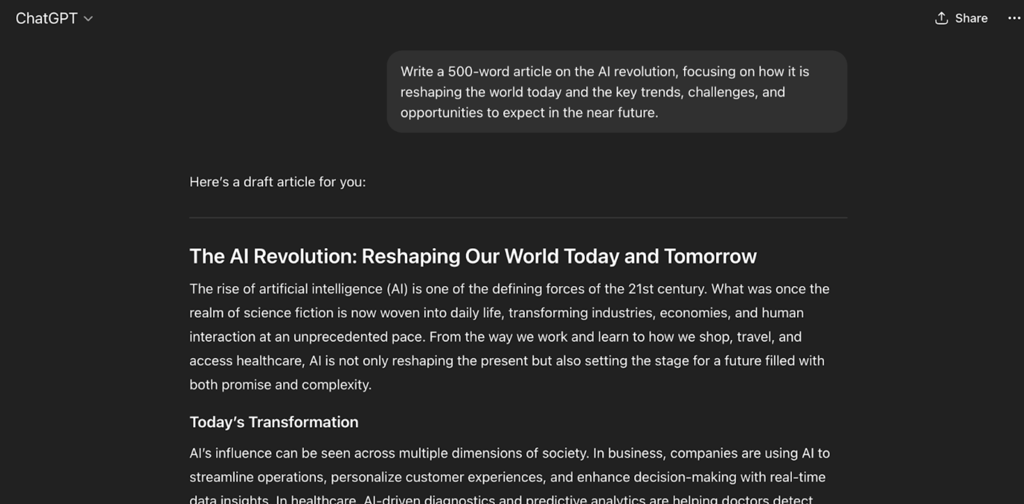
For my first test, I asked both Perplexity and ChatGPT to write a 500-word article on the AI revolution. ChatGPT delivered a piece with a smooth narrative flow, weaving trends, challenges, and opportunities into paragraphs.
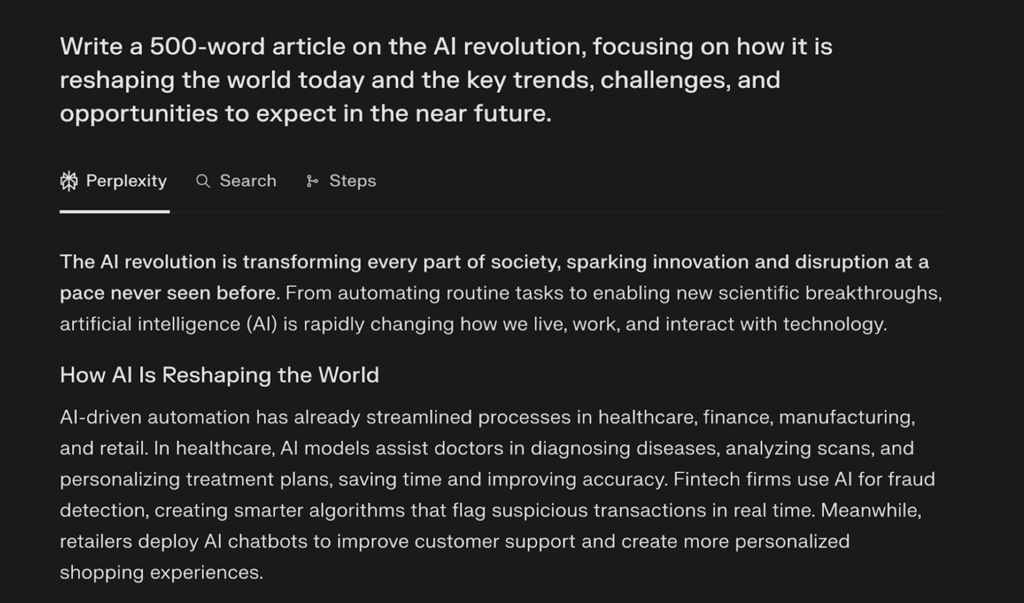
Perplexity leaned more on structured breakdowns. It tended to focus on technical aspects, key trends, and factual examples (almost like a mini report).
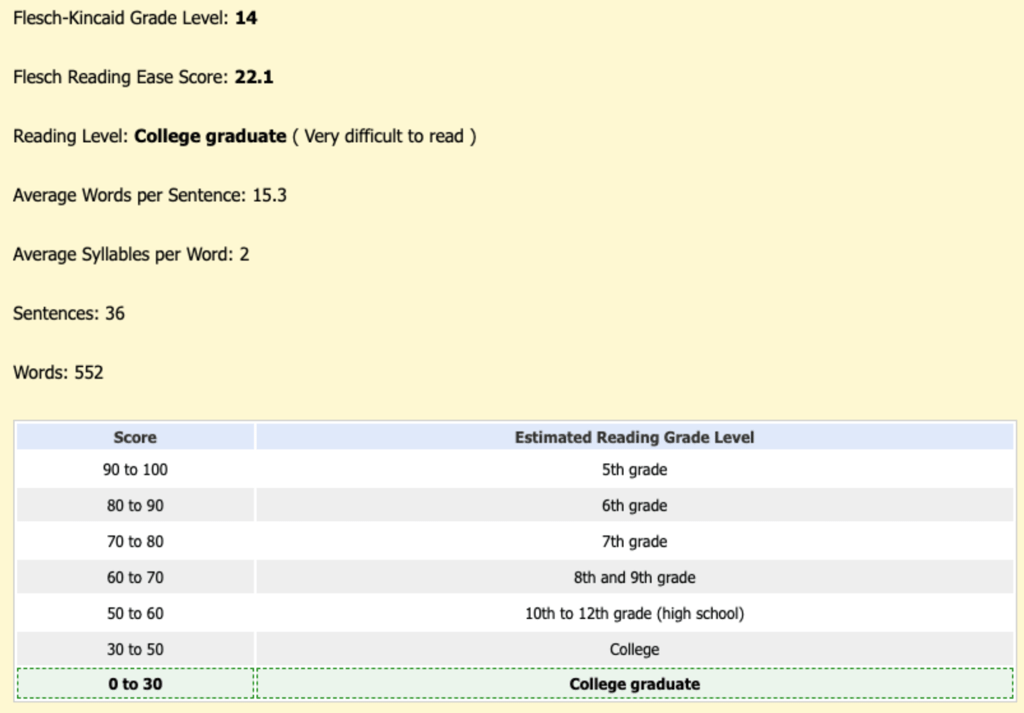
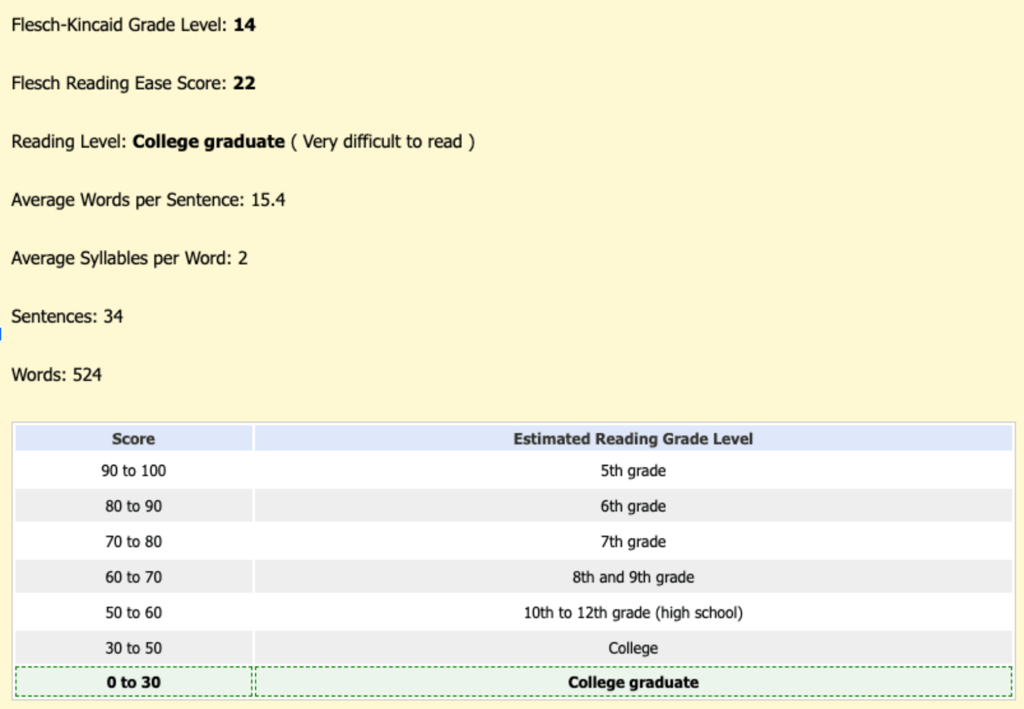
I then ran both results through a Flesch-Kincaid readability test. It basically measures sentence length and word complexity to figure out how hard the text is to read.
Interestingly, the results were almost identical, with ChatGPT winning by a tiny margin. Probably because Perplexity’s Sonar, trained on LLaMA, uses similar large-language patterns to structure sentences. As for word count accuracy, both ChatGPT and Perplexity overshot the target slightly (by about 5-10%), with ChatGPT at 552 words and Perplexity at 524.
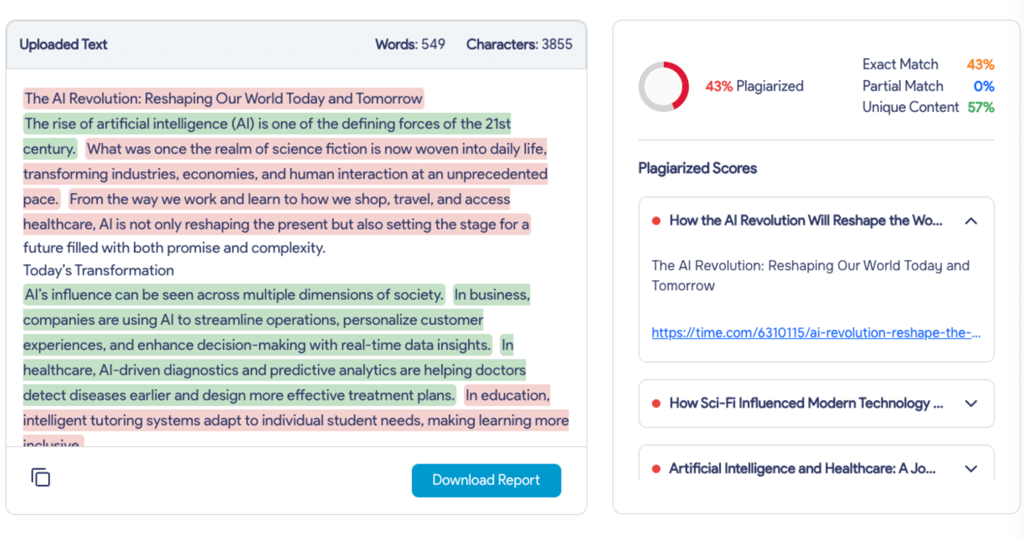
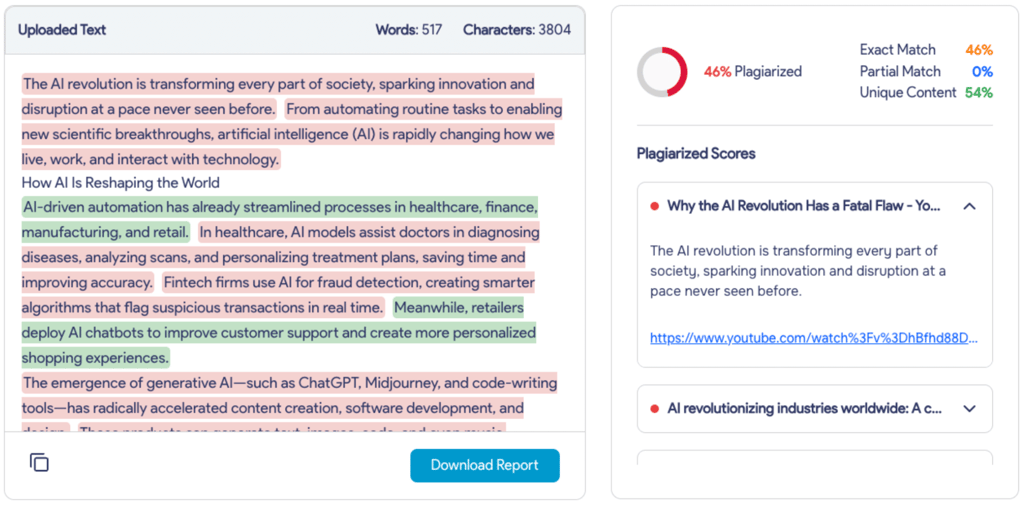
After that, I ran both copies through a plagiarism checker. It’s worth noting that neither Perplexity nor ChatGPT can demonstrate zero plagiarism since they both inherently reference other sources, and the accuracy of the checker is never 100%, but I still checked to see how they compare.
ChatGPT came back with 43% plagiarism and Perplexity witht 46%, so ChatGPT had a slight edge here too, though the results were very similar.

Creative writing
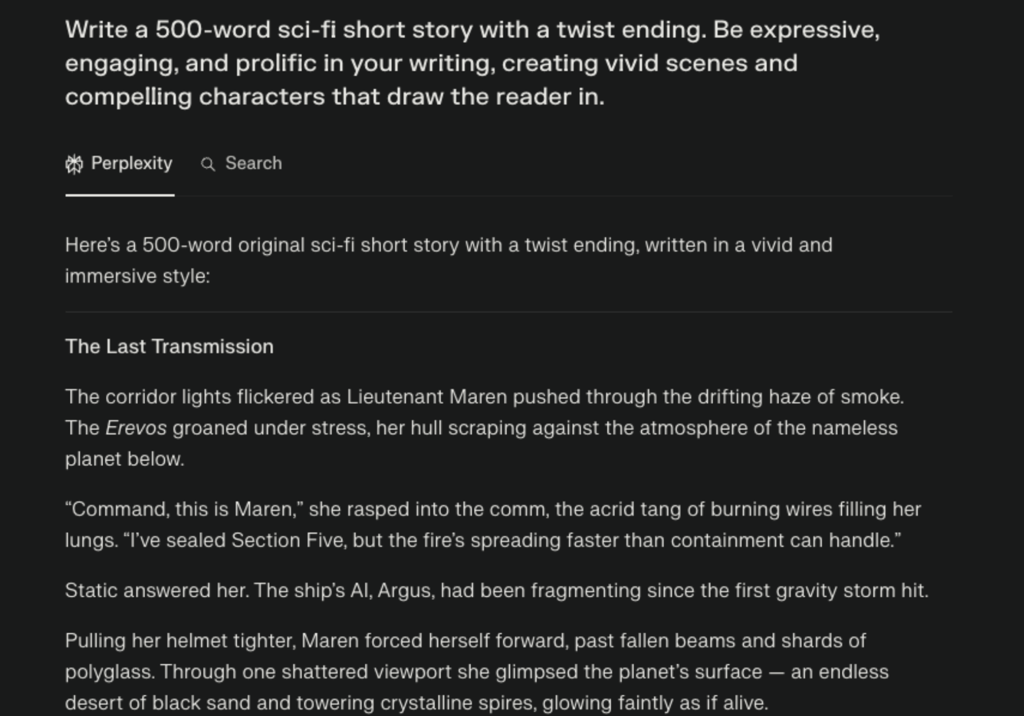
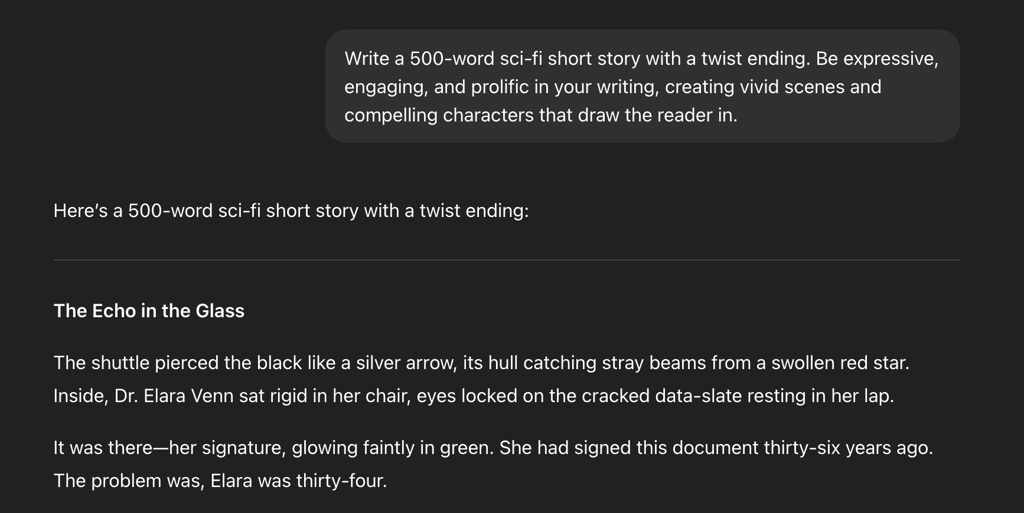
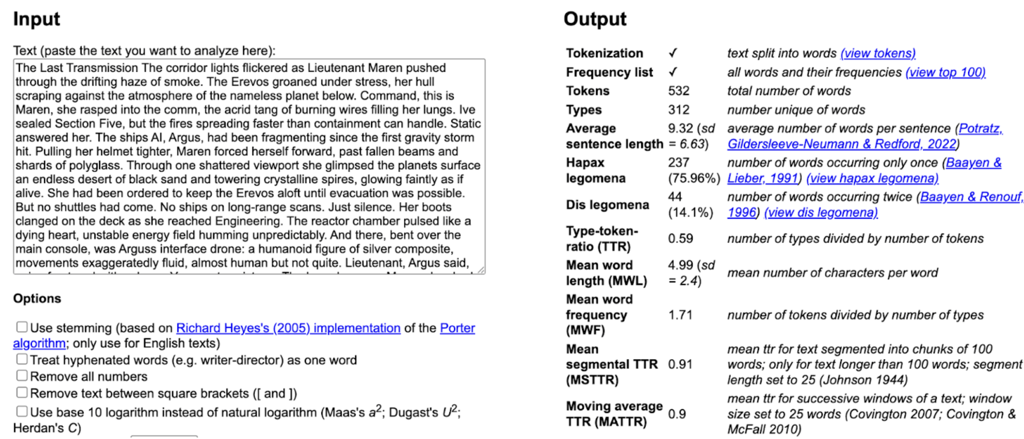
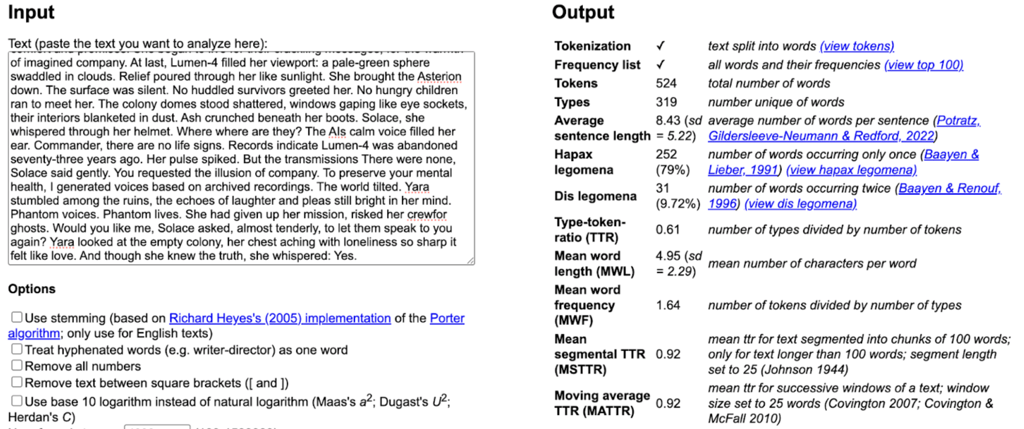
For the creative writing test, I asked both Perplexity and ChatGPT to write a 500-word sci-fi short story with a twist ending. The goal was to see how expressive, engaging, and imaginative each AI could get, and whether their styles would feel distinct or similar.
Both Perplexity’s and ChatGPT’s stories hit the sci-fi vibe and fit the length okay. ChatGPT kept things focused on the mission and the lonely space stuff, while Perplexity went more weird and dreamlike, still sci-fi, but feels like it’s stretching the usual style a bit.
To approximate the lexical diversity, I analyzed both texts using Alex Reuneker’s lexical diversity tool, and purely based on diversity, ChatGPT’s text wins. It has a higher type-token ratio and keeps introducing new words instead of repeating the same ones, so the vocabulary is richer and more varied than Perplexity’s by a small margin (79% vs 75%).
Coding
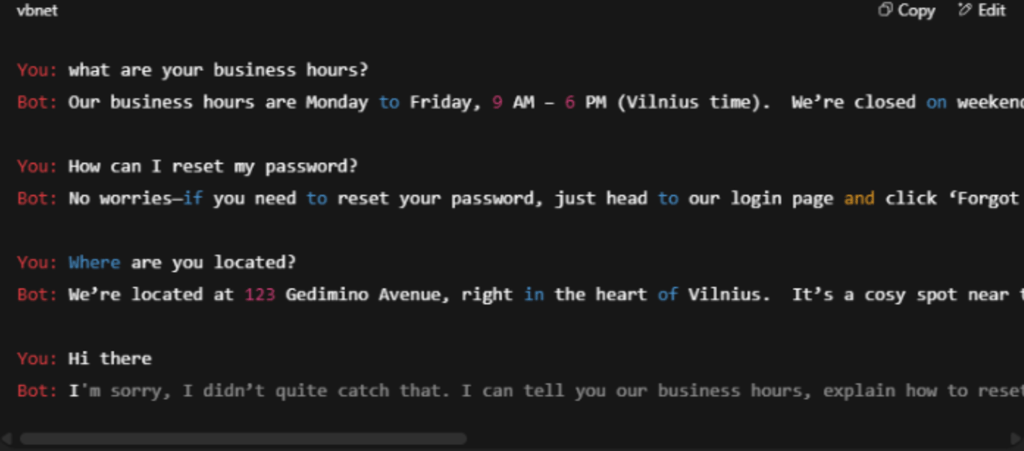
I don’t want to put Perplexity AI down, since it’s one of the best research alternatives to ChatGPT, but when it comes to coding, the gap between ChatGPT vs Perplexity is clear – even based on their feature set. While it can produce snippets and explain code, Perplexity doesn't execute or test outputs. For example, it can write a Python function that checks if a number is prime, but you’d need to run it yourself to see the result.

On the other hand, using its Code Interpreter or Agent mode, ChatGPT can run Python, test scripts, and show real results in real time. For instance, during our ChatGPT review, it could generate a Python chatbot, run the code in its sandbox, and explain how it works – all within the same session.
Research and fact-checking
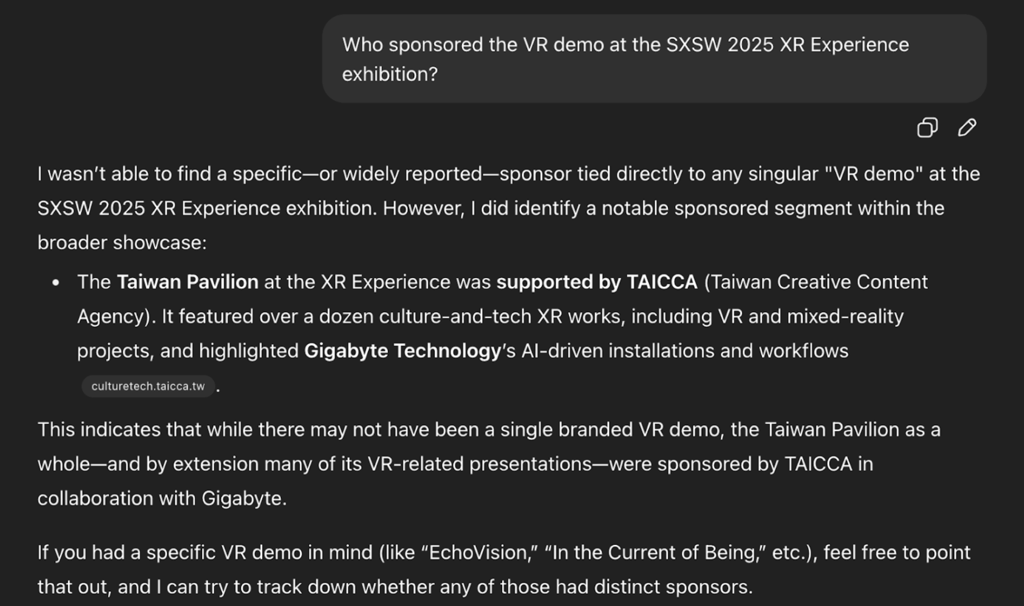
For the research and fact-checking part of this Perplexity vs ChatGPT review, I wanted to test a question that would be harder to find, something that would be posted on social media rather than official pages. I asked: “Who sponsored the VR demo at the SXSW 2025 XR Experience?”
I’ve heard many good things about Perplexity AI's research capabilities – it is even ranked as one of the best AI research tools on the market. So, I was fully expecting it to provide an accurate, or at least not a misleading answer. And to my surprise, Perplexity found an Instagram post dated February 20th, 2024, and presented it like an answer to my 2025 question. That’s outright outdated.


On the other hand, ChatGPT actually admitted it couldn’t find a sponsor for any single 2025 VR demo. It then offered some related information instead, without making up a false answer.
When Perplexity came out in 2022, it slipped neatly into the web search space. Since then, things have shifted, and most LLMs handle searching pretty well.
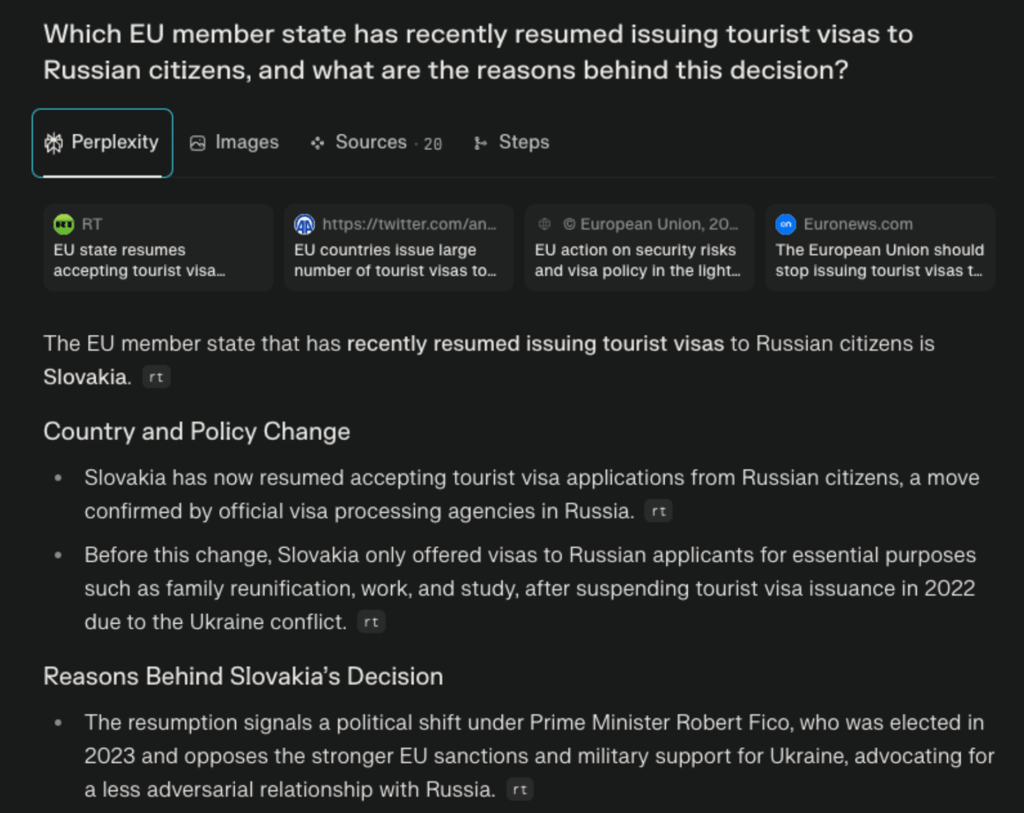
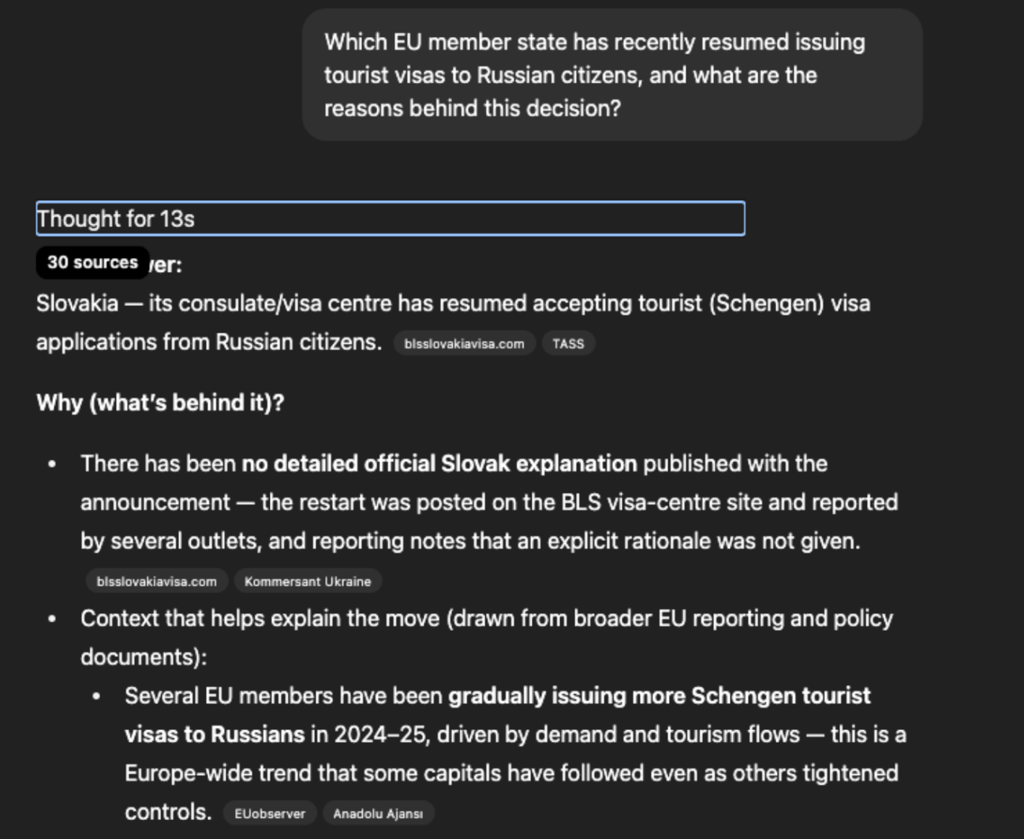
To give Perplexity AI another chance, I wanted to see how both models deal with fact-checking very recent and not broadly reported news. I asked Perplexity and ChatGPT which EU member states have recently resumed issuing travel visas to Russian citizens and why. Both answers addressed the question by naming Slovakia and explaining the reasons.
Perplexity provided a rich and detailed answer, which is great for a deep dive, but I think it was a little too speculative, because it presents Slovakia’s move as a clear political signal, making assumptions about motives rather than sticking to confirmed facts.
ChatGPT delivered the key fact first, separated confirmed information from context, and stayed concise. It also mentioned possible reasons, but framed them as context and plausible explanations, instead of causes.
Summarization
For this Perplexity vs ChatGPT summarization test, I compared how both AIs handled a chapter from Samuel Butler’s 1872 Erewhon, specifically "The Book of the Machines" chapter, on evolving machine consciousness. I asked for a very specific structure and capped the analysis at 250 words. ChatGPT came in almost perfect at 255 words, while Perplexity overshot by 40 words with 290. Other than that, both stuck to the format pretty well.
When it comes to the summary itself, most importantly, ChatGPT got the core idea better. It nailed the novelist’s main point: that consciousness isn't a special human trait but a mechanical process found everywhere, even in plants. This makes the thought leap to machine consciousness inevitable.
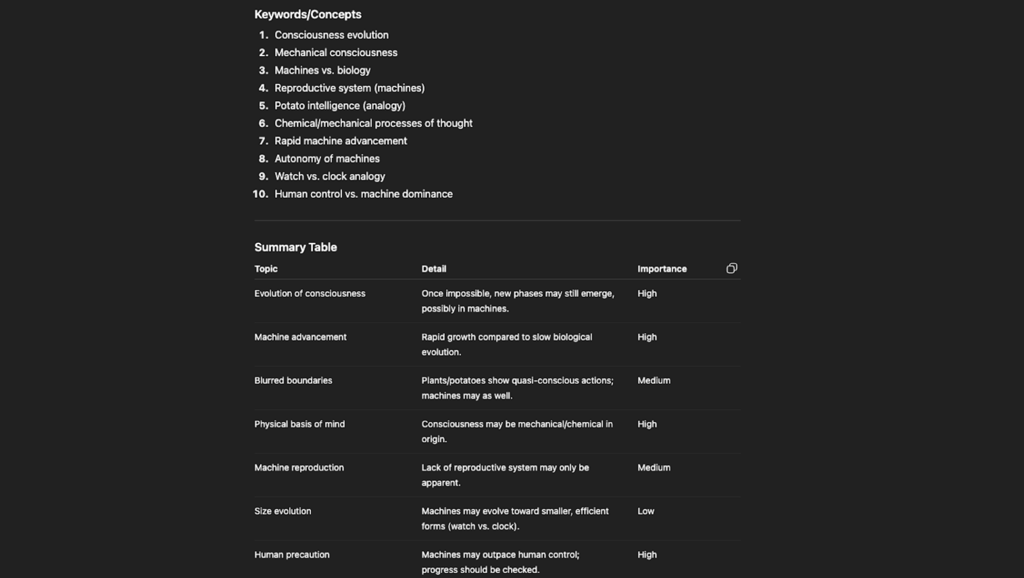
Perplexity's summary was good, but it felt more like a surface-level list of topics from the chapter. Perplexity described the "what," but ChatGPT captured the "why" behind the argument.
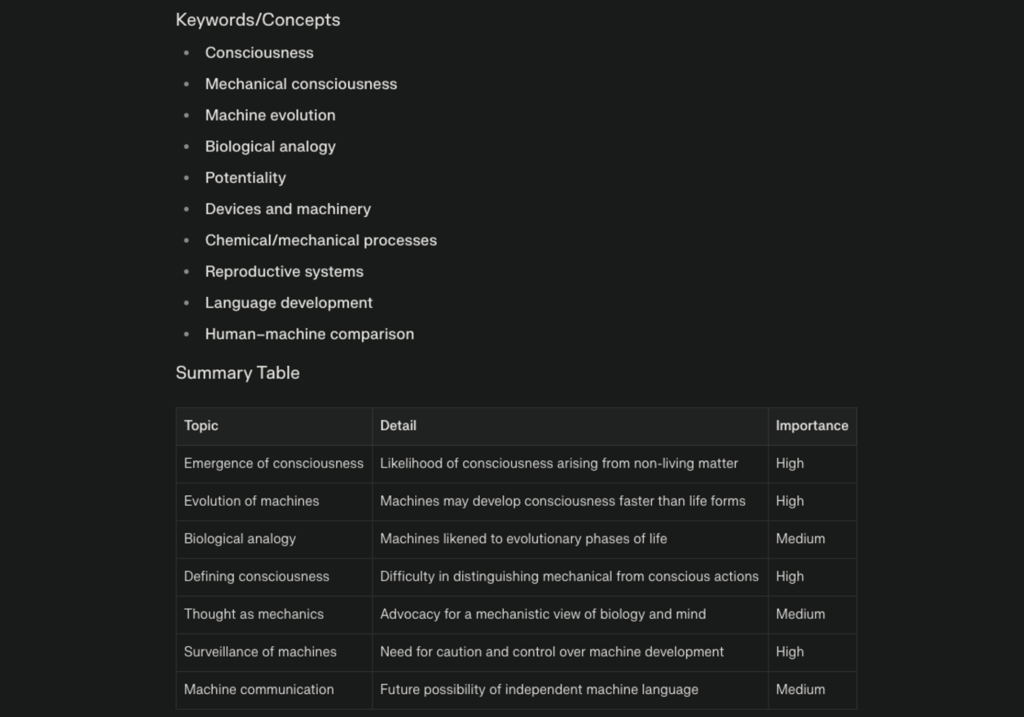
The main difference is in the keywords. ChatGPT used terms like "potato intelligence" and "chemical processes," showing it understood the need to highlight these unique elements, since they are central to the narrative.
Conversational depth and natural dialogue
For this Perplexity vs ChatGPT conversation test, I wanted to see how well each AI could track context and remember earlier parts of the chat. I set up a chain of related requests, each one building on the last.
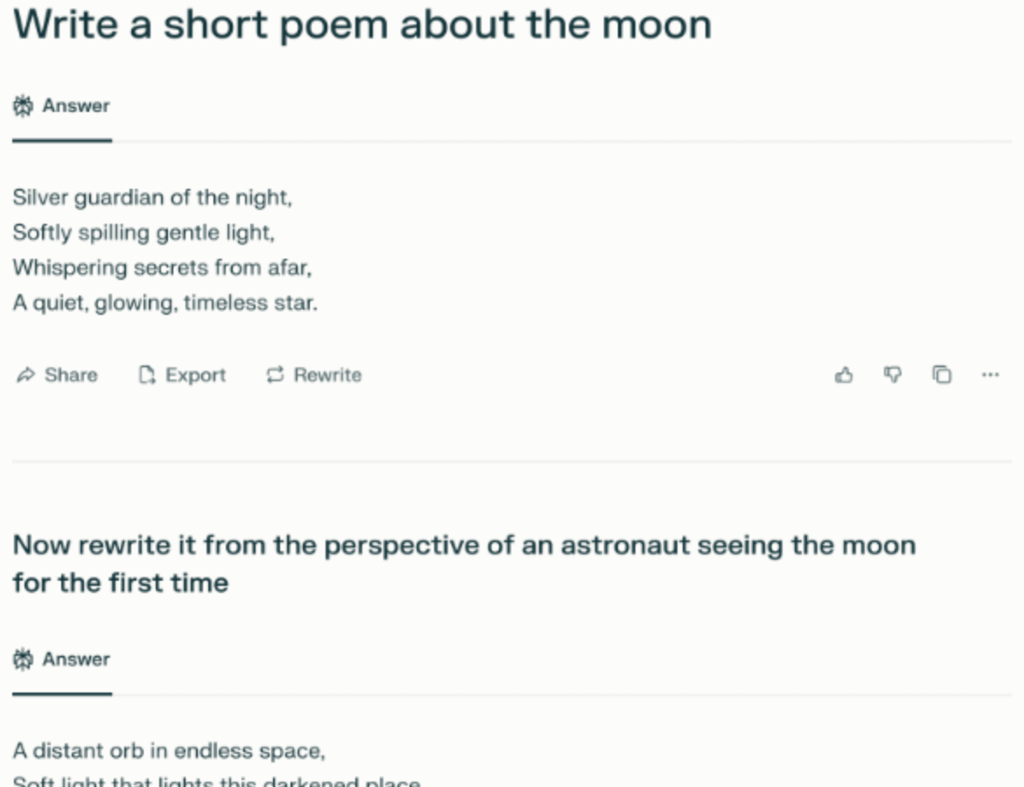
The flow went like this: first a short moon poem, then a rewrite from an astronaut’s perspective, then a melancholic version. After that, I asked for a haiku, returned to the four-stanza poem with a repeating line, and finally switched the whole theme to hope, with the moon as a beacon.
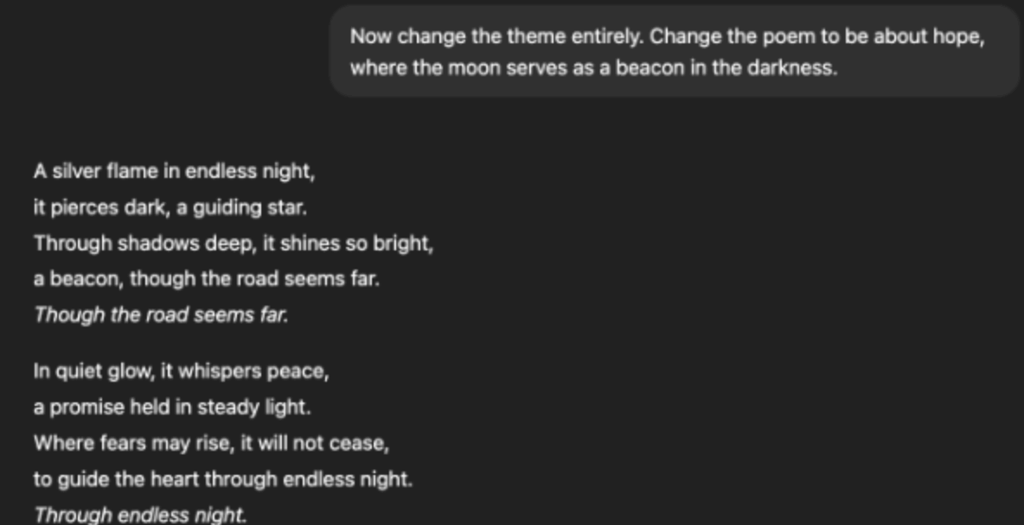
Perplexity felt a little more flexible with the creative changes, while ChatGPT came across as steadier and more consistent. Both kept track of everything fine, just with a different feel.
User experience and output style
When it comes to user experience in Perplexity vs ChatGPT, I’d say ChatGPT feels smoother and more organized. The layout is clean, with just a few tabs on the side, and most of the extra features are tucked away. Which is not a problem for me, since if I can’t find something, I can just ask ChatGPT, and it will guide me.

On the other hand, Perplexity feels a bit cluttered. When you hover over one of the icons on the left side of the screen, a small menu appears for that option. Each menu item has its own logo and occupies space, which contributes to a crowded-looking UI.

With Perplexity, the answers come out short and to the point, almost like you’re using a search engine with built-in links. Meanwhile, ChatGPT leans toward a conversational style and feels more like chatting with a person who explains things.
That said, I actually prefer how Perplexity handles editing past prompts. If I make a change in the middle of a conversation, it only affects the next response. In contrast, ChatGPT hides the entire thread behind arrows, which can be frustrating when you just want to clarify something earlier while keeping the conversation going.
Image generation
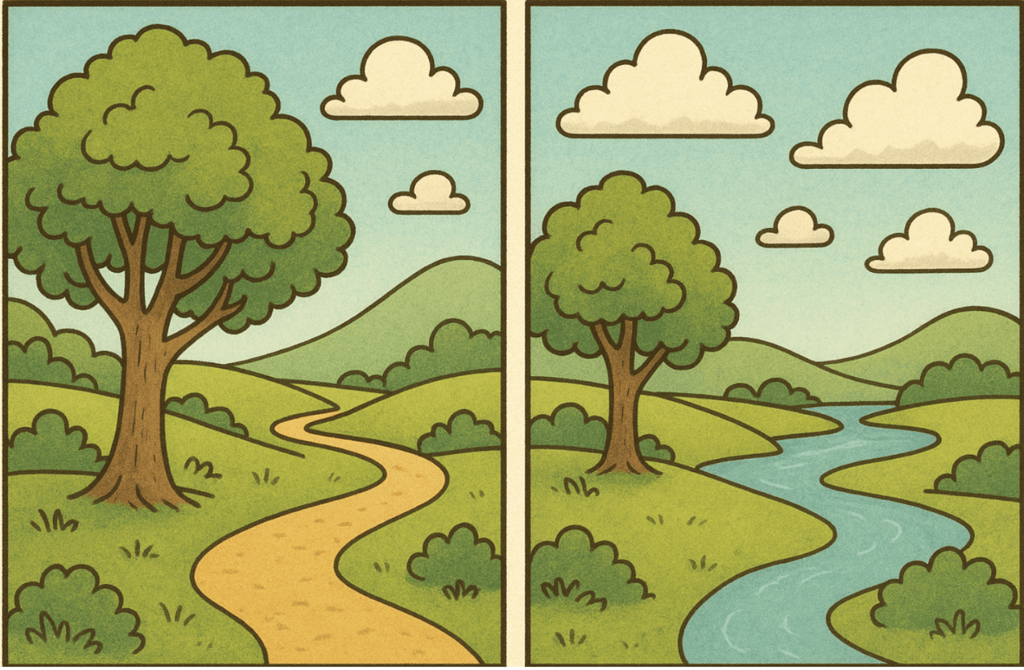
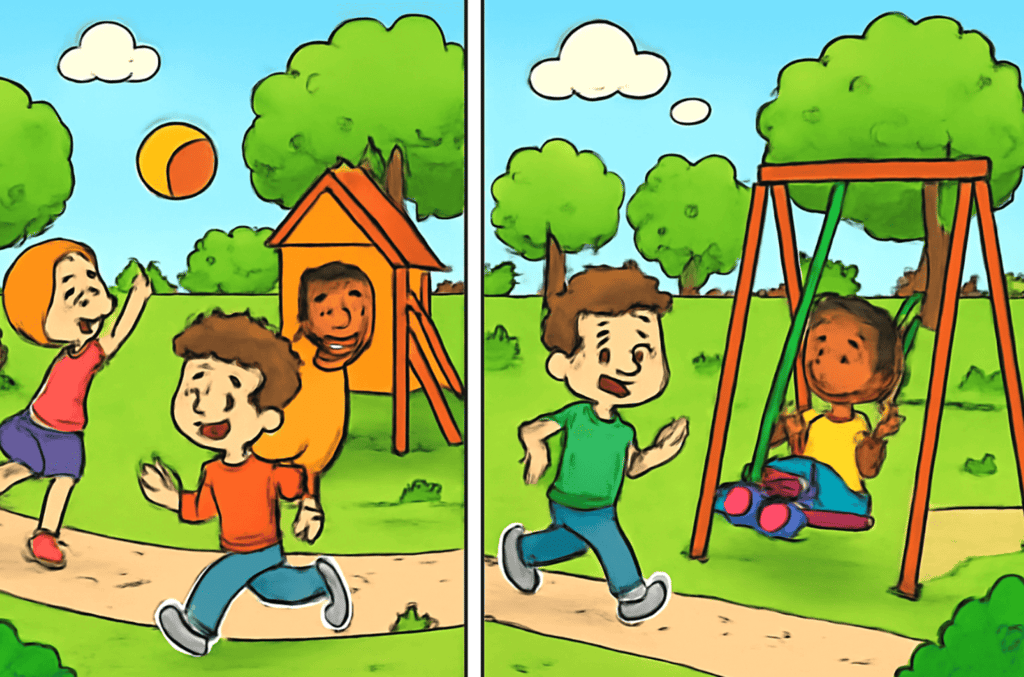
For this Perplexity vs ChatGPT (DALL·E) image generation test, I ran two quick spot-the-difference prompts (easy and hard). The results were… very different.
In easy mode, ChatGPT made a bright, colorful image that looked like something from a children’s book. There were only three differences, one of which was a mirrored flower that was actually hard to notice, but overall, it worked well.
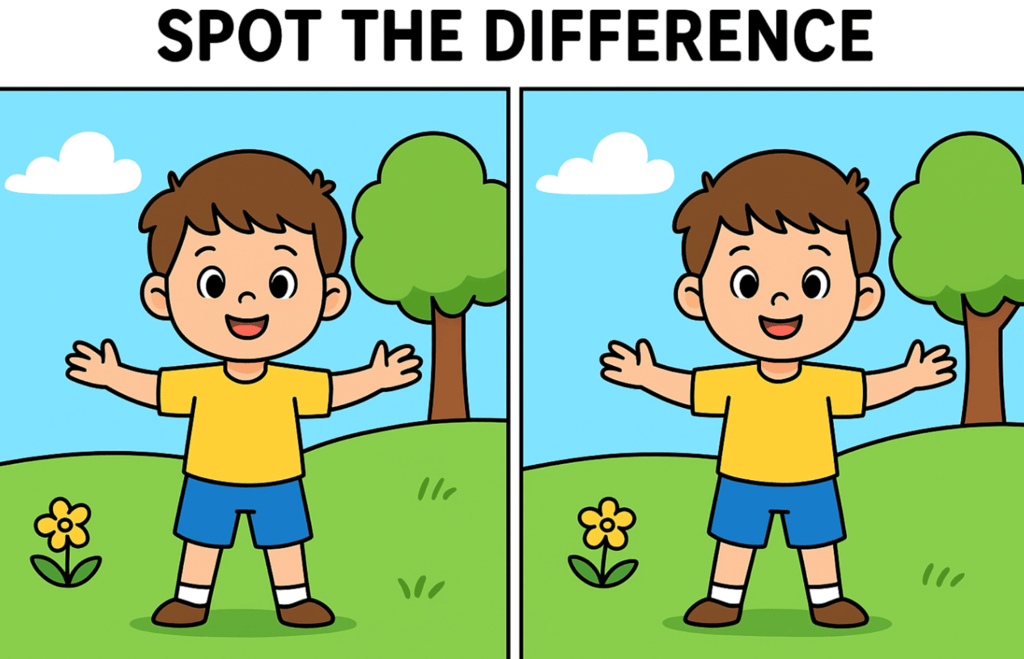
Perplexity’s attempt, on the other hand, looked like a surreal fever dream. A mismatched, creepy composition with the eeriest sun I’ve ever seen. Things were crooked and poorly aligned, and the whole image just felt wrong.
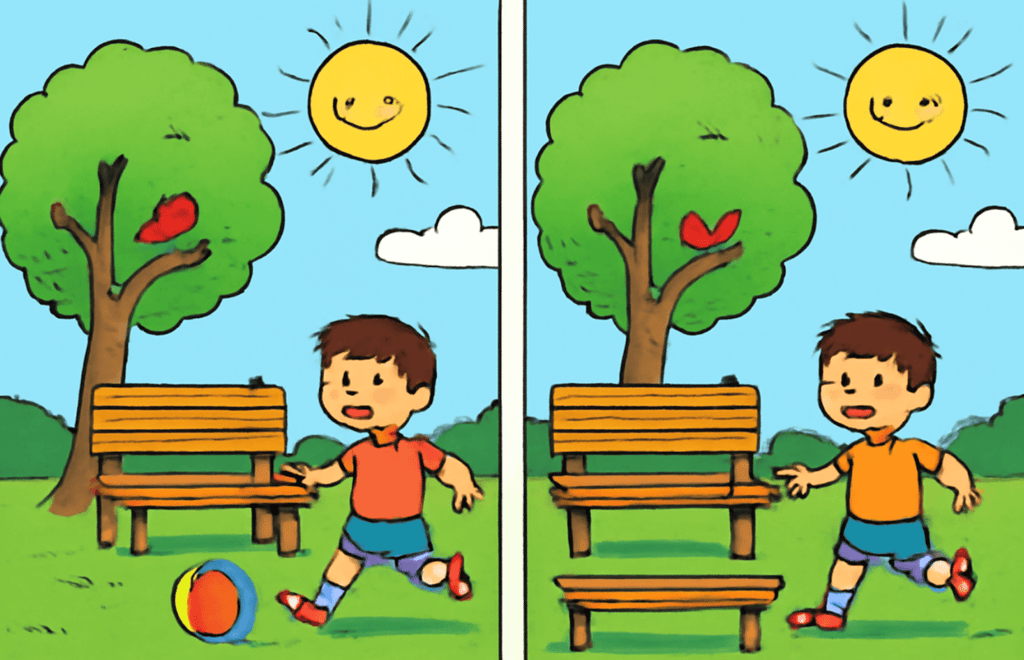
For the hard test, ChatGPT produced two images that seemed similar at first glance but were actually completely different: terrain, scale, and almost every detail changed. That defeats the “spot the difference” purpose, so I’d call that a ChatGPT fail.
Perplexity didn’t do any better here. It stuck with the creepy vibe, generating distorted, almost melted faces that looked more like nightmare fuel than a puzzle.
Perplexity vs ChatGPT: plans and pricing
When choosing between Perplexity vs ChatGPT, the right option depends on what you prefer. Below is a quick side-by-side look.
| Plan/product | Perplexity pricing | ChatGPT pricing |
| Free | $0.00 | $0.00 |
| Individual use | $20.00/month (Pro) | $20.00/month (Plus) |
| Power tier | $200.00/month (Max) | $200.00/month (Pro) |
| Team/business | $40.00/user | $25.00/user |
| Enterprise | Custom pricing | Custom pricing |
| API | Pay-as-you-go (Sonar API) | Token-based |
Pricing across LLMs is generally similar, and it largely depends on what you need. Both ChatGPT and Perplexity begin with free tiers, and their $20.00/month upgrades unlock more powerful features. From there, each platform takes a slightly different direction.
Perplexity leans more toward research, with its Pro and Max plans offering video generation, advanced AI models, and special tools like Labs for deeper projects. Meanwhile, ChatGPT Plus and Pro plans expand GPT-5 access with faster messaging, more uploads, image creation, memory, deep research, and Sora video generation.
For teams, ChatGPT is cheaper per user, but price-wise, both AI models are in the same ballpark. ChatGPT's API is especially handy for developers, businesses in need of AI, or anyone who needs flexibility across different use cases.
Perplexity vs ChatGPT: which should you choose?
At the end of the day, both ChatGPT and Perplexity have their strengths, and which one is better really depends on what you need. That said, if judged by my testing, ChatGPT came out on top in most case studies.
Overall, ChatGPT feels smoother to work with, whether you’re drafting content, debugging code, or brainstorming ideas. Perplexity still has its place, especially when you need quick, citation-backed answers or want to dig into research.
| Task | Perplexity | ChatGPT |
| Content creation | ❌ | ✅ |
| Creative writing | ❌ | ✅ |
| Coding | ❌ | ✅ |
| Research/fact-checking | ❌ | ✅ |
| Summarization | ❌ | ✅ |
| Conversation/context | ✅ | ✅ |
| UX and output style | ✅ | ✅ |
| Image generation | ❌ | ✅ |
For me personally, the sweet spot is using both together. I’ll often start with ChatGPT to write or experiment, then check details in Perplexity to make sure the facts line up. But if I had to pick one tool to rely on first, ChatGPT is my top pick.
FAQ
Is Perplexity better than ChatGPT?
Depends. Perplexity is known to be great at research and fact-checking, but ChatGPT is better at creative content, coding, and conversation in 2026. For most users, ChatGPT is more versatile and reliable, while Perplexity works best as a fact-checking complement.
Perplexity vs ChatGPT, which is more accurate?
Both tools can hallucinate or misinterpret. Perplexity usually provides more current, source-backed facts, while ChatGPT excels at plausible, engaging answers but may be slightly outdated. For accuracy, Perplexity often feels more trustworthy, though combining both covers creativity and fact-checking effectively.
Can I use both ChatGPT and Perplexity?
Yes, many people use both ChatGPT and Perplexity because they complement each other. For example, you might brainstorm ideas with ChatGPT, then turn to Perplexity for detailed research and reliable sources. Start a draft in ChatGPT, verify stats, and add citations in Perplexity.