Black U services emerge as a key tool in Chinese crypto money laundering
With Chinese criminals now dominating the crypto money laundering market, blockchain analysts have identified six types of laundering services.

Image by Cybernews.

 Follow us
With Chinese criminals now dominating the crypto money laundering market, blockchain analysts have identified six types of laundering services.
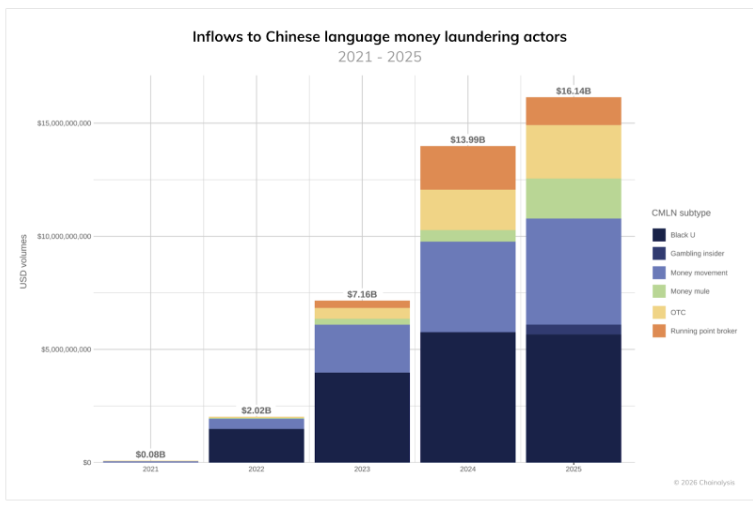
Analysts at Chainalysis estimate that Chinese-language money laundering networks (CMLNs) have processed 20% of illicit crypto funds over the past five years. Over $16 billion was processed across around 1,800 wallets in 2025 alone, an increase of around 14% from 2024.
The research found that criminals are using six primary money movement techniques, including running point brokers, money mules, over-the-counter (OTC) desks, Black U services, gambling platforms, and money movement services that offer the mixing and swapping of crypto assets.
Last year, Black U services, which involve selling illicit crypto assets at a discounted rate, were used to move the biggest share of the laundered money, while the money movement services came in second.





Here's how they all operate
Providers of the Black U services openly advertise that they specialize in laundering stolen crypto assets, including from hacks, exploits, scams, and wallet theft.
These vendors buy the illicit funds at a 10-20% lower price than a criminal would usually get at a regular exchange, Chainalysis said, suggesting that all these seemingly independent operations might function as separate units within a single organization, or it could be a coordinated network maintaining operational consistency.
Meanwhile, the money movement vendors offer swapping-as-a-service to enable their clients to convert their crypto into multiple assets, helping those seeking to keep funds on-chain.






When it comes to running point brokers, these are "the critical entry channel for illicit fund transfers," providing a bridge between legitimate financial systems and the criminal underground. To build this type of "bridge," criminals recruit individuals and use their bank accounts, digital wallets, or deposit addresses at mainstream exchanges to receive and forward illicit funds.
Next, money mule motorcades work on obscuring the origins of the funds through multiple transactions. For example, dealers meeting customers in person, ATM cash withdrawals converted to crypto assets, digital wallet transfers through third-party payment platforms, and card-based schemes using credit cards and gift cards in exchange for crypto.
Informal OTC and peer-to-peer (P2P) services operate similarly to legitimate OTC desks, except that funds are transferred without KYC (know your customer) verification, without regulatory oversight or jurisdictional affiliation, and while circumventing capital controls.
And finally, gambling services are also being used for both traditional and crypto-based laundering due to their high cash volumes, frequent transactions, and built-in mechanisms for converting funds.
"Additionally, some Telegram vendors offer insider tips suggesting predicted or rigged outcomes, with advertisements guaranteeing compensation if customers’ “winning numbers” are not selected," Chainalysis explained.
According to them, gambling insiders, running point brokers, and OTC services operate as the money laundering ecosystem’s primary aggregators, while Black U, money movement services, and money mules break down large criminal proceeds to evade detection thresholds.
Unlock more exclusive Cybernews content on YouTube.