Crypto-stealing GreedyBear just became even greedier
A crypto user-targeting attack group has been found to be using a new way to target victims, employing a new "redefined industrial-scale" strategy.

By Cybernews.

 Follow us
A crypto user-targeting attack group has been found to be using a new way to target victims, employing a new "redefined industrial-scale" strategy.
Researchers at Koi Security said that the GreedyBear attack group is now combining three tactics in its criminal activities: 150 malicious Firefox browser extensions, ransomware, and dozens of scam phishing sites. According to the researchers, user reports indicate that these criminals have managed to steal more than $1 million in crypto assets.
The research has shown that GreedyBear aims to impersonate popular crypto wallets such as MetaMask, TronLink, Exodus, and Rabby Wallet with malicious browser extensions. Moreover, there are signs that the same attack group might be expanding to Chrome extensions as well.
Meanwhile, with Firefox, it’s using the Extension Hollowing technique to bypass marketplace security and user trust mechanisms.
"Rather than trying to sneak malicious extensions past initial reviews, it builds legitimate-seeming extension portfolios first, then weaponizes them later when nobody’s watching," Koi Security said.






Koi also found that the campaign originates from the same threat group behind the earlier Foxy Wallet campaign, which exposed 40 malicious extensions, but the scale has now more than doubled.
The researchers have tied almost 500 malicious Windows executables to the same infrastructure, which includes credential stealers, ransomware variants, and various generic trojans.
The research has shown that these executables are distributed via various Russian websites that distribute cracked, pirated, or "repacked" software.
When it comes to crypto phishing sites, they’re found to be not typical phishing pages mimicking login portals, but "they appear as slick, fake product landing pages advertising digital wallets, hardware devices, or wallet repair services."
An example of a phishing site
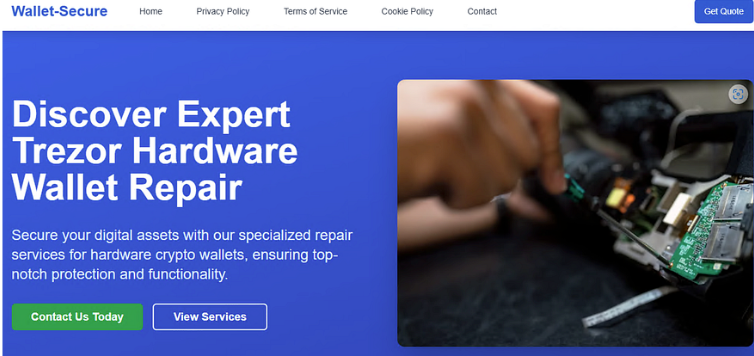
Koi Security warned that some of these domains are fully functional while others might still be waiting for their turn to be used.
Meanwhile, the researchers have also found signs showing that all these tactics are linked to one group, as almost all domains across extensions, EXE payloads, and phishing sites resolve to a single IP address: 185.208.156.66.
"This server acts as a central hub for command-and-control (C2), credential collection, ransomware coordination, and scam websites, allowing the attackers to streamline operations across multiple channels," they added, stressing that attackers arm themselves with increasingly capable AI and defenders must ramp up their efforts as well.