Investigation shows major crypto exchanges struggle to stop illicit flows
Hundreds of millions of dollars' worth of crypto assets continued to flow through major exchanges even after they paid penalties and were under the supervision of court-appointed monitors, an international investigation has revealed.

Image by Cybernews

 Follow us
Hundreds of millions of dollars' worth of crypto assets continued to flow through major exchanges even after they paid penalties and were under the supervision of court-appointed monitors, an international investigation has revealed.
The International Consortium of Investigative Journalists (ICIJ) has published The Coin Laundry report, which is based on more than 10 months of reporting across 35 countries. Researchers gathered hundreds of crypto asset wallet addresses linked to known illicit activity, while also examining reports, court records, sanctions lists, complaints filed with the Seychelles’ financial regulator, and speaking with scam victims, among other sources.
What they found is that money launderers for drug traffickers, Southeast Asian scam-center operators, and North Korean hackers used brand-name exchanges to move their funds.
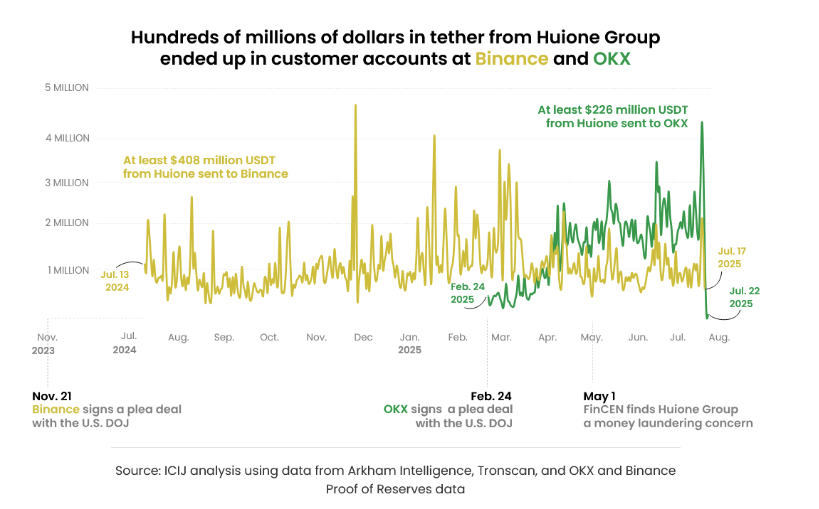
For example, the report claims that as recently as July 2025, the infamous Cambodian Huione Group transferred around $1 million worth of the tether (USDT) stablecoin a day to their accounts at the world's largest crypto exchange, Binance. In total, the investigators found more than $408 million sent from Huione to Binance from July 2024 to July 2025.
"Hundreds of millions of dollars flowed from Huione into Binance customer accounts while the company was under the supervision of two court-appointed monitors," the ICIJ said, reminding readers that the monitors were part of Binance’s November 2023 plea deal for violating US anti-money-laundering laws.





According to the report, another major exchange, OKX, received at least $226 million from Huione during the five months following the company's plea in the US in February to operating an unlicensed money transmitter.
"The transfers from Huione continued after its May designation as a ‘primary money laundering concern,’” the investigators stressed.
However, the investigative reporters noted that the resources required to accurately trace transactions make the task difficult for both crypto trading platforms and law enforcement.
"<...> a patchwork of laws and fragmented enforcement efforts often mean less government oversight for an industry where the largest actors facilitated tens of trillions of dollars in trading volume last year," they concluded.
Meanwhile, the co-founder of Binance, Changpeng Zhao (CZ), was recently pardoned by US President Donald Trump. CZ spent four months in prison in 2024 after pleading guilty to violating US money-laundering laws. The company itself paid $4.3 billion, one of the largest corporate penalties in US history.
However, in an exchange on X yesterday, the co-founder discussed the "delicate question" of the US refunding the billions paid since he was pardoned.
"I appreciate the pardon already. There is a balance in asking for more vs "what is fair" vs appreciate what you got already. IF we get any refund, we will be investing that in America anyway, to show our appreciation," CZ said.






Unlock more exclusive Cybernews content on YouTube.