We analyzed 5,000 reports from sextortion victims; here’s what we found
Cybernews analyzed over 5,000 Reddit posts from r/sextortion to find that 26% of victims pay their extortionists, yet 55% face continued threats afterward, while Instagram emerges as the top platform where these scams begin.

 Follow us
- 26% of victims paid the scammer, yet 55% of those who paid were threatened again
- Instagram was the first point of contact in 41% of reports
- Victims in strong distress were 2.5 times more likely to pay
- Sensitive content was leaked in only 1.6% of cases
According to the FBI, sextortion is now the second most common scam in the U.S., with over 75,000 reports in 2025 and losses totaling more than $44 million – a 68% increase over 2024.
The National Center for Missing & Exploited Children (NCMEC), largest child protection organization in the U.S., received an average of 137 reports of financial sextortion targeting minors per day in 2025, which is also a significant increase of 37% compared to the year before.
Tragically, NCMEC is aware of at least three dozen teenage boys in the U.S. who have taken their lives as a result of being victimized by this crime. The organization reports that teenage boys are the primary target for these scams.
Sextortion is a form of cybercrime in which an offender builds a relationship with the victim to obtain sexually explicit material, then threatens to release it publicly unless the victim pays money.
The insidious part of the scam is that the fraudsters specifically threaten to share the sensitive content with the victim's closest circle — friends, family, school or colleagues — which causes unimaginable stress.






For those who haven't encountered this scam, the increasing sextortion numbers might seem like just another statistic. But for victims, these scams are anything but that. Of all the online scams out there, it's hard to think of one more psychologically damaging.
To shed light on how sextortion scams tend to play out, we analyzed more than 5,000 posts from Reddit's r/sextortion community, spanning the past five years. The subreddit has around 52,000 total posts, making our sample size statistically significant. Victim posts were fed to an LLM to categorize sextortion cases across a range of variables: whether the person paid, whether the content got leaked, if the victim mentioned being distressed, whether they reported the scam, and which platform the first point of contact happened on, among other things.
We then reviewed the categorization manually to make sure it was accurate. The latest LLMs handle this kind of text categorization pretty well, at least after a few prompt adjustments and when you run one post at a time. Feeding AI more than one post at a time resulted in a lot of errors, so we ended up programming a small Python flow to supply only one post at a time, which ended up producing accurate results.
Findings after analyzing 5,000 sextortion reports
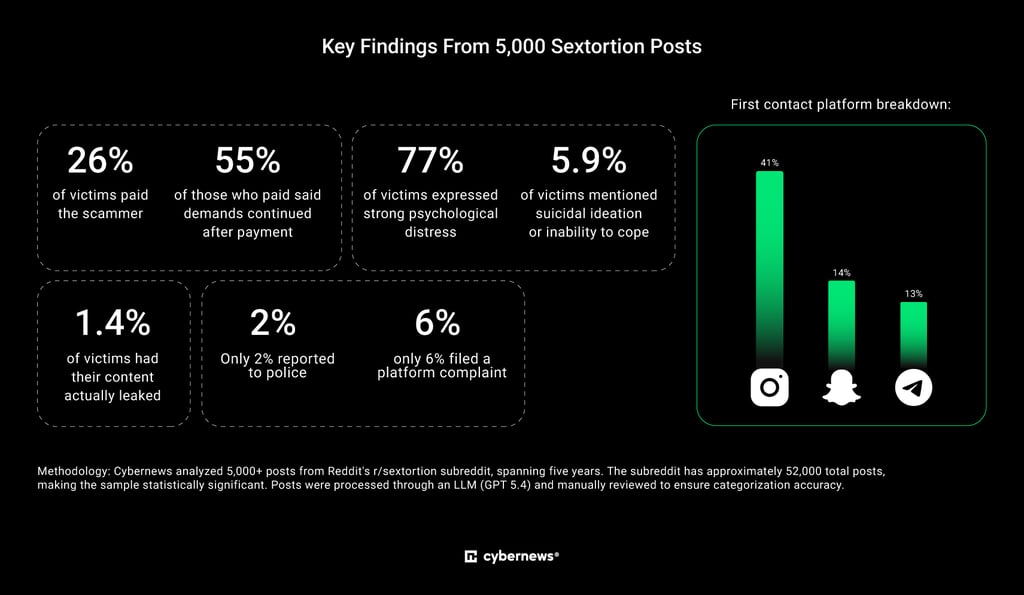
Our analysis reveals that more than a quarter (26%) of sextortion victim posts on r/sextortion report paying the scammer. Of those who paid, 55% said the threats and demands continued.
We also found that people are about 2.5 times more likely to pay when they mention feeling very fearful or anxious. To be more precise, victims who explicitly stated they were under strong emotional distress ended up paying 30.4% of the time, while those who appeared calmer and didn't explicitly describe themselves as overwhelmed paid only 12.3% of the time.
Practically everyone who offers advice in the comments of these posts tells the victim to simply block the perpetrator and avoid all further contact, which lines up with the FBI's own advice. But when you're under a lot of stress, it's easy to make fast, and not necessarily the best, decisions.
77% of victims report strong psychological distress because of the scam, even when the pictures haven't been leaked yet. Most tragically, 5.9% of victim posts mention an inability to cope or suicidal ideation.
We also discovered that, among all the victims sharing their experience on Reddit, only 1.4% reported that their sensitive content actually got leaked.
Although "only" might not be the best word here. People whose images were leaked describe a long-lasting impact. One victim reports being afraid to go outside even years later because they feel like everyone they pass on the street knows.
Likely because of the shame involved, only around 8% of victims mention reporting the incident directly to the police, through an online reporting platform, or to the platform where they got scammed. Which means that while the FBI and NCMEC report a significant annual increase in sextortion cases, the real scale of the problem is probably much worse than the current numbers suggest.
We also found that the most common first-contact platform was Instagram, accounting for 41% of cases, followed by Snapchat (14%) and Telegram (13%).
Because of the way Instagram works, it's almost the perfect criminal playground. Fraudsters can find a victim's closest circle very easily, screenshot it, and then threaten to share the pictures with them.
Who's behind these scams?
Network Contagion Research Institute (NCRI) investigation found that the uprising in financial sexual extortion was being driven by the Yahoo Boys, a group of cybercriminals in West Africa.
Law enforcement is catching at least some of the people responsible. In February 2026, United States Attorney David Metcalf announced that Afeez Olatunji Adewale, a 26-year-old Nigerian national, had been extradited from Nigeria to the U.S. He's now the third defendant brought to face charges in connection with the sextortion scheme that led to the death of a young man from Pennsylvania.
One scammer who agreed to speak on camera with ENDEVR laid out how these scams work: you create a fake female account using name generators. You find young men on Instagram or Snapchat. You build just enough rapport to get an explicit image. Then you begin blackmail. That's it, that's the whole "business model."
The criminal also said teenage boys are their primary target because they have a high sex drive and are very afraid of their images being leaked to their schoolmates, which makes them easy to manipulate and get money from.
One absurd element is that tutorials for this stuff have been, and still are, sitting online in plain sight. NCRI found sextortion scripts and how-to videos on TikTok, YouTube, and Scribd.
That NCRI report came out over two years ago. In June 2026, we checked ourselves, and a variety of that kind of material is still online on both Scribd and TikTok.
We reported the sextortion-related tutorials on both platforms. Scribd took them down fairly promptly, though that hadn't happened on TikTok yet, four days after our report.
How to protect yourself against sextortion scams
Simply being aware of how these scams work and that this is now a very popular method among fraudsters is a huge help. While researching sextortion, we came across TikTok videos explaining that these relationship-style scams are best for beginners to start with, since they're easy to execute and quickly profitable.
The general advice is that if you are talking to someone you've just met online and requests for explicit imagery arrive early — be very suspicious.
Criminals rarely spend a lot of time building rapport. The "relationship" usually starts strong and escalates to requests for images within 30-60 minutes or even faster, which is a huge red flag.
BBC reports that a 16-year-old took his own life only 90 minutes after receiving the first message — that's how fast things escalate.
It's not that a genuine connection can't happen online, but precisely because it can, scammers exploit that to put money in their pockets and are okay with destroying lives along the way.