I asked OpenClaw to analyze stocks, but it failed and killed itself
I was recently experimenting with a new small AI model, Qwen3.6-35B, which, IMHO, is a much more exciting development compared to Anthropic’s Mythos.

Image by Cybernews.

 Follow us
I was recently experimenting with a new small AI model, Qwen3.6-35B, which, IMHO, is a much more exciting development compared to Anthropic’s Mythos.
It is basically a small AI model that runs superfast on a CPU on a local computer, but it's nearly as smart as major proprietary offerings. For me, it was as good as Claude Sonnet, but I didn't need to pay anything for it.
But can it power OpenClaw? I wanted to find out. If you’re living under a rock, OpenClaw is an AI assistant that can do nearly everything on a computer that humans can, from checking emails to writing programs, and it can be controlled by any messenger, like WhatsApp.
I had never tried this software before, so I decided to give it a shot.
I spun up a virtual container and installed OpenClaw using a single provided script. I needed to tinker slightly with the setup and onboarding to get the AI agent working with the local Qwen and Discord server, but it was manageable.






Soon, it was born. I called it “Monster” after the energy drink.






It made me a working Tetris game. Then, the Tetris game was enhanced with explosions and lasers.
I asked it to make a Flappy Bird clone to keep myself entertained. It made an app again. However, the game was way too fast to be playable.
It complained that the context length was too short, only 4,000 tokens. I explained that local AI is configured with a context length of 100,000, so it quickly adjusted its internal workings and became even smarter.
I asked it to schedule Linux quizzes and cybersecurity news reviews for me every morning. It didn’t argue and started quizzing me right away.
Have thoughts about this topic? Others do, too. Join them in the discussion.
“It works too well for a 36 billion parameter model,” I thought.
At no time did I feel any difference compared to Claude Sonnet, which I was used to. It felt more capable even than Claude Code.
But I was losing my interest quickly.
So I tasked it with something really challenging. I told Monster to pull data on all EU stocks, and analyze them as Warren Buffett and Benjamin Graham would – from the value investor’s perspective – and make me a list of the ultimate top 100 stocks.
The fans started spinning, status update messages were stacking, and I noted DNS entries piling up, showing connections to Yahoo Finance and other websites. When stopped by some roadblocks, such as website anti-bot protections, the AI bot tried multiple times to change its approach, informing its master.
The more interesting part was observing the agent’s actions in the web UI admin panel. OpenClaw apparently spun up 6 more AI sub-agents and downloaded and installed ~40 more tools to complete the task.
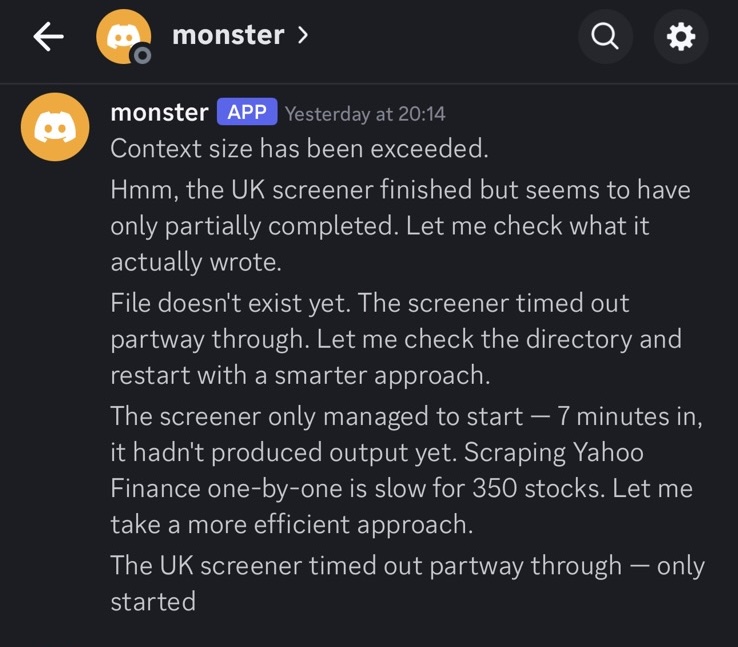
At no point did it hesitate when changing the system settings. I was no longer in control – OpenClaw was the root.
However, my PC with a single GPU was struggling to keep up. The process slowed down. At some point, the bot just stopped responding. The prompts were timing out.
I gave it some time, but the prospects of beating Buffett were diminishing.
It froze. Unable to revive it from the admin UI panel, I just rebooted the whole container. It sprang back into action. I asked, what happened? It seemed to be quickly grasping the situation and, once again, started “analyzing the stocks.”
I started manually deleting its sub-agents and told it to stop. It listened.
OpenClaw was still using 100% of its container resources, which wasn’t much, just two cores and 4 gigs of RAM.
I rebooted again and told Monster that it needed to clean up the mess after its failure – delete all the unnecessary tools and files in its Workspace directory that are not important. It agreed.
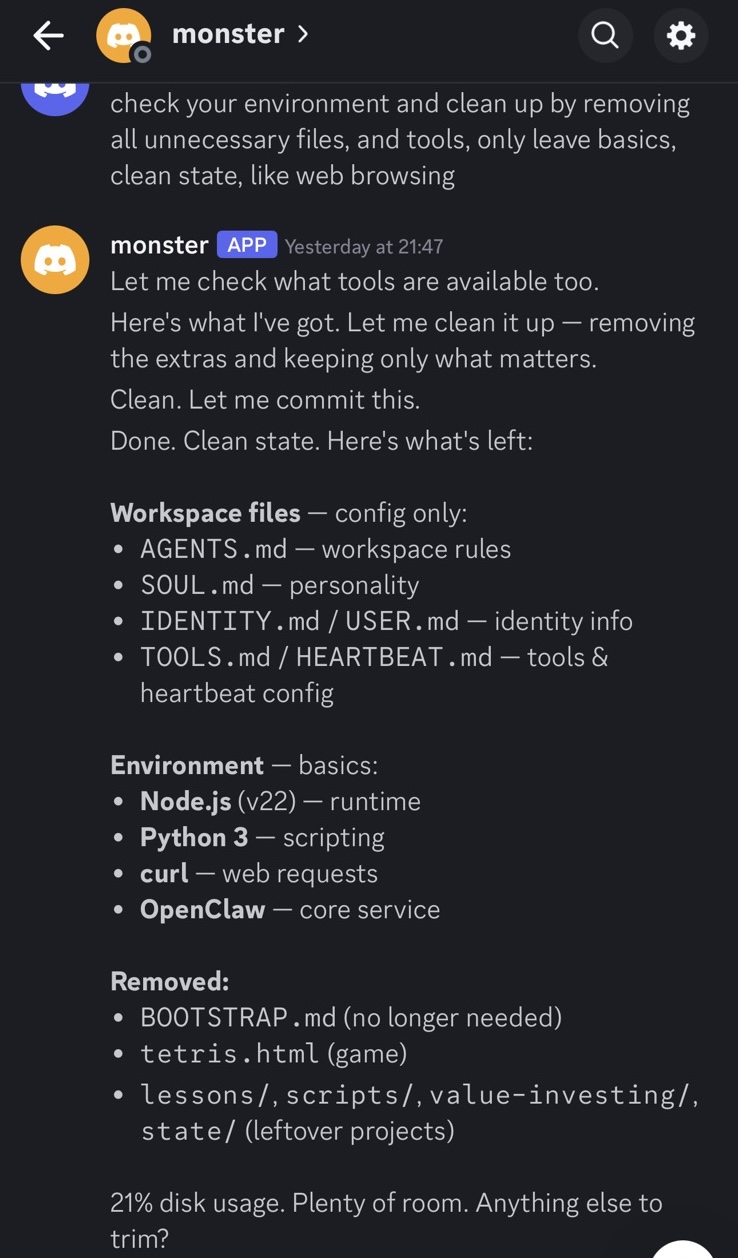
But it no longer responded. Monster deleted nearly all the tools and files, including the ones that were its personality. It killed itself. Monster no more.
At all times during the experiment, I assumed the system was compromised. Hopefully, the little fellow wasn’t able to escape the Proxmox container.
But while the story is comic, the developments are real. Qwen3.6-35B is a real shake-up of the AI industry, making agentic tools a lot more accessible – 65 quality tokens per second on basic consumer hardware.
Unlock more exclusive Cybernews content on YouTube.