Raspberry Pi 5 doubles down and launches 1GB model amid rising memory costs
Raspberry Pi has introduced a 1GB version of its Raspberry Pi 5, half the RAM of its previously smallest model at 2GB. The new version is cheaper and can handle simpler projects or applications that do not require as much RAM. Prices have increased as AI tools tend to require more and more memory, raising questions about the company’s strategy.


 Follow us
Raspberry Pi has introduced a 1GB version of its Raspberry Pi 5, half the RAM of its previously smallest model at 2GB. The new version is cheaper and can handle simpler projects or applications that do not require as much RAM. Prices have increased as AI tools tend to require more and more memory, raising questions about the company’s strategy.
Raspberry Pi is a small single-board computer that was originally created to teach programming in schools. As the gadget’s popularity has grown, it has become popular among DIY enthusiasts who make electronics, robots, and even small servers as a hobby.
Until now, the Raspberry Pi 5 series computers could be purchased with a minimum of 2GB of RAM, along with other higher-memory variants of 4GB, 8GB, and 16GB. The more the RAM, the higher the price, which for Raspberry Pi 5 is increasing and varies from $50-$55 for 2GB RAM to $120-$145 for 16GB. It’s a tendency seen among the big industry players as well.
“The current pressure on memory prices, driven by competition from the AI infrastructure roll-out, is painful but ultimately temporary. We remain committed to driving down the cost of computing and look forward to unwinding these price increases once it abates,” the company states.
As of now, Raspberry Pi has launched a new 1GB version of its flagship Raspberry Pi 5, and it costs just $45.







The lower-memory variant of the Raspberry Pi is aimed at entry-level users and simple projects, while the higher-RAM boards are created for more complex projects or assignments, such as AI experiments.
As the company puts it, “in happier news,” it is now releasing its 1GB version of Raspberry Pi 5.
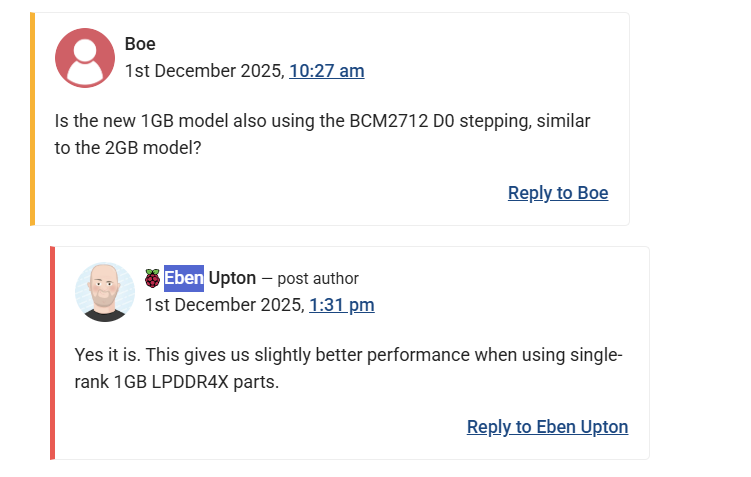
It uses the BCM2712 D0 processor stepping – the same as the 2GB model, according to Raspberry Pi co-founder Eben Upton. He noted that this configuration provides slightly better performance when paired with single-rank 1GB LPDDR4X memory, ensuring that the lower‑memory board still delivers a responsive experience for basic projects and applications.
RAM prices are skyrocketing, and industry insiders are expecting much more pressure as demand is continuously fueled by the increasing expansion of AI computing and data centers. At the beginning of October, Raspberry itself announced it would increase the number of computers with more RAM.
“The insatiable demand for High-Bandwidth Memory (HBM) for AI applications is competing for fab space with the commodity LPDDR memory used by Raspberry Pi, leading to shortages and price rises. At this point, memory costs roughly 120% more than it did a year ago,” the company announced at the time.
The biggest technology market players are also reacting to the changes in the industry. China's Xiaomi says that surging memory chip prices have pushed up its smartphone costs.
PC and prebuilt‑system makers such as CyberPowerPC and Maingear have also recently announced price hikes because global RAM (and SSD) costs have surged.






Unlock more exclusive Cybernews content on YouTube.