This new technology may help prevent battery explosions
The new technology can tell if a battery has misplaced parts, built-up gas, or dry zones.
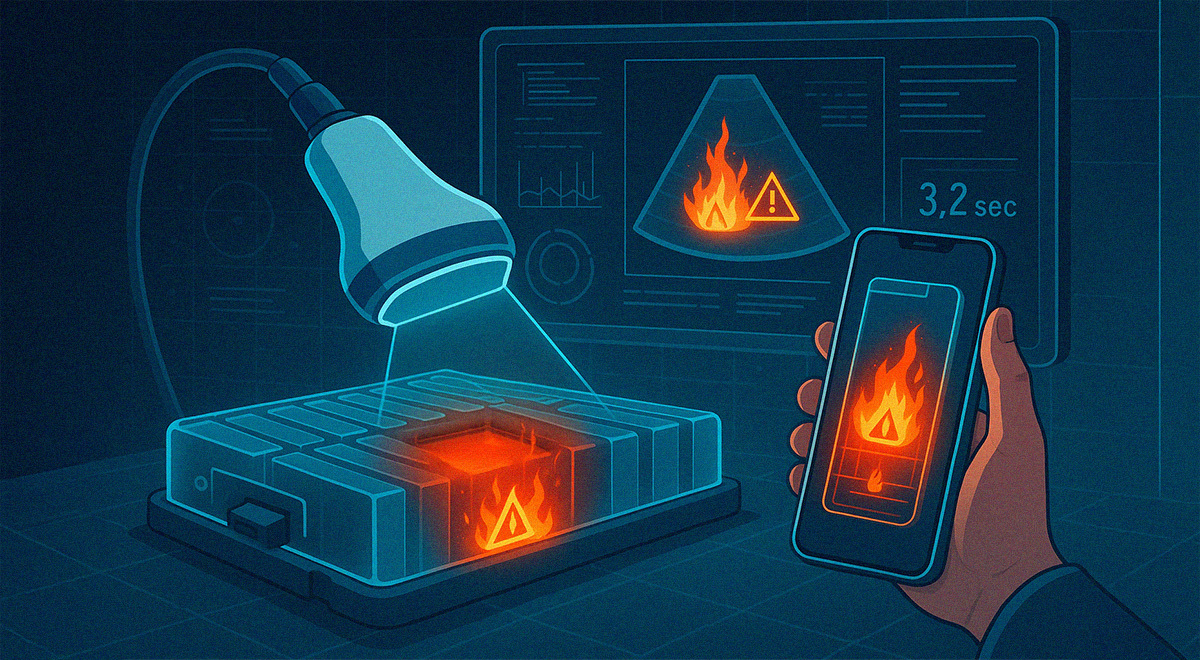
Image by Cybernews

 Follow us
The new technology can tell if a battery has misplaced parts, built-up gas, or dry zones.
With the use of electronics constantly increasing, accidents caused by batteries have been on the rise, too.
It’s been reported that in 2024, 277 fires in the US were started by lithium-ion batteries.
To counter this, researchers from Drexel University have found a way to spot defects before batteries pose risks.
The scientists have developed a benchtop diagnostic tool that can detect possible issues inside lithium-ion batteries, replacing X-ray scans.





The new tool can more quickly identify flaws that could cause batteries to overheat, a frequent safety concern in batteries that power many electronics, such as smartphones, laptops, and e-bikes.
The researchers used scanning acoustic microscopy, which sends low-energy sound waves through the lithium-ion batteries. When the waves pass through different materials, they change speed, revealing the structure and mechanical properties inside the battery.
Interesting Engineering reports that this type of detection allows researchers to look for built-up gases, internal cracks, dry areas, or out-of-place components.




Currently, battery manufacturers check batteries via visual inspection, testing sample cells, and using X-rays to check for quality. However, this method has proven to be limiting, slow, and expensive.
Considering the amount of electronics we use daily and the number of batteries needed for them to function, there’s a higher chance that they will decrease in quality.
The researchers shared that ultrasound can not only detect possible flaws in batteries but could also be useful in testing and developing new battery types.
The scientists also created open-source software for the tool that provides data analysis. This way, they hope that ultrasonic testing will become more available and used routinely in battery development.
The research team plans to work with the system further, with its updates making it even easier to spot battery issues.