5 best shockwave therapy devices for home use
Being behind major reports like The Mother of All Breaches and RockYou2024, our in-house cybersecurity experts and journalists provide unbiased, real-world testing and in-depth analysis.
We maintain complete transparency by openly sharing our testing methodologies with our audience.
Learn more
As consumer recovery tools gain popularity, many people want the best shockwave therapy device for home use to help manage muscle pain, symptoms of plantar fasciitis, tendinopathy, and boost recovery after workouts.
Consumer shockwave devices aren’t the same as clinical extracorporeal shockwave therapy (ESWT). They aren’t built to diagnose, treat, or cure medical conditions. In Cybernews health-tech coverage and scam-detection reporting, I often come across loosely regulated devices and exaggerated health claims.
I, together with the Cybernews research team, reviewed official specifications, device disclosures, safety documentation, and recurring user feedback to identify the best shockwave therapy devices for home use.
Below, I’ve included my top five picks, and I’ll dive into their key features. I’ll also discuss consumer shockwave therapy safety, buying factors, and offer you my final recommendations.
5 best shockwave therapy devices for home use – shortlist
- MODOY Extracorporeal Shockwave Machine ESWT03 – best overall shockwave therapy device for home use
- Kalecope Shockwave Therapy Machine Q60 – best for long-term support
- PUYGEH Shockwave Therapy Machine CH800 – best for high-output
- SHOCK VITALIZE Lite-First – best for whole-body use
- PerVita Medical PSP20 – best premium pick with a sturdy build


Our team of in-house researchers, writers and editors reviews and analyzes health tech products using a research-driven approach. We gather data from multiple sources, fact-check all information, and conduct our research based on peer-reviewed studies, expert opinions, consumer ratings, and regulatory approvals.
You can learn more about how we test health tech products here.
5 best shockwave therapy devices for home use – our detailed list
Below are detailed product descriptions for each shockwave therapy device for home use I’ve picked. You’ll find key information, why I picked each one, and my pros and cons.
1. MODOY Extracorporeal Shockwave Machine ESWT03 – best if you need a larger screen and strong features
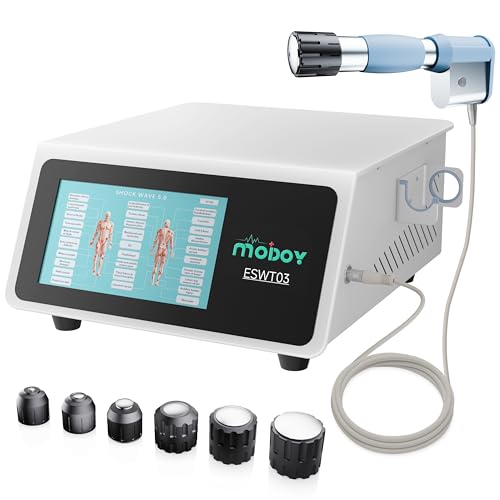
I picked MODOY Extracorporeal Shockwave Machine ESWT03 because it has the essentials, like a combination of a broad energy range and frequency adjustment, a large 10.1-inch touchscreen, and seven interchangeable heads.
It’s for when you want fine settings control and body-area coverage with one touch. Although it’s a heavier all-metal machine, impressive specifications like 2.76-inch impact depth, auto-drain system, metal handle, and 24-hour email support give it the overall win.
2. Kalecope Shockwave Therapy Machine Q60 – best if you want a lighter machine with setup presets
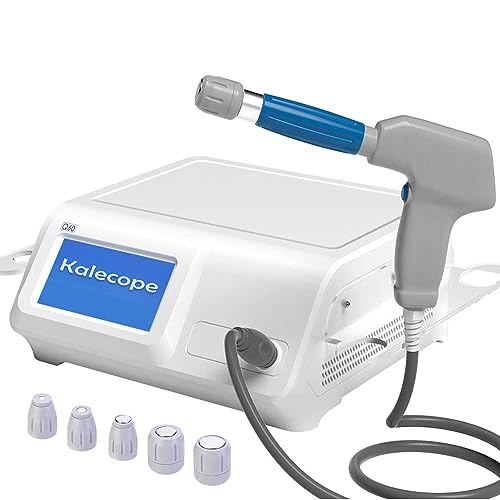
I chose Kalecope Shockwave Therapy Machine Q60 because it’s a lighter machine with preset-led, guided setup. Key features include a 7-inch HD touchscreen, preset default parameters, touch-based treatment-area selection, plus five interchangeable treatment heads for various body areas.
The official information says the main unit can withstand up to 80 million shocks. There’s also 24-hour technical support and repair help. It’s a good choice for long-term ownership and those who prefer easy setup but aren’t after premium specifications.
3. PUYGEH Shockwave Therapy Machine CH800 – best if you need a higher frequency ceiling
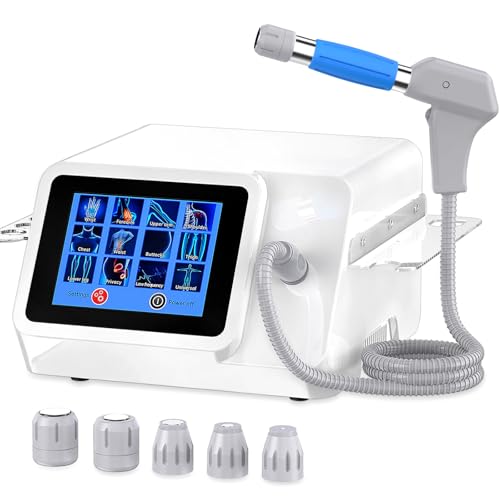
I picked PUYGEH Shockwave Therapy Machine CH800 because it’s a more clinic-style experience with a broad frequency range and dual-voltage options (for different regions).
Key features include up to 10 bar of energy, a 1-22hz frequency range, 110V-220V power, an 8-inch HD touchscreen, plus five different heads. It uses a pneumatic ballistic design powered by an air compressor, so the operating format is more transparent than some generic rivals.
However, it’s bulky and requires regular maintenance. You must clean the handle tube and replace the projectile body.
4. SHOCK VITALIZE Lite-First – best if you want body-part presets with more treatment heads
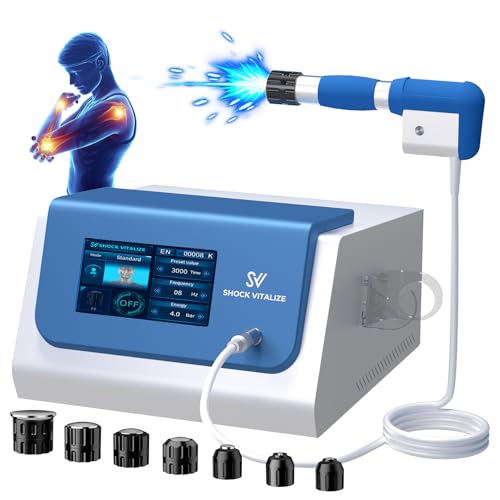
SHOCK VITALIZE Lite-First is best if you want a more body-part based setup that’s visual. You get seven included heads for home use, three operating modes, 12 body-part displays, one-touch start, and a 7-inch HD touchscreen.
There’s up to 1.77 inches of penetration depth, an aluminum alloy handle, and a specially coated bullet body rated for up to two million uses. There’s also automatic drainage and a special exhaust system.
5. PerVita Medical PSP20 – best if you want a premium shockwave therapy device
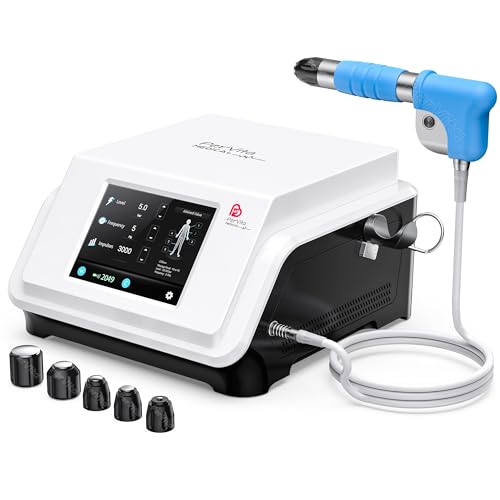
PerVita Medical PSP20 is more expensive than the others here, but justifies that with hardware quality and premium feel. It has simple controls and less maintenance overall.
Key features include five interchangeable massage heads, and a depth of up to 1.96 inches. The machine has an aluminum alloy handle, while the body is rated for over two million impacts. There’s automatic drainage, and preset impulse values from 500 to 5000.
Our methodology
Home shockwave therapy devices aren’t a substitute for professional treatment. I evaluated my picks using manufacturer transparency, technical parameters, safety disclosures, and online user sentiment:
- Technical specifications and power range transparency (25%): I prioritized devices with clearly listed energy/frequency/mode ranges, and treatment-head details. Brands that explained what the machine actually offers scored higher.
- Safety features and contraindication clarity (20%): I assessed safety disclosures, contraindication language, and realistic claim framing. I gave extra points when brands didn’t just imply medical treatment.
- Ease of use and adjustability (15%): I assessed screen layout, presets, and settings-adjustment complexity. Brands that balanced adjustability with home use in mind scored higher.
- Build quality and durability expectations (15%): I compared machine and handle materials, drainage methods, and solidity. Devices built for long-term use scored higher.
- Price-to-feature ratio (15%): I considered price vs controls, accessories, and official specifications. I gave extra points when price-to-features was honest.
- User feedback consistency (10%): I concentrated on recurring positive/negative themes. I avoided isolated comments.
What is shockwave therapy and how does it work?
ESWT sends mechanical shockwaves through your skin. Simply put, this is audible, low-energy sound waves that may increase blood flow to the area and support healing. Research is still developing.
Radial shockwave therapy delivers energy across a wider area, while focused shockwave therapy does this in a more precise way to attempt to target tissue more accurately.
Remember, consumer devices aren’t equivalent to clinical-grade ESWT treatments. Home devices should be treated as recovery-support tools. They’re not for diagnosing, treating, curing, or preventing disease. If you experience persistent pain or have any health issues, speak to a doctor.
Types of shockwave therapy devices
It’s important to understand the types of shockwave therapy devices available today. Here’s a helpful list:
- Radial shockwave devices: less precise, most common for home use. These have broader, more diffuse output. They’re for larger or more superficial areas.
- Focused shockwave devices: narrower waves with potentially deeper targeting. These are more common in clinics than at home.
- Pneumatic shockwave machines: Compressed air and a projectile method to create the wave. There are radial-style machines for general soft-tissue support at home.
- Electromagnetic shockwave devices: A recognized ESWT generation method that’s deeper, more controlled, and precise. It’s usually associated with professional systems rather than consumer home devices.
Mostly, you’ll realistically come across radial models (including pneumatic radial) for home use. Focused and electromagnetic machines are uncommon for home use.
Benefits of using shockwave therapy
Shockwave therapy has been studied in supervised clinical settings, where it may help manage pain and support tissue healing in some musculoskeletal conditions. That doesn’t mean a home-grade device will perform the same, so treat these potential benefits as possible outcomes:
- May support muscle recovery: Some medical sources say ESWT may help reduce pain. Potential pain reduction following some sports injuries and orthopedic recovery is also mentioned.
- May help manage certain tendon conditions: Some sources say ESWT has been used for patellar and hamstring tendinopathy. Sources also include Achilles tendinopathy.
- May help manage plantar fasciitis symptoms: ESWT is commonly mentioned in connection with plantar fasciitis symptom management.
These potential beneficial outcomes require consistent ESWT sessions. Results also vary depending on condition and condition severity. Outcomes usually come from at-clinic ESWT systems rather than at-home devices. At-home devices aren’t intended for treatment. Ask your doctor if home-grade devices could help to support symptom management.
Safety tips for using shockwave therapy machine at home
Using a shockwave therapy machine at home requires diligence. Here’s what to consider:
- Consult a healthcare professional before use: Don’t use the device without medical guidance, especially if you have a known medical issue or ongoing pain.
- Low intensity first: Build up intensity slowly. Stop if you feel sharp pain, or if you feel off.
- Limit sessions: Follow your clinician’s advice regarding session duration and frequency. Don’t overuse the device.
- Use gel and follow setup instructions: Clean the area you want to treat. Apply coupling gel. Maintain the device as directed in the manual.
These devices aren’t intended for medical treatment. ESWT may not be an option if:
- You’re pregnant
- Take anticoagulants or blood-thinning medication
- Have a clotting disorder
- Are under 18
- Have active cancer
- Have a history of bone cancer
- Have a foot infection
- Have had an Achilles tendon or plantar fascia rupture
- Had a steroid injection in the past 12 weeks
- Have a cardiac pacemaker
How to choose the best shockwave therapy device for home use
Several aspects matter before purchase. Here’s a list that will help you:
- Adjustable intensity levels: you should start gently and increase only when safe to do so. At minimum, look for adjustable settings.
- Number of attachments: more treatment heads usually means better body coverage. At minimum, look for five heads for different treatment areas.
- Energy output range (bar/Hz): clearly displayed bar and Hz ranges show the brand is honest. At minimum, the device should clearly list both.
- Ergonomics and weight: a heavy machine is harder to move and use. At minimum, check the host weight before you buy.
- Warranty and return policy: these protect you if the machine arrives faulty or is not a good fit. At minimum, look for a warranty and a return policy.
- Customer support transparency: this matters with setup and maintenance hiccups. At a bare minimum, support contact details must be provided.
- Clear contraindication disclosures: explaining who shouldn’t use the device. At minimum, there must be a “safety” section.
Cheaper devices usually sacrifice transparency or build quality. Mid-range ones might have a balance of features and value, while premium home devices are more adjustable, but expensive.
Home shockwave therapy vs professional treatment
Home shockwave therapy and professional treatment are quite different. They differ in cost, power, and precision (mainly). At a clinic, a trained professional will administer ESWT using high-grade equipment, while monitoring every stage. At-clinic systems may send more precise, stronger waves to a narrower treatment area, including deeper tissue if required.
Home-grade machines are typically lower-intensity with safeguards for general use. Cost differs because professional treatment means paying per session (often several visits), while a home device is for ongoing self-use.
Home devices can be more convenient, but they’re not equivalent to a professional, controlled ESWT system.
Bottom line: which shockwave therapy device is best for home use?
For most people looking for the best shockwave therapy device for home use, the “ideal” model is the one that best fits your needs. For example, athletes looking for exercise recovery management may opt for highly-adjustable, high-intensity models. Budget shoppers might prefer entry-level machines with basic attachments. In my evaluation, the MODOY Extracorporeal Shockwave Machine ESWT03 provided a good balance of everything.
If you want to try ESWT for plantar fasciitis (or certain tendon conditions), consult your doctor regarding suitability and safety before buying.
Buyer checklist:
- Confirm energy output range
- Check warranty/return policy
- Read independent user feedback
For more, explore our other health-tech material on the best vagus nerve stimulator, best PEMF mat, and best red light therapy devices.
FAQ
Is home shockwave therapy safe?
Generally yes, but it’s not suitable for people with contraindications like pregnancy, cancer, clotting disorders, infections, recent steroid injections, or pacemakers. Always consult your doctor before use.
How often should you use a shockwave therapy device at home?
Clinicians generally recommend ESWT in sessions spread over weeks, not constant daily use. It’s best to stick to the device’s manual and your doctor’s advice.
What conditions can shockwave therapy help with?
The research is still evolving, but some research posits that it may support the management of conditions like plantar fasciitis, Achilles tendinopathy, patellar tendinopathy, hamstring tendinopathy.
What is the difference between radial and focused shockwave therapy?
Radial shockwave therapy spreads energy over a broader area, while focused shockwave therapy more precisely targets a smaller area. In reality, radial systems are more common as at-home devices.
Are home shockwave therapy devices as strong as clinic machines?
No, professional systems often deliver more precise, stronger waves. Home devices are built with the general, unsupervised user in mind, so power is typically lower for safety purposes.
-
Storz Medical
Difference between radial and focused shock wave therapy
-
Storz Medical
Extracorporeal Shock Wave Therapy (ESWT) – An innovative method for pain treatment
-
NHS
Extracorporeal shockwave therapy for Achilles tendinopathy and plantar fasciitis
-
Mayo Clinic
The evolving use of extracorporeal shock wave therapy in managing musculoskeletal and neurological diagnoses
-
Physiopedia
Extracorporeal Shockwave Therapy
-
Boston Children’s Hospital
What is shockwave therapy?
-
IEEE
Effectiveness of Extracorporeal Shock Wave Therapy for Rapid Relief of Exercise-induced Muscle Fatigue