Oxiline Scale MD Pro vs Hume Body Pod: which body composition device is better?
Being behind major reports like The Mother of All Breaches and RockYou2024, our in-house cybersecurity experts and journalists provide unbiased, real-world testing and in-depth analysis.
We maintain complete transparency by openly sharing our testing methodologies with our audience.
Learn more
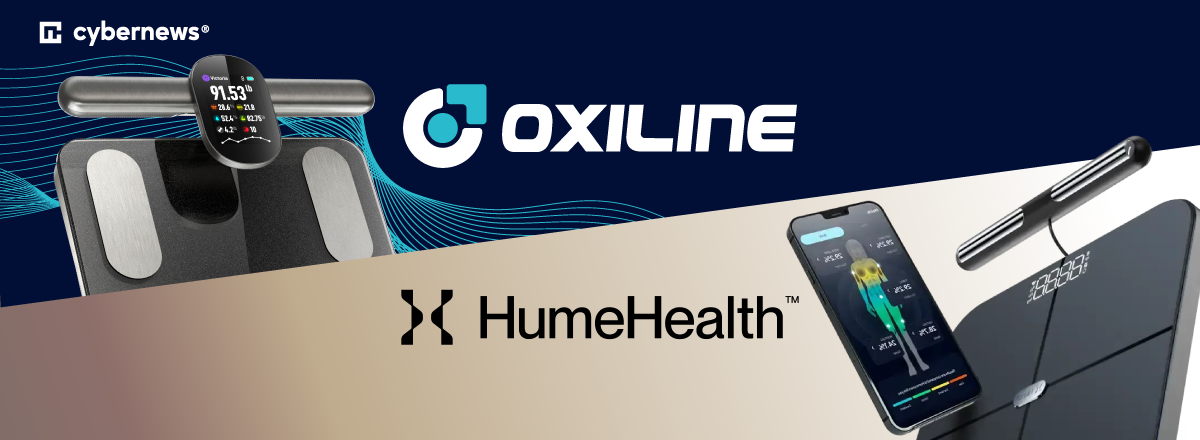
Wellness technology innovations are getting more impressive by the day, and even something seemingly ordinary like a smart scale can change the way you’re tracking fitness goals. This Oxiline Scale MD Pro vs Hume Body Pod comparison proves it, and in it, I’ll explain how they can help you optimize your physical wellbeing.
The Oxiline Scale MD Pro delivers basic performance tracking with personalized insights, while Hume’s Body Pod is a bioimpedance health device with more specific readings. So, the big question is: which one should you choose?
I worked with the Cybernews research team to give you the specifics of both and to discuss the nuances that separate them. This analysis will help you make an educated purchase decision depending on your health tracking needs and budget.
For users prioritizing affordability and basic daily tracking, the Oxiline Scale MD Pro is a solid choice, offering essential body composition readings for convenient at-home use, while those seeking deeper insights and advanced health metrics may prefer the Hume Body Pod, which is better suited for fitness enthusiasts who want more detailed, health-focused readings with actionable insights.
Oxiline Scale MD Pro vs Hume Body Pod overview
Before you move on to my detailed breakdown of these devices, take a peek at some interesting head-to-head facts:
| Feature | Hume Body Pod | Oxiline Scale MD Pro |
| Type | Handheld bioimpedance device | Smart scale |
| Location | Portable | Stationary |
| Metrics tracked | Body fat percentage, muscle mass, metabolic rate, hydration level, body age analysis | Weight measurements, body composition analysis, BMI, bone mass, visceral fat |
| Technology (BIA-based) | Advanced BIA with 8-point contact | Standard BIA |
| Radiation | None | None |
| App support | iOS and Android | iOS and Android |
| Subscription | Optional subscription for advanced insights | Not required |
| Price range | $366 original price, $183 discounted price | $399 original price, $199 discounted price |


Our team of in-house researchers, writers and editors reviews and analyzes health tech products using a research-driven approach. We gather data from multiple sources, fact-check all information, and conduct our research based on peer-reviewed studies, expert opinions, consumer ratings, and regulatory approvals.
You can learn more about how we test health tech products here.
How we evaluate body composition devices
I wanted to do this Oxiline Scale MD Pro vs Hume Health Body Pod comparison the right way, which is why I came up with a specific head-to-head methodology:
- Accuracy and technology (30%). I first looked at the technology used in both devices, focusing on bioimpedance and body composition tracking. I also compared the accuracy claimed by these brands with that of clinical-grade DEXA scans.
- Health metrics depth (25%). I compared the range of tracked metrics, analysis capabilities, and actionable insights.
- Ease of use and accessibility (20%). To make sure both devices are user-friendly enough, I analyzed the daily operational convenience and comfort of use.
- Cost and long-term value (15%). From the upfront cost to subscription plans and charges, I made a full breakdown of the price-to-value ratio.
- User experience and app quality (10%). I put both brands' apps to a head-to-head test in terms of layout design, visual insights, and in-app health recommendations.
What is Oxiline Scale MD Pro?
The Oxiline Scale MD Pro is a smart scale that relies on bioelectrical impedance to measure body composition. Here’s how it works: as soon as you set foot onto the device, its tiny electrodes send light electricity through your body.
This allows the scale to track different metrics based on resistance, including metabolic rate readings, body water percentage, and visceral fat levels.
I’d say it’s perfect for budget-conscious users looking to get a single health tech solution for the whole family, and the no-subscription policy for the app makes it a great everyday option.
What is Hume Body Pod?
Compared to the Oxiline device, the Hume Body Pod is a much more sophisticated option. It’s still a smart scale by design, but the depth of body composition analysis metrics outweighs that of the Scale MD Pro.
It uses advanced, multi-frequency bioelectrical impedance tech, featuring 8-point contact measurement. This means that it has more sensors than the Oxiline Scale MD Pro, which leads to full-body results, including the torso, arms, legs, and heart.
The app, packed with actionable and personalized health-related insights, makes it even more professional, and the brand claims the scans feature up to 98% accuracy.
What’s so special about it is the segmental analysis function, which helps pinpoint imbalances between your upper and lower body.
Plus, it has way more analytical points than Scale MD Pro, including lean mass percentage, skeletal muscle mass, metabolic rate tracking, and body age metrics.
Oxiline Scale MD Pro vs Hume Body Pod: design and user experience
Overall design and user-friendliness dictate the way each device is used, which is why I compared their main usability features:
- Physical design and setup. Both devices feature a smart scale design with a handheld measurement bar. The main difference is that Hume’s Body Pod uses multi-frequency sensors, unlike the single-frequency measurement of the Scale MD Pro.
- Daily usability. While these devices are great for daily tracking, the Scale MD Pro is prone to 2% to 4% daily fluctuations due to factors such as food intake or skin moisture. Hume Body Pod's creator claims it is a more precise option, differing by just 2% to 3% from DEXA scan results.
- Comfort and speed. The Oxiline Scale MD Pro features a more comfortable, classic bathroom scale design with 10-second measurements. On the flip side, the Hume Body Pod takes 30 to 45 seconds, and its shape is a bit bulkier and less comfortable.
- App experience. The app is where the Hume Body Pod excels, offering advanced insights and personalized health-related recommendations. It does require a subscription for unlocking its full capacity, though, so Oxiline’s app isn’t half bad, considering it’s free and includes all the basic trend lines.
Oxiline Scale MD Pro vs Hume Body Pod: accuracy and technology
The sheer tech sophistication and measurement accuracy are among the most notable differences between these two devices. The Oxiline Scale MD Pro relies on consumer-grade, single-frequency BIA technology and uses foot-to-foot measurement by sending electrical signals up one leg and down the other.
Scale MD Pro also features a handheld tracking bar, similar to that of Hume’s Body Pod. It helps track muscle rate, skeletal muscle percentage, and overall muscle mass, in addition to standard weight measurement. As mentioned, 2% to 4% daily body mass fluctuations are possible.
The Hume Body Pod uses advanced, multi-frequency BIA with an 8-point contact measurement. This leads to more advanced tracking and precise measurements with clear differentiation between intracellular and extracellular water, which ultimately translates to more nuanced composition analysis.
Based on most user reviews and underlying technology, the Hume Body Pod should provide tighter results with fewer fluctuations in back-to-back measurements. However, I’d still note that there are limitations to the BIA technology, and it’s by no means a replacement for clinical DEXA testing.
Oxiline Scale MD Pro vs Hume Body Pod: data and insights
This category is a major factor in your Oxiline Scale MD Pro vs Hume Body Pod decision, as actionable insights derived from data readings can make or break a health tech device. Here’s my comparison summary:
- Actionable insights. The Oxiline Scale MD Pro tracks your weight, body fat percentage, muscle mass, and similar metrics. All data is clearly displayed within the app, and you can even see a graph showing how it changes over time. Still, its lack of actionable insights makes Hume Body Pod a better choice overall, as it analyzes health-related patterns and provides context-specific recommendations.
- Trend tracking. The trend tracking capability of the Scale MD Pro is also rather limited, as you can mainly just follow rising/dropping trends. With the Hume Body Pod, however, you can also see how different trends correlate, with charts and diagrams giving you a more detailed explanation of each trend.
- Data visualization. Oxiline’s visualization capabilities are limited to data presentation, while Hume takes a different approach with comparative body diagrams presenting complex segmental analysis information in a relatively simple way.
- Health recommendations. Hume beats Oxiline in terms of health recommendations, thanks to its nutrition timing suggestions and workout intensity tips. I also felt like Oxiline’s feedback is a bit vague, as opposed to Hume’s descriptive and personalized comments.
Oxiline Scale MD Pro vs Hume Body Pod: cost and value
One thing that I found to be particularly interesting was that both these devices cost almost the same. After all, they use a similar layout with a handheld tracking bar, but Hume offers a $183 discounted price, versus the slightly higher $199 you'd have to pay for the Oxiline Scale MD Pro.
At a glance, it makes a lot of sense to just go with the Body Pod, considering it packs much more serious hardware, with multi-frequency measuring and an 8-point contact patch. And all that for a lower price? Sounds like a great deal, right? Well, not necessarily, since it also requires a monthly subscription for unlocking full functionality with personalized insights.
That is precisely what makes Oxiline Scale MD Pro a more cost-effective option, at least in my mind. You can still get all the basic health-related measurements suitable for everyday users without having to pay the premium Hume subscription price of $9.99/month or higher.

Oxiline Scale MD Pro vs Hume Body Pod: setup and accessibility
Another category where I had to raise my voice for Oxiline’s Scale MD Pro is the initial setup convenience. You just have to unbox it, place the scale on a flat, hard surface, and install the app.
You can then create an account and fill in your basic details, but it’s all done in just 5 to 10 minutes. User instructions are very clear from the get-go, so I don’t think there can be any problems with the setup.
The Hume Body Pod requires a bit more input. You’ll be required to set up your activity level, fitness goals, and other factors that affect the recommendations algorithm.
That’s also the reason why the Body Pod has a steeper learning curve. In terms of daily convenience, Hume’s Body Pod takes more time for each measurement (up to around 45 seconds), and Scale MD Pro feels rather like using a regular scale.
Oxiline Scale MD Pro vs Hume Body Pod: pros and cons
Since both devices have some upscale features and certain drawbacks, it comes in handy to get a detailed overview of their pros and cons ahead of making the final call:
Oxiline Scale MD Pro vs Hume Body Pod: user and expert opinions
To give you my final Hume Body Pod vs Oxiline Scale MD Pro verdict, I compared user reviews and feedback on Trustpilot, Reddit, and similar platforms.
When it comes to Scale MD Pro, most users report they’re satisfied with the basic tracking capabilities, even though the amount of actionable data is much lower compared to the Body Pod. I’ve also heard a fair share of praise for the beginner-friendly interface, but some claim significant fluctuations in the results of consecutive scans.
Hume’s Body Pod is described as the ultimate option for athletes on many fitness forums, with most users praising the accuracy and depth of personalized insights. Some even report that the device, together with in-app insights, helped them figure out why they were losing muscle mass, which I found to be pretty cool.
Oxiline Scale MD Pro vs Hume Body Pod: which one should you choose?
Ultimately, the Oxiline Scale MD Pro vs Hume Body Pod comparison mainly boils down to personal preference.
I’d recommend Scale MD Pro to everyday users looking for simple and affordable tracking of the basic fitness metrics. It’s also a better choice for monitoring health-related metrics for the entire family, and it’s easy enough to use even if you’ve got no previous experience with smart scales.
With that in mind, I still feel like the Hume Body Pod is better for serious fitness optimization and for tracking performance and effectiveness.
FAQ
How accurate is the Oxiline Scale MD Pro compared to the Hume Body Pod?
The Oxiline Scale MD Pro is less accurate than the Hume Body Pod, as it uses a consumer-grade, single-frequency BIA technology, which is inferior to the multi-frequency measurements of the Body Pod.
Does the Hume Body Pod require a subscription to work fully?
No, the Hume Body Pod doesn’t require a subscription to fully function, but you will not be able to get actionable insights and personalized health recommendations without one.
Does the Oxiline Scale MD Pro measure the same metrics as the Hume Body Pod?
While some aspects that these devices cover match, such as weight, body fat percentage, visceral fat, and muscle mass, the Oxiline Scale MD Pro doesn’t track advanced metrics like segmental body composition and body age, and the Body Pod does.
Is the Hume Body Pod worth it if I already own the Oxiline Scale MD Pro?
It all depends on your fitness goals. If you need basic measurements and trend tracking, there’s not much sense in upgrading to Body Pod, but it’s recommended for those looking for deeper insights and addressing muscle imbalances.
Can the Oxiline Scale MD Pro be used without a subscription?
Yes, the Oxiline Scale MD Pro can be used without a subscription, and you’ll still get access to the official app with visual data representation and basic fitness tracking.