Oura Ring 4 review for 2026: industry leader or just another trendy hype?
Being behind major reports like The Mother of All Breaches and RockYou2024, our in-house cybersecurity experts and journalists provide unbiased, real-world testing and in-depth analysis.
We maintain complete transparency by openly sharing our testing methodologies with our audience.
Learn more
The Oura Ring has been a biohacker-beloved wearable since it launched in 2015, and in this Oura Ring review, I’m diving into why it’s grown such a cult following. With Gen 3 introduced in 2021 and the upgraded Gen 4 arriving in October 2024, this smart ring intends to track your sleep, recovery, and overall health with precision.
If you're anything like me and value real data on how your body’s working, it’s easy to see the appeal of the Oura Ring. But is it actually useful or just smartly marketed?
To find out, I joined forces with the Cybernews research team and explored real user feedback, expert takes, and scientific studies done on this wearable. In this review, you’ll find everything we uncovered to help you decide if the Gen 4 Oura Ring is the right fit for what you’re looking for.
| ⭐️ Rating: | 4.8 |
| 💸 Price: | $349-$499 |
| 📱 App integration: | Yes ($5.99/month for a subscription), compatible with iOS and Android |
| 🔋 Battery life: | Up to 8 days |
| ⚙️ Main features: | Sleep tracking, heart rate monitoring, activity tracking, readiness score, stress management tools, women’s health insights |
| 🔒 Money-back guarantee and warranty: | 30-day returns and a 1-year warranty |
Pros and cons of Gen 4 Oura Ring


Our team of in-house researchers, writers and editors reviews and analyzes health tech products using a research-driven approach. We gather data from multiple sources, fact-check all information, and conduct our research based on peer-reviewed studies, expert opinions, consumer ratings, and regulatory approvals.
You can learn more about how we test health tech products here.
What is the Oura Ring?
The Oura Ring is a widely adopted smart ring that tracks your sleep, recovery, and many other health metrics like heart rate and temperature. The Gen 4 Oura Ring features upgraded sensors with 18 optical channels for improved accuracy. The ring is made of durable titanium, worn on your finger, and lasts up to 8 days on a single charge.
Unlike smart watches, Oura Ring is more comfortable for daily use, and you can pick from a few different colors (silver, black, stealth, brushed titanium, gold, and rose gold). These colors are available in two Gen 3 and Gen 4 styles: Heritage (flat-top design) and Horizon (rounded design).
Oura Ring features aim to tackle all of the essential health factors. Therefore, its key features are comprehensive sleep tracking, personalized readiness score, and activity monitoring.
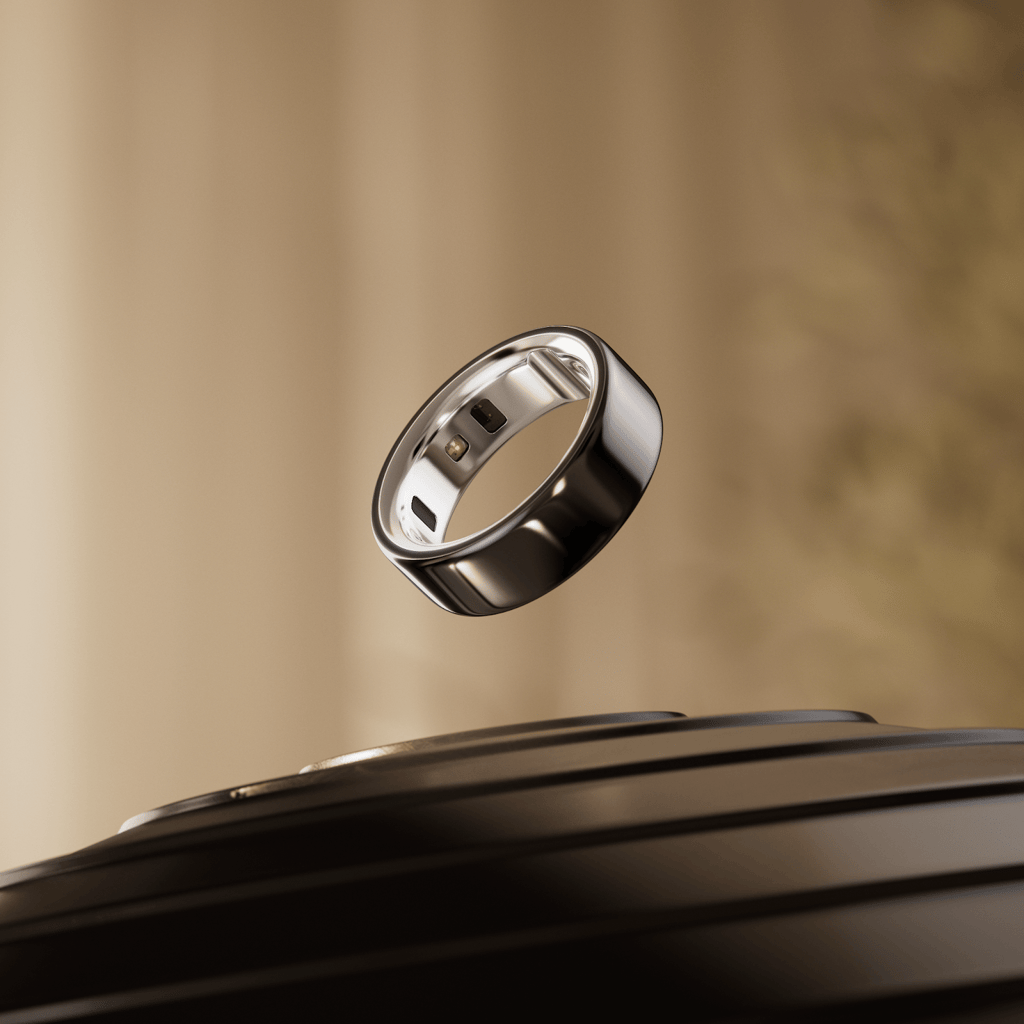
More precisely, the Oura Ring sleep tracker monitors different sleep stages, including deep, light, or REM, sleep duration, and sleep efficiency. Oura Rings claims it also tracks how often you wake up during the night and how long it takes you to fall asleep.
From my findings, the ring is designed to track the number of steps, calories burned, and how long you have been active during the day. Additionally, Oura Ring might send you a reminder to move if you haven’t been active for a while.
Ultimately, you get a personalized readiness score, which is calculated using a combination of metrics like sleep quality, recent activity, heart rate variability, resting heart rate, and body temperature. This feature potentially assesses your overall health and recovery status, which might help you understand if you should push yourself or relax.
What likely sets the Oura Ring apart is its focus on personalized insights and recovery. Also, it has a better and more discreet design than any other health-tracking device that we’ve seen so far.
Get the Oura Ring for the best price with a special Oura Ring promo code.
Who should use the Oura Ring?
Many health-focused folks who have already tried and tested the Oura Ring say that it’s the best wearable for health tracking. However, this doesn’t apply to each user.
Regardless, Oura Ring’s features and functionalities may be suitable for health enthusiasts, as it tracks different activities during the day, such as calories, steps, and how long you have been active.
Also, it may be beneficial if you want to track and improve your sleep, as the Oura Ring for sleep monitors various aspects, from the length of sleep to its quality to how long you’ve spent getting asleep. Aside from this, anyone who is looking for non-intrusive health monitoring may find this device useful.
Thanks to the tracking of around 20 biometrics, according to their official website, Oura Ring should give you insights about your heart rate, blood oxygen, breathing regularity, heart rate variability, temperature, activity, and sleep, which can help you assess your overall health and well-being.
As someone who’s very much into women’s health, I have to mention that Oura Ring is also a valuable tool for women, as it uses continuous temperature tracking and cycle predictions to potentially help monitor menstrual phases, identify fertile windows, and spot subtle hormonal shifts over time.
Oura Ring: design and comfort
When it comes to the physical aspects of the ring, the Gen 4 Oura Ring steps things up. Starting off with the basics, the Gen 4 Oura Ring is fully made of titanium. On the other hand, the Gen 3 version features a titanium exterior with an epoxy interior. Both versions are built to last. Also, they are both lighter-than-average rings with a non-allergenic and water-resistant design.
On top of this, while there aren’t many sleek health trackers, Oura Ring might be one of them. It has an incredibly lightweight design that ranges from 3.3g to 5.2g. Basically, the ring tracker’s aesthetics make it feel and look like your regular piece of jewelry.
Thanks to the wide range of colors, expanded sizing range of the Gen 4 Oura ring (4-15), and the recessed interior sensors at 0.3mm, you should be able to wear it daily without even noticing that the ring is on your hand.
Some users say they’re able to sleep with it, which isn’t the case with some health-tracking devices, such as smartwatches, which are bulkier than the Oura Ring.
What is the difference between Oura's 3rd and 4th generations?
As of 2025, only the 3rd and 4th generation models of the Oura Ring are sold on the market. Earlier versions are no longer available for purchase, including their chargers. As our Oura Ring 4 vs Oura Ring 3 comparison revealed, while both Oura Gen 3 and Oura Gen 4 may offer you advanced health tracking with sleek, comfortable designs, there are some notable differences you should be aware of.
Check the chart below to see how they compare across key features.
| Gen 4 | Gen 3 | |
| Sensor system | Red and infrared LEDs track blood oxygen, green and infrared LEDs monitor heart rate, heart rate variability, and respiration, a digital sensor tracks skin temperature variations, and an accelerometer tracks movement and activity | Red LEDs measure blood oxygen, green LEDs monitor heart rate 24/7, PPG sensors track resting heart rate, heart rate variability, and respiration, NTC sensors monitor skin temperature trends, and an accelerometer tracks movement and activity |
| Design | Entirely made of titanium, making it lighter and more durable | Made of a titanium exterior with an epoxy interior |
| Size range | Extended to size 4-15 to accommodate more users | Comes in sizes 6-13 |
| Automatic activity detection | Added heart rate data into detectable activity in addition to over 40 other activities like rowing, yardwork | Limited to detecting basic activities such as running, walking, cycling without heart rate metrics |
| Battery life | Up to 8 days of battery life | Up to 7 days of battery life |
Having compared the two models, I can say that the Gen 4 Oura Ring levels up your experience, especially if you’re upgrading from the older model. The Oura Ring 4 features a full titanium construction, replacing the Gen 3's titanium exterior and epoxy interior. This change enhances durability and reduces potential skin irritation. Also, the Gen 4's sensors are recessed to just 0.3mm, compared to the Gen 3's 1.3mm protrusions. This means a more comfortable fit, especially during activities like weightlifting or side-sleeping. Gen 4 now also offers a bigger selection of ring sizes (4-15), accommodating more finger sizes.
Oura Ring 4: features and functionality
Now that you’re more familiar with how Oura Ring works, let’s dive deeper into its standout features and see what you may benefit from the latest model (Gen 4).

Sleep tracking
The Gen 4 Oura Ring provides you with a sleep score by considering a few fundamental aspects. More precisely, it focuses on your total sleep time, including naps, your sleep efficiency, or how long you’ve been asleep versus how long you’ve been awake, restfulness (disturbances during sleep), and also your sleep stages. This refers to light, deep, or REM sleep.
Another aspect that’s calculated in the Oura Ring sleep data is your sleep latency. In other words, this represents the time you need to fall asleep when you go to bed and whether and how often you wake up at night.
Aside from the sleep score, Oura Ring states that it can also determine your chronotype, meaning identify whether you’re a morning person or a night owl, along with your optimal sleep schedule after 90 days of using the device.
Activity tracking
Another prominent feature is the Oura Ring (Gen 4) activity tracking, which tracks how active you’ve been during the previous day.
In other words, this monitoring feature should represent how many steps you’ve made, whether you’ve been sitting for too long, how long you participated in medium-to-high-intensity training, and the number of burned calories, which is a good indication of whether you’re meeting your fitness goals.
On top of this, you can also find the Oura Ring heart rate tracking. As one of the first trackers to measure the HRV, Oura Ring shows the regularity or irregularity between pulses, coming in handy during exercise.
If you have a high HRV, it might mean that you’re in good shape and relaxed, while a low HRV alerts you that you may be going through some emotional or physical stress.

Readiness score and stress management tools
Oura Ring’s Readiness score is a combination of different recent activities, such as sleep data, activity tracking, heart rate variability, and body temperature. Its goal is to potentially show you whether you’re recovered and prepared and, if so, how well prepared you are to take on the new day.
This score also might tell you if you should relax during the day or challenge yourself to be more active. Basically, it should represent an average of your overall health and well-being. While this Readiness score sums up your sleep, activity, and heart data, beware – it’s a novelty metric – not a definitive measure of your health.
Aside from this, Oura Ring should provide you with a resilience level score. This feature most likely measures how much stress you’re dealing with and whether you’re bouncing back from it.
On top of this, the stress monitoring feature might include tracking daily movement and activities, as well as manually added tags that should give you better insights into your daily condition.
How accurate is Oura Ring?
In order to evaluate the Oura Ring’s accuracy, I explored numerous user experiences, reviews, and studies on the device’s performance. Starting from what’s available on the website, you might expect it to measure your resting heart rate with 99.6% reliability, monitor heart rate variability with 98% reliability, and track temperature changes as small as 0.13 °C/ 0.234 °F.
In fact, according to a study they conducted on 49 healthy subjects, Oura Ring has shown to be a reliable tool for measuring average nighttime resting heart rate and variability, as well as highly accurate in assessing body signals and long-term health behavior. While Oura claims near-pinpoint accuracy, it’s difficult to independently verify these exact figures, so take them with a grain of salt.
However, some user reviews state that the fitness tracker’s performance might not be the best, as it wasn’t able to detect what activity was done or to track calories burned from cardio and non-cardio activities.
A particular user in a blog post shared that the Oura Ring performs better in terms of sleep tracking accuracy compared to Garmin. The user came to this conclusion after testing both devices, stating that the results from the Oura Ring were more accurate than those of the Garmin watch.
Ultimately, the results of Oura Ring vs competitors are also more reliable according to users. In fact, a user on Reddit claims that they got results that Apple Watch can’t detect and that even though they tried WHOOP, it showed as a lousy option to them.

Based on all of the reviews, it seems like Oura Ring offers accurate and reliable results for most users.
Oura Ring: customer reviews and feedback
While I scratched the surface of some of the smart ring testimonials, let’s delve into more detail. Some Oura Ring user reviews on Reddit reveal that they like how the device helps them take corrective action and understand what they need to improve.
There are also Oura Ring reviews claiming that the HRV monitoring helped them achieve more good than bad days. There is also positive Oura Ring feedback on sleep tracking, with users claiming the ring provides them with accurate results.
Additionally, one of the best things, according to those who’ve tried this smart ring, is the lightweight design, which is much more comfortable than other wearables.
Here’s what some Oura users share on Reddit:
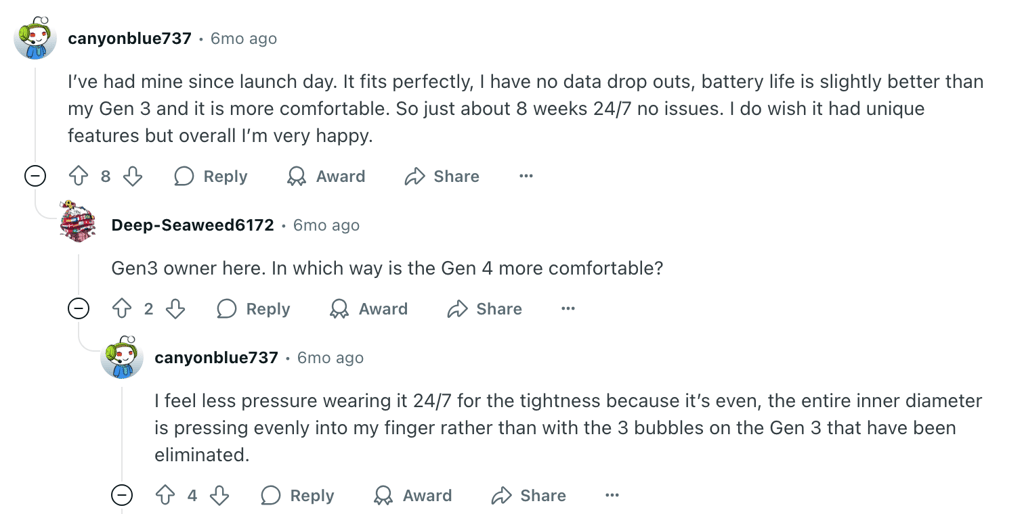
And even though there are some critiques, the pros seem to outweigh the cons of Oura Ring, making it a potentially decent health-tracking device.
Other health tech devices to increase your well-being:
Best smart rings: check out the best smart rings the market has to offer this year
Best sleep-tracking ring: learn how to track your rest smarter and which smart ring to get
RingConn smart ring review: see how RingConn stacks up in 2026
Femometer review: discover everything about this fertility tracker in our full review
Oura Ring review: final thought
Based on my thorough Gen 4 Oura Ring review and all the user testimonials, it seems like Oura Ring is a great addition if you’re into health metrics and want to biohack some of your daily routines. No surprise this ring’s taken the market by storm – its users love helpful daily readiness scores and a fit so comfortable you’ll barely notice it’s on.
It definitely balances wearability and functionality, especially for those who want discreet and less-bulky wearable health tech devices to track their health. You should find the sleep analysis and readiness scoring feature particularly helpful for forming healthier habits. And while it’s not quite perfect yet, each new generation brings it closer to being one of the most valuable health wearables available.
Disclaimer: While the Oura Ring can provide helpful insights by measuring various health-related metrics, it is not intended to diagnose, treat, or replace professional medical advice. Always consult a medical professional for concerns regarding your health.
FAQ
Is it worth getting the Oura Ring 4?
Yes, it’s worth getting the Oura Ring 4 if you’re leaning towards a modern look and feel of data-driven fitness and health insights. It’s considered a top-tier wearable for sleep and heart rate monitoring, daily readiness insights, and a discreet form factor. However, the ring’s price and need for a subscription can deter some.
Does the Oura 4 require a subscription?
Yes. While the app itself doesn’t require a subscription per se, you’ll want to get a subscription to access its full features. After a 1-month free trial, the Oura Membership costs $5.90/month or $69.99/year. Without a subscription, you have limited access to basic metrics only and won't receive in-depth insights or personalized guidance.
Does Oura 4 track steps?
Yes. The Gen 4 Oura Ring tracks your steps thanks to a 3D accelerometer. Recent updates have tuned its step-counting accuracy by distinguishing actual steps from other hand movements. However, you can still encounter occasional discrepancies compared to wrist-based trackers.
Is Oura Ring better than Garmin?
It depends on what you use it for. While Oura Ring might be better for sleep tracking, recovery insights, and its modern look, Garmin is a winner in GPS and real-time workout data. Most often, Oura is geared toward wellness-focused users and Garmin is best for athletes.
Is the Oura Ring better than the Apple Watch?
It depends. The Oura Ring outperforms the Apple Watch in sleep accuracy, recovery tracking, and long-term health insights. On the other hand, it lacks a screen, workouts, and GPS. You might want to pick Oura for quiet biofeedback, and go with Apple Watch if you want an all-in-one wrist computer.
What exactly does the Oura Ring do?
Oura Ring potentially tracks your heart rate, breathing regularity, heart rate variability, temperature, activity, and sleep, providing you with insights about your health and well-being.
Does Oura have a monthly fee?
Yes, Oura has a monthly fee for the Oura Ring membership that gives access to personalized recommendations, advanced sleep analysis, readiness and stress scores, and more. Without a membership, you'll still see your basic scores (like Sleep, Readiness, and Activity), but you won’t have access to more advanced features.
Can you shower with Oura Ring?
According to the official website, you can wear your ring in the shower, as they claim it’s water resistant.