“This is what happens when you stop asking politely:” Burlison demands 1952 UFO video
Congressman Eric Burlison has taken to X to reveal that MIT’s Lincoln Laboratory has agreed to disclose a historical UFO video from 1952, commonly known as a “flying saucer talk.
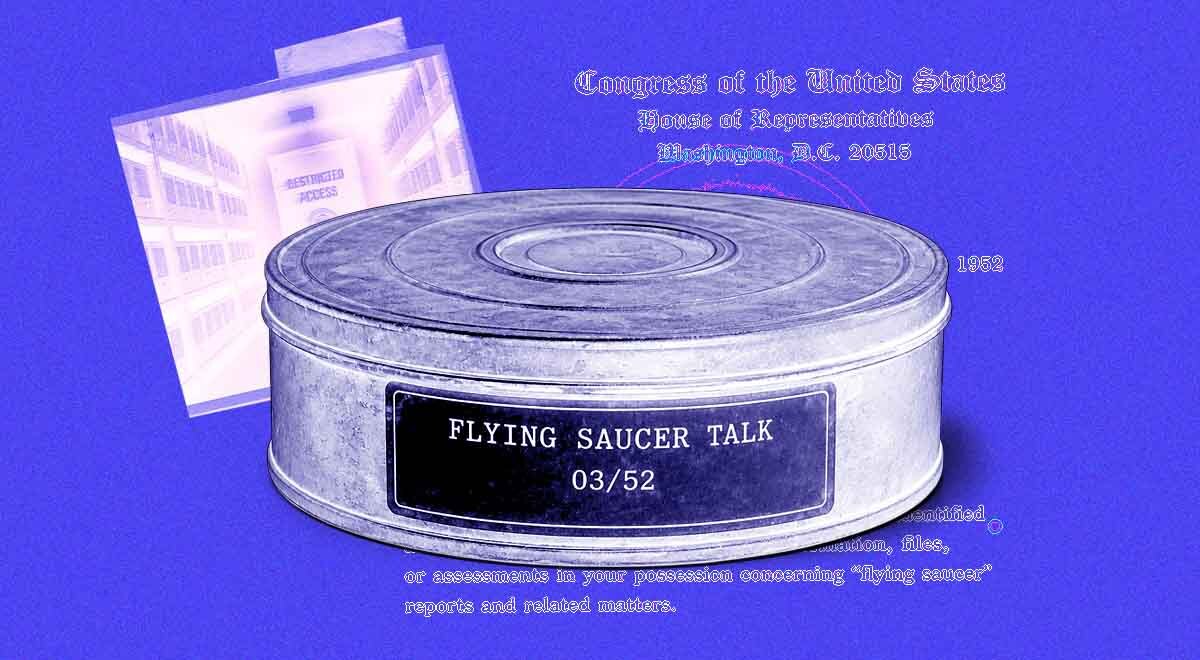
"Flying saucer talk." Image by Cybernews.

 Follow us
Congressman Eric Burlison has taken to X to reveal that MIT’s Lincoln Laboratory has agreed to disclose a historical UFO video from 1952, commonly known as a “flying saucer talk.”
- Congressman Eric Burlison says MIT Lincoln Laboratory has agreed to hand over a long-sought 1952 UFO briefing video to Congress.
- The footage reportedly shows Project Blue Book director Edward Ruppelt briefing top scientists and military officials on UFO investigations.
- Burlison says private contractors may be holding UFO-related information beyond the reach of public records requests and government scrutiny.
Key Takeaways by nexos.ai, reviewed by Cybernews staff.
Known technically as “AF-ATIC-FILM, 03/52,” the video was put in the spotlight on May 7th this year, when Burlison sent a formal congressional letter seeking the release of the Beacon Hill video briefing, a Cold War scientific advisory group addressed by a prominent Air Force officer.
On X, Burlison declared: "We told MIT Lincoln Labs we know the exact video file you are holding, by name, and we want it. They admitted it exists and agreed to turn it over."
Burlison said the lab had agreed to comply by handing over the material, though it was unclear whether a full or partial unveiling was on the cards.






We told MIT Lincoln Labs we know the exact video file you are holding, by name, and we want it.
undefined Eric Burlison (@EricBurlison) June 24, 2026
They admitted it exists and agreed to turn it over. That is what happens when you stop asking politely and start naming names.
What is the “flying saucer talk?”
From 1952 to 1969, the US Air Force ran a covert operation to determine whether UFOs posed a risk to national security by scientifically analyzing available details. The code name for this operation was “Project Blue Book.”
And as geopolitical tensions were peaking in and around 1952, project director Edward J. Ruppelt spent a large chunk of the time briefing military officials, scientists, and government researchers during one of the busiest years in UFO history.
The video that Burlison wants contains a significant briefing given by Ruppelt.
It occurred in March of that year, a few months before the famous UFO radar incidents in Washington, DC, that fueled national concern.
In 1956, when he released his book, The Report on Unidentified Flying Objects, Ruppelt described spending entire days briefing elite scientific groups about UFO reports and Air Force investigations, during which he narrowed the focus from 45,000 military sightings to 750 for Project Blue Book.
The contractor theory
Back in May, when Burlison sent the letter to the Lincoln Laboratory requesting the reel-to-reel recording, he also posted on X about his feelings toward institutional concealment.
“If you really want to hide something from Congress, you don't put it in a government file cabinet,” Burlison asserted, adding that “you hand it to a private contractor.”
If you really want to hide something from Congress, you don't put it in a government file cabinet. You hand it to a private contractor.
undefined Eric Burlison (@EricBurlison) May 14, 2026
That's why my investigation is following the trail into RAND, MITRE, Aerospace Corp, MIT Lincoln Labs, and the Northrop Grummans of the world. pic.twitter.com/gyayt6YuOB
Burlison's assertions align with whistleblower David Grusch’s view that sensitive UAP programs could be compartmentalized within contractor networks rather than within government agencies.
The private contractors Burlison mentioned can conceal information because they are exempt from the Freedom of Information Act (FOIA). Congress may well have the power to scrutinize the military, but much less so for private corporations.
Grusch was one of the first whistleblowers to proclaim that private corporations could be partial to reverse-engineering retrieved UFO craft, for commercial gain.
The UFO disclosure movement has picked up a lot of traction recently. Burlison and Grush, among others, appeared on Capitol Hill on June 8th, seeking out more transparent and robust efforts from all concerned in the process.





