FAA ends Northeast ground stops after 8-hour comms outage, Verizon backup cable cut
One failed circuit. One severed backup cable. Thousands of flights thrown into chaos.
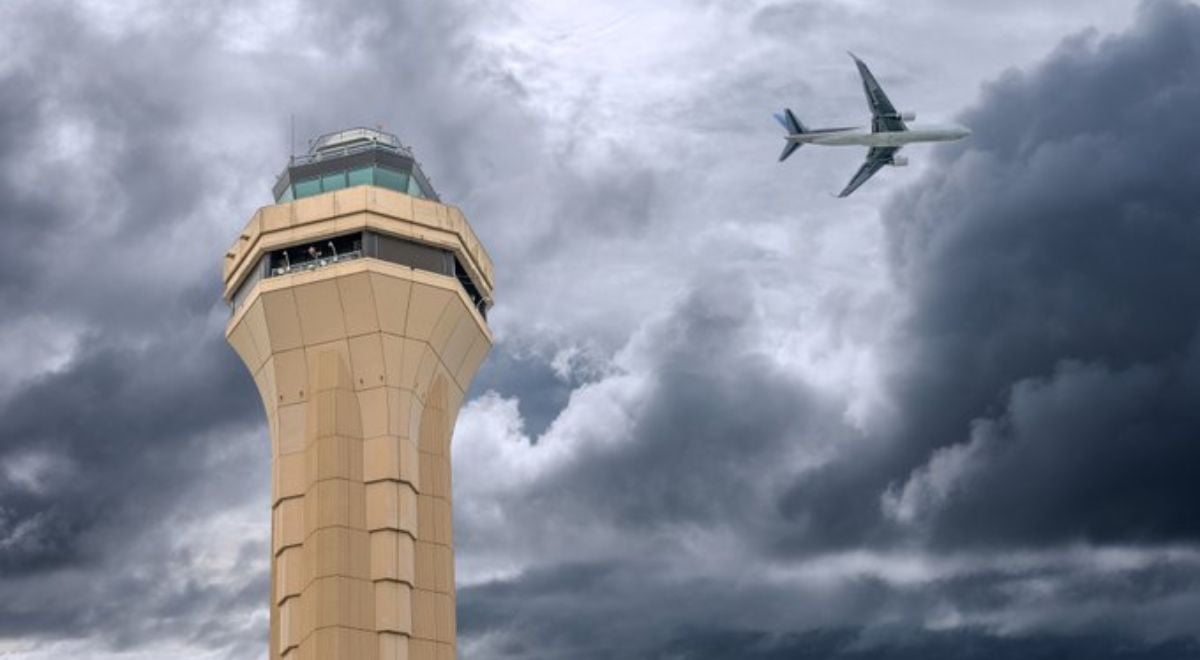
Image by the Federal Aviation Administration

 Follow us
- The FAA restored Northeast airport operations after rolling ground stops that lasted more than eight hours on Monday.
- More than 7,000 flights were delayed or canceled from Philadelphia to Boston, with disruptions reaching Europe.
- A primary FAA data circuit failed, and the backup Verizon fiber cable was accidentally cut.
- Verizon said New Jersey Transit contractors cut the cable near an Amtrak rail line.
A perfect storm for travel mayhem hits the Northeast on Monday after the FAA loses communications with air traffic control due to technical issues and, at the same time, construction crews cut a Verizon fiber cable handling the FAA's backup communications system.
At 6:00 p.m. Monday, US Transportation Secretary Sean Duffy took to X, announcing that the more than 8-hour Federal Aviation Administration (FAA) telecom outage – which forced the agency to pause flights in the Northeast – was officially over.
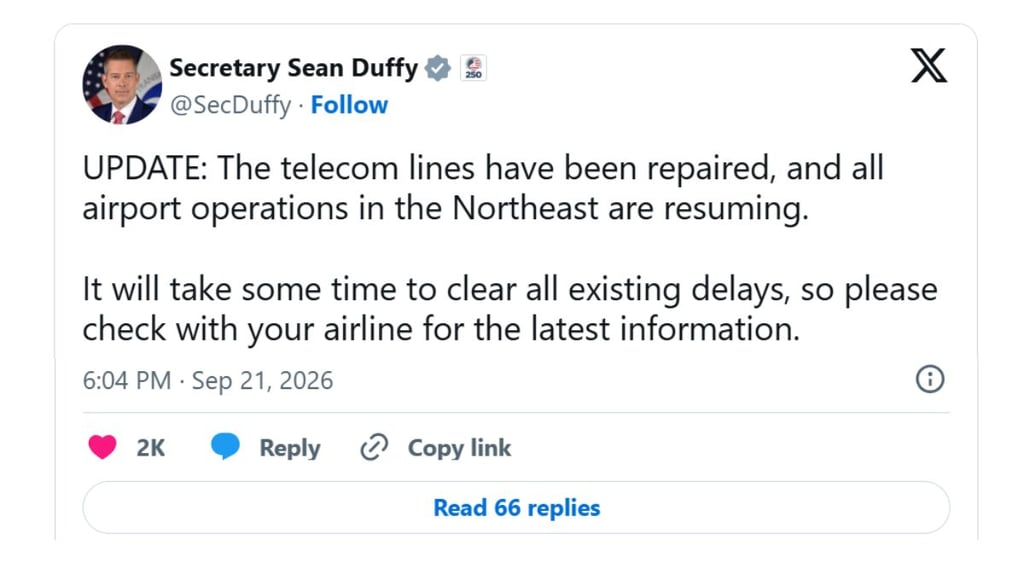
"The telecom lines have been repaired, and all airport operations in the Northeast are resuming. It will take some time to clear all existing delays, so please check with your airline for the latest information," Duffy posted.




More than 7,000 flights nationwide – including 1,400 alone between JFK, LaGuardia, and Newark – were delayed or canceled throughout Monday as the FAA issued rolling ground stops at five major airports across the Northeast corridor starting around 9:45 a.m.
Affected airports included:
- Philadelphia International Airport (Pennsylvania)
- Newark Liberty International Airport (New Jersey)
- Teterboro Airport (New Jersey)
- John F. Kennedy International Airport (New York)
- LaGuardia Airport (New York)
- Westchester County Airport (New York)
- Boston Logan International Airport (Massachusetts)
Primary fails, backup cable already cut
It all started when a primary data circuit failed at the FAA's Philadelphia Terminal Radar Approach Control (TRACON) facility, disrupting telecommunications used to manage aircraft across the Northeast.
In case of an outage, an FAA backup connection is designed to kick in, rerouting traffic through a second fiber-optic cable to compensate for any loss.
But the FAA soon learned that the secondary, Verizon-owned cable had been severed by construction crews in New Jersey.
“This is one of the old L3 Verizon circuits that’s part of our obsolescence replacement plan.FAA administrator Bryan Bedford told reporters at a press conference Monday afternoon.
“Unfortunately, that circuit failed today, and when it went to flip into the back-up, we discovered that the back-up fiber had a break.
The FAA head – who stressed that the FAA would not restart incoming traffic “until we make sure the airspace is safe” – had also said the "massive" fiber break would take an estimated 13 hours to repair, with the fix coming in about four hours ahead of schedule.
After some confusion about who actually cut the cable (the Transportation Secretary first blamed Amtrak), it turns out New Jersey Transit (NJT) was the responsible party.
Apparently, a NJT construction crew, working near an Amtrak rail line, was the one who “dug up and cut our cable,” Verizon said.
The telecommunications giant was quick to put out their own statement refuting Duffy's claims.
"We have a fiber cable running adjacent to an Amtrak rail line in New Jersey. Construction contractors working in the area dug up and cut our cable. Verizon’s facilities were fully functional up to that point. Verizon bears no responsibility for this incident," it said.
Newark takes the biggest hit, EU airlines give up
Although Philadelphia was the first ground stop, the sheer volume of inbound and outbound flights at Newark Airport is what set off a chain reaction, not just across the US, but internationally.
According to Flightradar24, “No commercial flights landed at Newark from 9:38 a.m. to 5:22 p.m.” – nearly eight hours.
By 5:30 p.m., 107 Newark-bound flights had diverted to 34 airports, subsequently affecting 25 airlines.
United Airlines was hit hardest with 70 diversions, while Dulles International Airport in Virginia – the primary gateway for Washington, DC – took in 19 diverted flights, while JFK took 12.
And over in Europe, the news was not much better.
Lufthansa and Swiss International Air Lines simply chose to cancel Atlantic crossings to Newark altogether while the outage continued, with pilots turning US-bound planes around mid-flight.
Even United reportedly canceled all remaining domestic Newark flights for the rest of Monday to prioritize international departures.
Meanwhile, in an ironic twist, the FAA rolled out its first trial of a new $875 million AI system that is supposed to “reduce delays & cancellations for the traveling public."
The SMART system – aka Strategic Management of Airspace, Routes, and Trajectories – is said to monitor factors such as weather, airline schedules, airport capacity, and airspace constraints to predict traffic flows and identify issues before they occur.
Besides delays, the AI system is also expected to reduce stress on air traffic controllers and lower travel prices, the FAA said.




Stay updated with our latest stories and follow us on social media
Be the first to discover new stories, ideas, and updates from our team.