How Trading Costs Quietly Reduce Profits (and What Traders Can Do)
 Follow us
Trading success is often associated with strategy, timing, and risk management. However, trading costs play a larger role than many traders realize. According to several industry estimates, spreads, commissions, and financing fees can account for up to 15–20% of a retail trader’s potential returns over time.
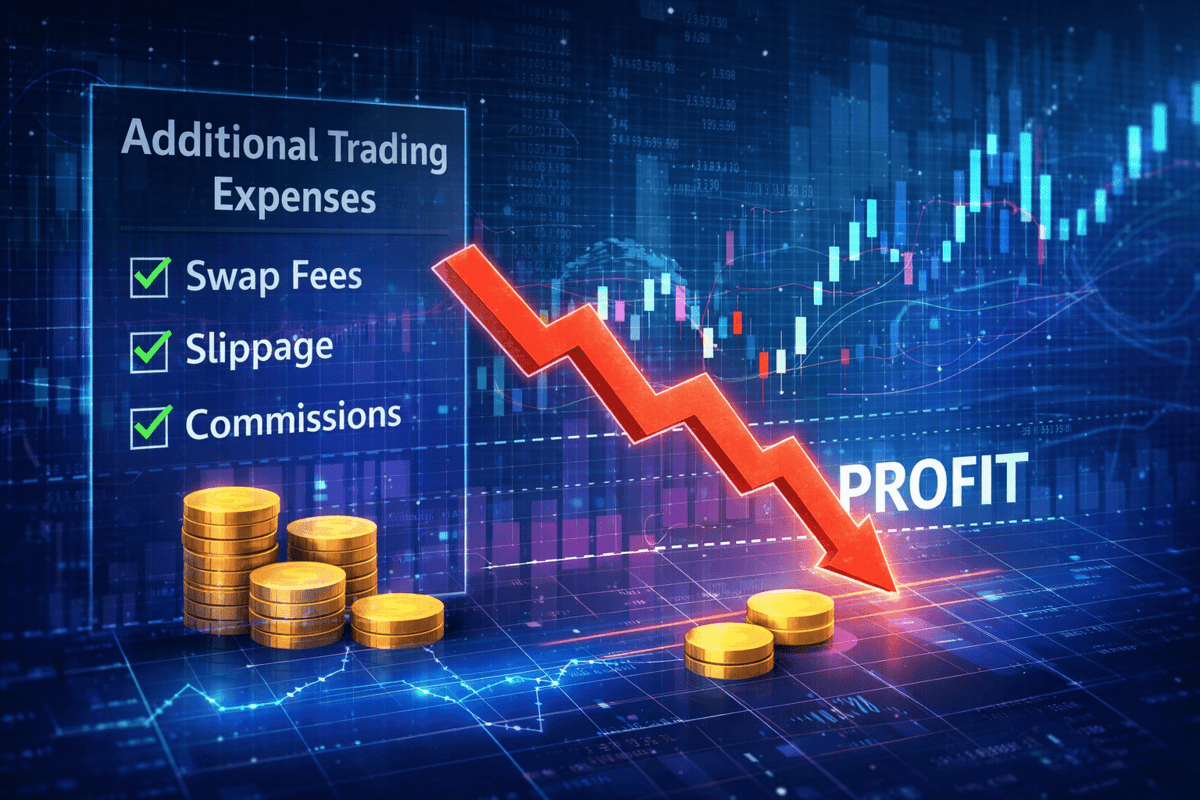
Individually, these expenses may appear small. Over hundreds of trades, however, spreads, swap fees, slippage, and execution conditions can gradually reduce overall profitability.
For active traders, the cumulative effect can become significant.
The real cost of a trade
Many traders focus primarily on the spread when estimating costs.
If EUR/USD shows a spread of 1.2 pips, it is easy to assume that this represents the full cost of entering the market. In reality, trading expenses often involve several additional factors.
Swap rates – These apply when positions remain open overnight. While day traders may rarely notice them, swing traders holding positions for several days can accumulate noticeable financing charges.
Slippage – During volatile market conditions, trades may execute at prices slightly different from those displayed on the screen. Small differences may appear insignificant, but can affect results when repeated frequently.
Leverage – Higher leverage increases market exposure but reduces the margin buffer available to absorb temporary market fluctuations.
Together, these elements form the real cost structure behind every trade.
Why execution models matter
The broker’s execution model can also affect trading outcomes.
Some brokers operate under a market maker model, where trades may be internalized within the broker’s system. In this structure, the broker can effectively become the counterparty to client positions.
Many market makers operate transparently, but this setup can sometimes lead traders to question execution fairness during volatile conditions.
Alternatively, brokers using Straight Through Processing (STP) or Electronic Communication Network (ECN) models route orders directly to liquidity providers.
In these environments, execution is typically driven by market liquidity rather than internal dealing processes. As a result, order fills can become more consistent, particularly during active market periods.
Matching broker conditions to trading style
Trading strategies vary widely, and broker conditions that work for one trader may not suit another.
Scalpers, for example, rely heavily on fast execution and tight spreads because their trades often last only seconds or minutes.
Swing traders, who hold positions for several days or longer, tend to pay closer attention to swap rates and overnight costs.
Some brokers offer swap-free accounts, which eliminate overnight financing fees entirely. These accounts can be useful for traders who prefer longer holding periods.
Market access can also play a role. Traders who move between forex, indices, or commodities may benefit from platforms that provide multiple asset classes within a single trading environment.
Choosing the right trading environment
Because trading costs involve multiple elements, comparing brokers based on spreads alone rarely provides the full picture.
A more practical approach is to evaluate the overall trading environment, including execution quality, financing costs, platform reliability, and regulatory oversight.
Testing demo accounts during active market hours can provide insight into execution conditions before committing real funds. Starting with smaller live positions can also help confirm that real trading matches expectations.
A shift toward cost transparency
As traders become more aware of hidden costs, some brokers have begun focusing on simplified pricing structures.
One example is RYOEX, which operates using a no-dealing-desk model that routes orders directly to liquidity providers. The broker also offers swap-free accounts designed to remove overnight financing charges.
For traders who regularly hold positions beyond a single trading session, this structure can help reduce one of the more persistent trading expenses.
Final thoughts
Trading profitability depends on many variables, including strategy and risk management. However, the structure of trading costs can also influence long-term results.
Understanding how spreads, execution conditions, and financing fees interact can help traders select platforms that better support their trading approach — and ultimately keep more of the returns their strategies generate.