Seedance 2.0 Explained: How ByteDance’s Next-Gen AI Video Model Signals a Shift in Generative Video
 Follow us
ByteDance is advancing its generative AI ecosystem with the release of Seedance 2.0, the latest iteration of its Seed video generation model. As AI video moves beyond experimental clips toward practical production workflows, this update reflects a broader industry transition — from visual novelty to structural reliability.
Over the past year, competition in generative video has intensified. The conversation is no longer centered on whether AI can produce video, but whether it can generate footage that remains coherent, controllable, and usable across longer sequences. Seedance 2.0 appears to focus squarely on these challenges.
From Seedance 1.5 to 2.0: What Has Actually Changed?
Seedance 1.5 introduced improved motion realism compared to earlier versions, yet it still faced limitations in extended sequences. Subject identity drift, inconsistent lighting, and unstable camera simulation were occasional constraints, particularly in multi-second narrative clips.
Seedance 2.0 addresses these issues through architectural refinements aimed at temporal stability and multimodal reasoning.
Reported Enhancements in Seedance 2.0
- Stronger temporal coherence to reduce frame jitter and object morphing
- More consistent subject identity across longer sequences
- Improved camera movement simulation (panning, tracking, zoom transitions)
- Higher detail stability and improved rendering fidelity
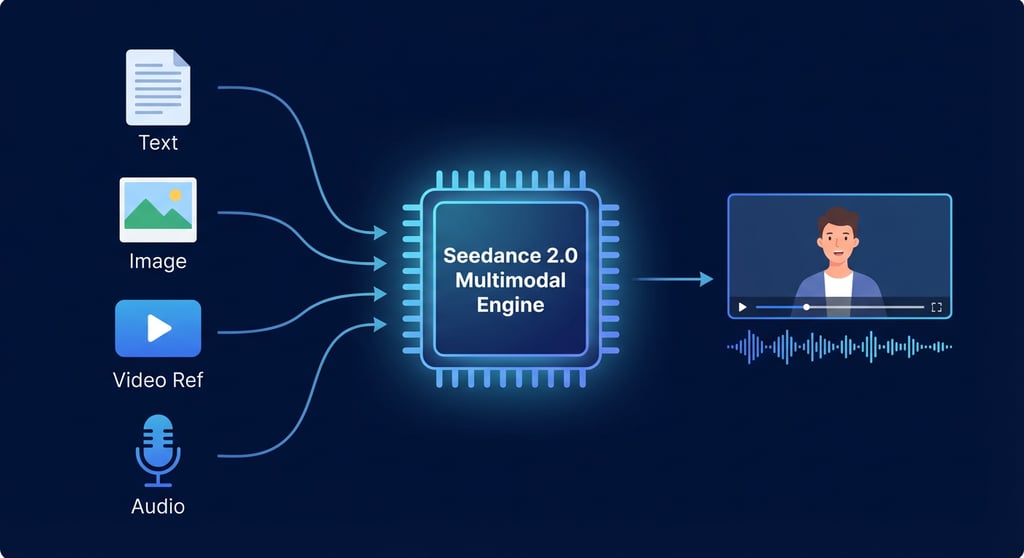
- Multimodal input support (text, images, video references, and audio)
- Native synchronized audio generation with lip-sync capability
For those interested in hands-on experimentation, Seedance 2.0 is already accessible through Piclumen, which provides a practical interface layer for interacting with the model. Rather than functioning as a foundational model developer, Piclumen serves as a deployment channel that lowers technical barriers and enables creators to test multimodal workflows more directly.
According to official ByteDance documentation, Seedance 2.0 video generator supports the integration of multiple visual and audio inputs simultaneously, enabling what is described as “all-round reference” generation. The system interprets semantic relationships across modalities to guide scene structure and motion consistency.
Technical Comparison: Seedance 1.5 vs Seedance 2.0
To contextualize the update, the following table outlines key capability differences based on publicly available information:
| Feature | Seedance 1.5 | Seedance 2.0 |
| Temporal Coherence | Moderate motion stability | Enhanced long-sequence continuity with reduced frame inconsistency |
| Resolution | Up to 1080p HD | Higher-fidelity rendering with improved cinematic detail |
| Multimodal Inputs | Text + limited image guidance | Text + multiple images + video clips + audio references |
| Audio Generation | Limited or external workflow | Native stereo audio generation with synchronized lip-sync |
| Scene Control | Basic motion interpretation | More precise prompt-to-motion translation and camera logic |
| Editing & Continuation | Static clip generation | Directed editing and video extension capabilities |
| Pipeline Efficiency | Standard generation workflow | Optimized generation pipeline with reported performance gains |
While Seedance 1.5 focused on improving visual plausibility, version 2.0 appears designed to strengthen controllability and workflow integration.
Why Temporal Stability Is a Meaningful Advancement
One of the most persistent weaknesses in early AI video systems was not frame quality but continuity. Individual frames could appear impressive, yet subtle distortions accumulated across time:
- Objects subtly reshaping mid-motion
- Lighting inconsistencies between frames
- Physically implausible movement paths
These issues stem from the complexity of predicting sequences over time. Video generation requires not just spatial modeling but temporal alignment — a far more computationally demanding challenge.
Seedance 2.0’s reported improvements in temporal modeling and semantic alignment suggest a move toward more disciplined motion synthesis. The integration of synchronized audio further signals a shift toward complete media outputs rather than silent visual demonstrations.
The Broader Evolution of AI Video Generators
The emergence of Seedance 2.0 reflects a broader maturation phase within the AI video generator landscape.
Early-stage systems prioritized:
- Short-form experimentation
- Stylized aesthetics
- Visual novelty
The current trajectory emphasizes:
- Multi-second narrative continuity
- Scene-level coherence
- Audio-visual synchronization
- Fine-grained control and editing
- Workflow compatibility
In other words, the central question has evolved from “Can AI generate video?” to “Can AI generate usable, controllable video?”
Importantly, this shift does not imply replacement of creative professionals. AI video systems increasingly function as ideation engines, pre-visualization tools, and rapid prototyping platforms. Much like digital photography expanded production possibilities without eliminating photographers, generative video appears poised to augment rather than displace traditional workflows.
Looking Ahead
Seedance 2.0 represents a maturation step rather than a radical reinvention. Its emphasis on motion stability, multimodal integration, and controllable generation suggests that AI video development is entering a refinement phase.
Future directions in AI video generation are likely to include:
- Cross-scene narrative memory
- Near real-time generation pipelines
- Enhanced physics simulation
- Seamless integration with editing ecosystems
- Personalized motion and style tuning
As generative video models continue to evolve, their long-term impact will depend less on novelty and more on reliability and creative control.
If early AI video demonstrated possibility, the current phase is testing practicality. Seedance 2.0 may well represent an early signal that the industry is moving toward production-ready generative media systems.