Why the Internet isn’t the same for everyone?
 Follow us
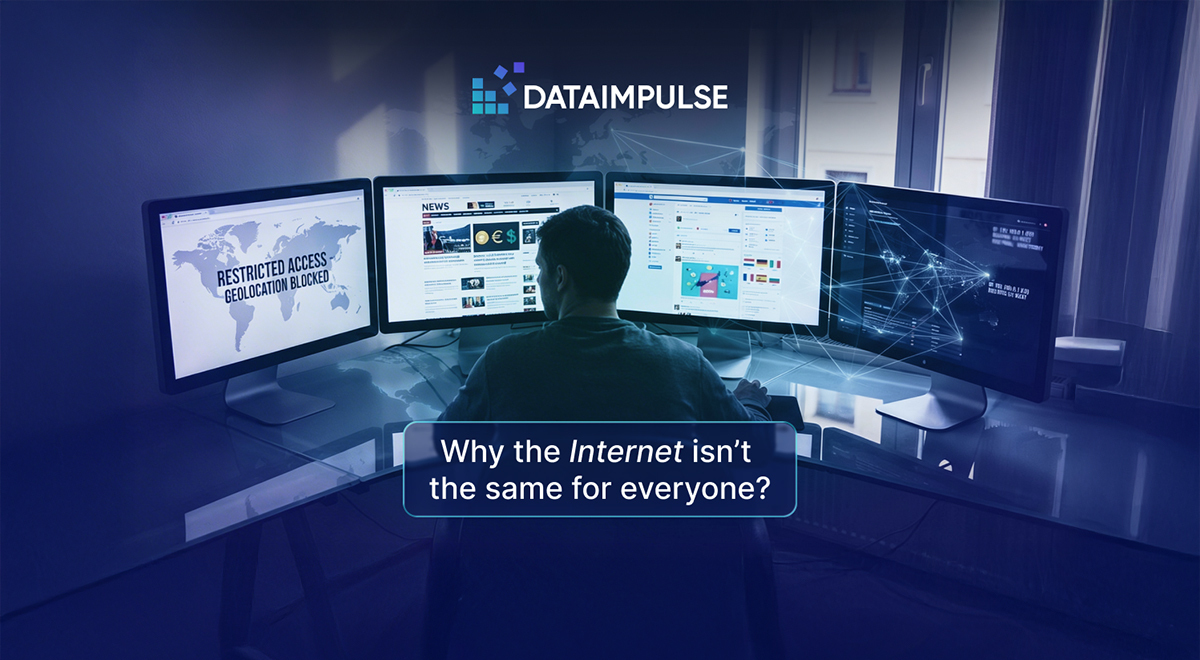
One of the top digital marketing trends in 2026 is the relevance of data. Companies try to conduct regional research and show users content that feels local and personalized. Many websites are usually translated and keep the same information for every user, no matter where they are. But some take it further, changing data depending on location and target audience. Less good options, filtered results may seem unfair. In some cases, access to content can be limited.
Being aware of the mechanisms behind the World Wide Web is the first step to understanding why it happens. Keep reading.
The Internet knows your location, how?
The system doesn’t see a physical location directly. It figures it out based on clues and data. The most typical way this happens is through the user’s IP address, assigned by the Internet Service Provider. When users connect to a website, the device sends the IP along with the main request. Sites compare it against huge geolocation databases that can map IP ranges to countries and regions. The data is usually accurate at a country level. The more precise the information, the harder it is to find.
Web pages don’t focus only on IP-based geolocation. They refine this initial assumption using a combination of additional signals for a more accurate result. These may involve details such as device language, time zone, browser settings, and previous habits. On mobile devices, GPS can also contribute to this process. With such details, even if the exact physical position was never shared, platforms narrow down users’ locations.
IP-based content personalization
To make personalization a part of their approach, many platforms use tracking technologies and data sources. Cookies and scripts are the common ones. If you’ve ever made a purchase on Amazon or similar apps, the interaction doesn’t simply fade away. The system remembers what products you looked at or bought later, and how long you stayed, so the next time you can see analogous offers. Websites also pick up information about your device and operating system. Even your screen size or language settings may be exposed. These details form a so-called device fingerprint.
One of the key signals is still the IP address. It can immediately show a place where a user is connecting from. Based on this, platforms localize content, adjusting language, currency, promos, or even product availability. On Amazon, as an example, the same item may be promoted differently depending on the user’s location. A customer in the US could see discounted shipping and region-specific recommendations, while a client in the UK could notice other prices and suggested products for the locals.
Heavy content localizations can create uneven access, and sometimes users from one market unintentionally compete with or replace traffic from another. It is a phenomenon called cross-market traffic cannibalization and occurs when the search engine chooses the page it considers most relevant for the user’s query and intent. The reasons are duplicate content, incorrect hreflang tags, and insufficient localization for language and culture. Businesses can fix this by applying hreflang tags, running SEO audits, properly localizing, and geotargeting.
Geo-blocks and the ‘gray zone’
Governments like China and India limit access to global data due to their local policies. Certain news sites or social media apps may be partially or completely blocked, while other content is curated to obey the rules. These restrictions are often driven by legal or licensing requirements, but users may feel frustrated when trying to access information that is publicly available elsewhere. The ‘gray zone’ is visible when location-based personalization, though justified by legal or business reasons, leaves users unclear about where the boundaries lie. It’s also important to look at how people respond to these limitations. Tech-savvy users often turn to tools that change their current location, but then the question of compliance with laws and terms of service arises.
Why do inaccuracies happen?
Errors in location-based content happen because of constraints of geolocation systems. They lean on enormous databases to map IP addresses to regions, but these aren’t always up to date. IPs can be reassigned, masked, or routed through corporate networks. Dynamic IPs and proxy networks can even map multiple users to a single location.
Platforms combine IP data with other key signals. If they are incomplete, systems have to make the best guess using probabilistic models. Even advanced algorithms can’t guarantee perfect accuracy, so gaps between assumed and actual user location are inevitable.
Change what the Internet shows you
Altering geographic signals can help you access a different version of the same website. If you change your apparent location, you’ll be able to see various search results and prices. Another important step is to clear cookies, use private browsing sessions, visit a site without logging into your personal account, and switch language settings. These actions may decrease the effect of prior interactions.
An additional tool, like proxies, can be worth considering in this case. DataImpulse has its own pool of ethical IPs and presents coverage for 195 countries. With proxies, users can modify location signals, stay anonymous during browsing, route their connection through different regions, and scrape the data they need.