Why Your Hosting Provider Is the Most Overlooked Link in Your Supply Chain Security in 2026
 Follow us
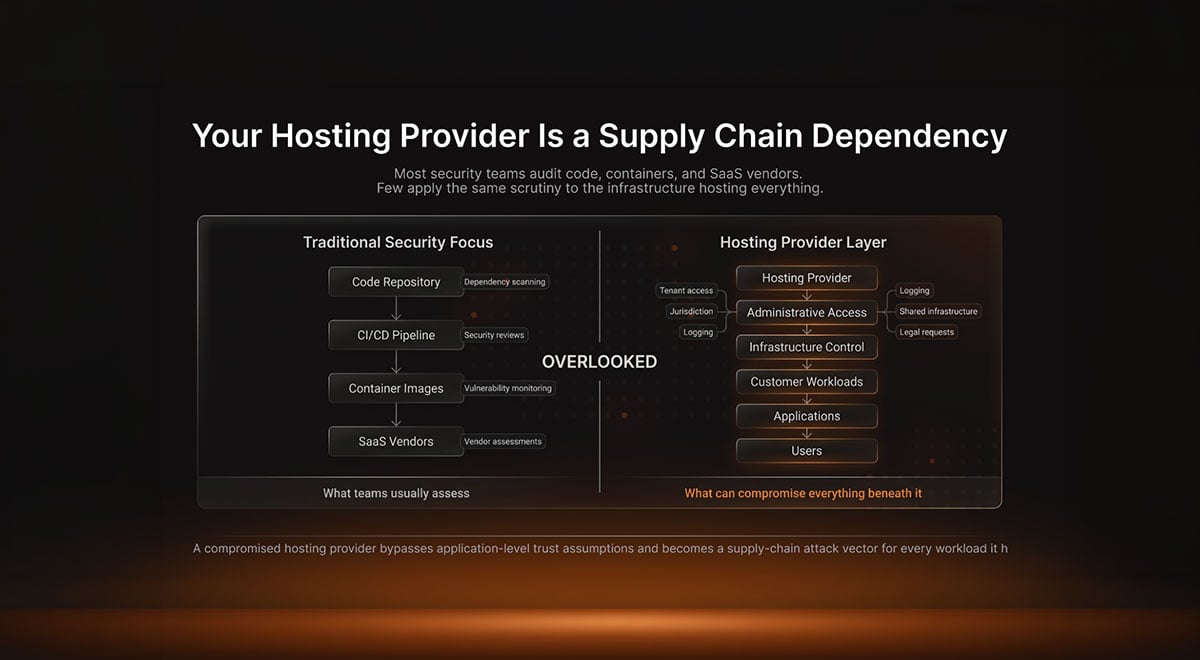
Security teams audit npm dependencies. They scan container images. They monitor CI/CD pipelines and review SaaS vendors. One layer almost nobody audits with the same rigor: the hosting provider. That gap stopped being theoretical in February 2026, when Notepad++ confirmed a likely China-sponsored actor had spent months inside its hosting provider, picking off select customers through tampered software updates. The compromise didn't start with malicious code. It didn't start with a poisoned package. It started with the hosting layer itself.
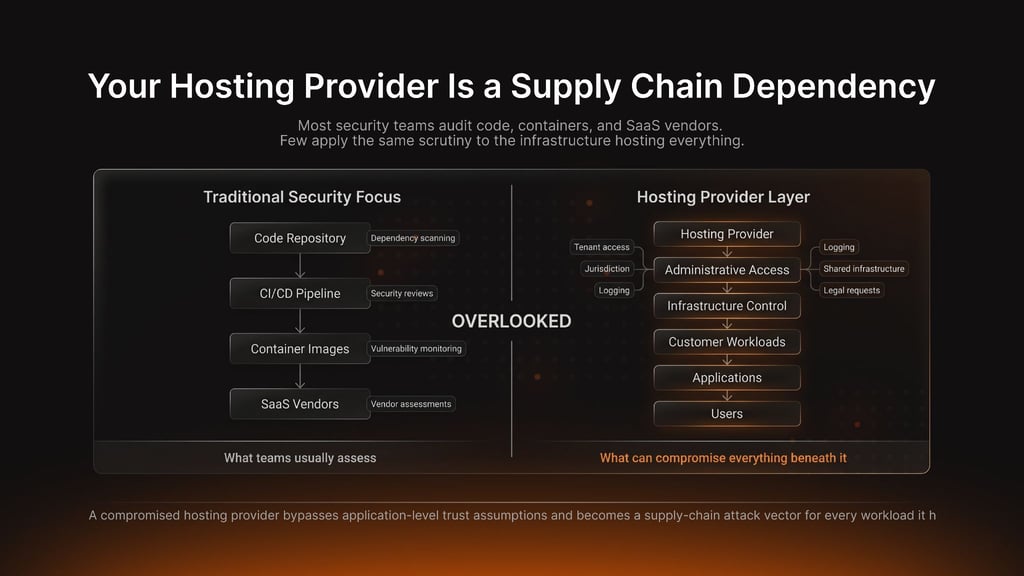
The hosting provider is a supply chain dependency. Most threat models still treat it as a utility.
The hidden link in your supply chain
Supply chain frameworks like SOC 2 CC9.2 and ISO 27001 A5.19 cover supplier risk. Yet hosting providers fall into a procurement category, not a security one. They're scored on price, SLA, and features. The questions that actually matter for a tier-1 supply chain dependency? Those rarely come up. Who has administrative access to your tenant? What's the provider's response policy when a foreign legal demand lands? What logs does the provider keep? Who else is on the same hardware?
These are the same questions teams ask SaaS vendors all the time. The difference: hosting compromise is more catastrophic. The attacker walks into the platform running your entire stack.
What to look for in a supply-chain-aware hosting provider
Providers built around hosting-layer supply chain risk share a recognizable pattern. Independent legal jurisdiction, outside foreign compulsion. No shared administrative access between tenants. Documented no-logs operation. Encrypted storage where provider compromise doesn't grant data access. A published policy for handling legal demands, written down rather than handled case-by-case.
Providers like PrivateAlps have built their infrastructure around exactly these vectors. Switzerland-based jurisdiction. Isolated tenants. No-logs operation. Encrypted storage. Explicit policies for refusing cross-border legal demands by default. This category doesn't compete on managed service breadth. It offers a hosting layer designed not to become a supply chain compromise point.
Real 2026 attack data
The case for treating hosting as supply chain isn't speculative. The first months of 2026 made it real.
In December 2025, Notepad++ disclosed that some customers had received malicious software updates. By February 2026, maintainers confirmed the cause: their shared hosting provider had been compromised by a China-linked actor (Lotus Blossom, per Rapid7) with access running from June through December 2025. The targets weren't random. A government organization in the Philippines. A financial institution in El Salvador. An IT service provider in Vietnam. Plus individuals scattered across several countries.
In April 2026, Vercel disclosed a breach traced back to a compromised OAuth integration with Context.ai. The attack chain showed how OAuth trust between hosting platforms and third-party tools opens lateral movement paths that quietly bypass perimeter defenses. Stolen Vercel data - internal database, API keys, npm and GitHub tokens - was later listed for $2 million on BreachForums.
In March 2026, the LiteLLM PyPI package was compromised through stolen CI/CD credentials from Trivy. The malicious package harvested AWS, GCP, and Azure tokens. SSH keys. Kubernetes secrets. All of it sitting on the same machines that run npm install and pip install every day.
Kaspersky telemetry tells the same story. Roughly 19,500 malicious packages discovered in open-source projects by the end of 2025 - a 37 percent year-over-year jump. IBM X-Force tracks a nearly fourfold increase in large supply chain compromises since 2020.
The four hosting-layer attack vectors
Hosting-related supply chain compromise falls into four categories. None of them need a vulnerability in your application code.
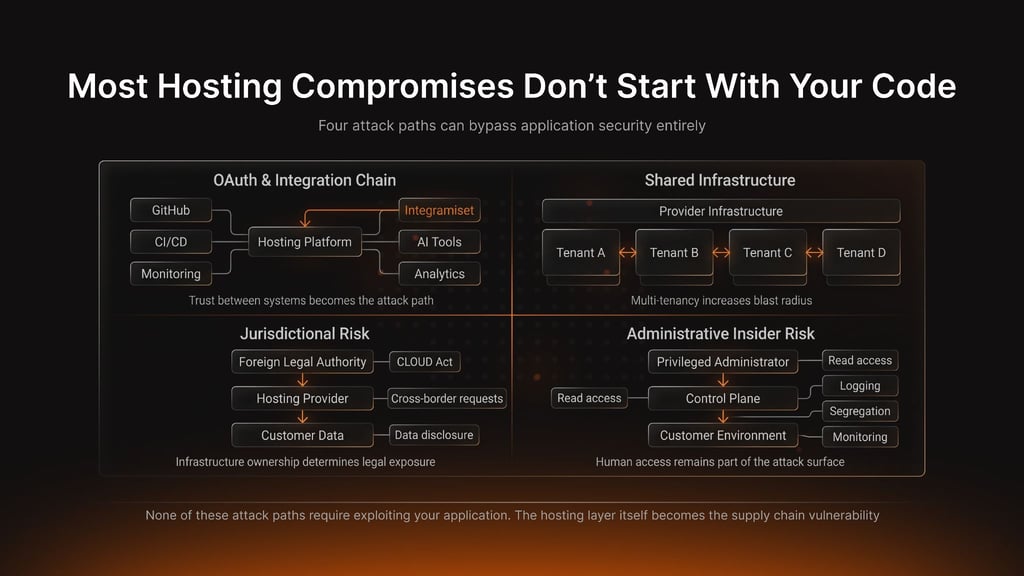
OAuth and integration chain compromise. Modern hosting platforms expose dozens of OAuth integrations. One compromised integration cascades across customers, as the Vercel–Context.ai incident showed.
Shared infrastructure compromise. Multi-tenant hosting concentrates blast radius. When one tenant or the provider itself is compromised, lateral movement to other tenants is structurally easier than the marketing copy admits.
Jurisdictional legal compulsion. If the provider's parent company is incorporated where laws permit compelled disclosure - the US CLOUD Act being the most consequential example - that compulsion gets exercised through the hosting provider. Where the servers physically sit doesn't change the answer.
Administrative insider risk. Provider employees with privileged access are themselves a supply chain attack surface. Few customers ever audit how their hosting provider screens, monitors, or segregates administrative personnel.
Why hyperscaler scale doesn't solve this
The instinct is to assume the biggest hosting providers are the safest. The 2026 data complicates that view. Hyperscaler scale doesn't reduce supply chain blast radius. It amplifies it. The customers most likely to see a CLOUD Act disclosure order sit on the largest US providers. The platforms most attractive to OAuth chain attackers have the most integrations. The administrative risk surface is biggest where the administrative population is biggest.
This isn't an argument against hyperscalers for every workload. It's an argument against the assumption that scale alone equals supply chain safety.
Practical questions to ask your current provider
Before next month's vendor risk review, run these five questions past your current hosting provider:
- Under whose jurisdiction can your data be legally compelled, and what's the documented response procedure?
- Who inside the provider organization has administrative read access to your tenant, and how is that access logged?
- What operational telemetry about your workloads does the provider keep, where is it stored, and for how long?
- What's the documented OAuth scope and revocation process for every third-party integration with your tenant?
- What's the documented data exit procedure if you needed to leave tomorrow?
If the answers come back vague, templated, or routed through sales - the hosting layer is already a supply chain risk you're not managing.
The outlook
Supply chain attacks won't slow in 2026. One hosting provider compromise cascades into thousands of customers. Regulators are catching up. The EU Cyber Resilience Act requires manufacturers to begin reporting actively exploited vulnerabilities from September 11, 2026. The NSA's March 2026 guidance pulls digital supply chain AI risks across internal teams and external providers into the same frame.
The security teams that ride out the next wave aren't the ones running the most sophisticated detection tools. They're the ones already treating their hosting provider as the supply chain dependency it actually is - and choosing accordingly.