Nearly half of young Europeans turn to AI for mental health support, experts urge caution
According to a new study, a growing number of young Europeans are turning to artificial intelligence (AI) tools for mental health issues. Experts say this isn’t without risks for their well-being and privacy.

Image by Cybernews

 Follow us
According to a new study, a growing number of young Europeans are turning to artificial intelligence (AI) tools for mental health issues. Experts say this isn’t without risks for their well-being and privacy.
- Nearly half of young Europeans (11-25) use AI chatbots for mental health support during emotional stress or anxiety.
- Most young users trust AI, 69% believe it offers reliable advice and 56% think it keeps secrets.
- Experts warn AI may provide harmful advice and increase dependency while reducing real social interactions.
Key Takeaways by nexos.ai, reviewed by Cybernews staff.
A survey by the VYV Group and the CNIL, conducted among 3,800 young people aged 11 to 25 in France, Germany, Ireland, and Sweden, suggests that nearly half of young Europeans rely on AI chatbots when they’re experiencing emotional stress or anxiety.
To them, AI is an accessible conversation partner available at any time that offers means for personal reflection and unbiased advice.
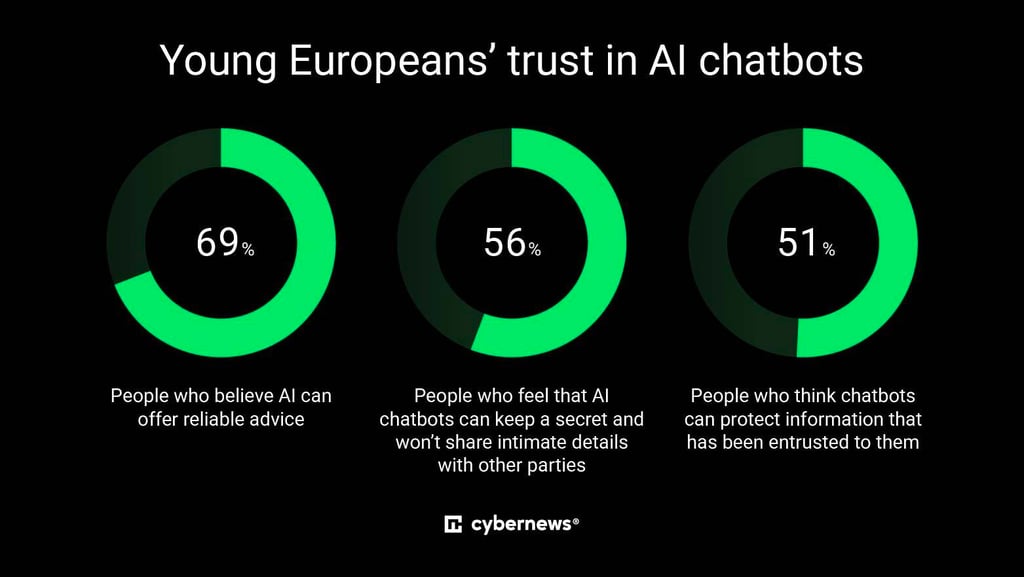
In total, 69% of young people believe that AI can offer reliable advice. Well over half (56%) feel that AI chatbots can keep a secret and won’t share intimate details with other parties. And 51% think that chatbots can protect information that has been entrusted to them.






However, AI tools aren’t designed to offer professional mental healthcare and may even deliver inaccurate, overly simplistic, or even harmful advice, experts say. On top of that, users could become overly dependent on these tools and waive real-life social interactions altogether.
The CNIL, France’s privacy and data protection authority (DPA), argues that the rise of conversational AI for mental health issues brings new challenges to preserving our privacy.
“Conversational AIs collect personal data, sometimes sensitive, without us always being aware of it. It is urgent to explain to young people how these systems work, what traces they leave, and what their rights are. Transparency is essential to enable them to make informed choices and keep in mind that AI systems are just tools: machines and not humans,” Marie-Laure Denis, President of the CNIL, says in a statement.
According to the VYV Group and the CNIL, as conversational AI continues to evolve, the challenge will be balancing innovation with responsibility. The goal is to ensure that digital mental health support does not come at the cost of our well-being or privacy.
Unlock more exclusive Cybernews content on YouTube.