Credifence review: protecting your cards with smart RFID blocking


Imagine noticing a credit card charge you definitely didn’t make. Your wallet is still in your pocket, all your cards are there, and you haven’t tapped your phone or card to pay for anything. Then you recall that brief moment on the subway when someone brushed past you. Sometimes, that’s all it takes.
While this might sound like a rare scenario, electronic pickpocketing, often called RFID skimming or wireless theft, happens more often than many people realize. The good news is that there are ways to reduce the risk, including using RFID/NFC blocking tools like Credifence.
Because I travel frequently and spend a lot of time in crowded places, these kinds of scams are always on my radar. That’s why I teamed up with the Cybernews team to take a closer look at Credifence and find out whether it’s actually worth carrying in your wallet.
Quick overview of Credifence
Before I move on with this Credifence review, let’s first take a look at the basics:
| Brand | Credifence |
| Product | RFID/NFC card protector |
| Overall rating | 4.2/5 ⭐ |
| Description | Credifence is a card protector that blocks RFID skimmers and NFC scanners, preventing them from reading data off any bank or ID cards in its vicinity |
| Key specs | CyberShield RFID-blocking technology, battery-free operation, app-free usage |
| Pricing | From $39.98 (for 2 cards) |
Our methodology
While the Cybernews team and I didn’t personally test the Credifence RFID/NFC blocking card, we did conduct a thorough review. We based our research on official spec sheets, real user reviews, and expert opinions, evaluating the product based on the following criteria:
- Technology and effectiveness (30%). We first examined the card’s blocking tech, making sure it can actually stop RFID skimmers and unauthorized NFC payments.
- Design and build (25%). Since the card will stay in your wallet, we also evaluated its size and build quality to ensure it’s both durable and convenient to carry around.
- Ease of use (20%). As a passive blocking card, Credifence is supposed to be simple to use, and that’s also something we gauged according to verified feedback.
- Price and value (15%). From there, we checked Credifence’s pricing and compared the cost of its blocking card with competing products to assess its value.
- User feedback (10%). Last up, we examined verified comments across multiple review platforms to see how Credifence’s users really felt about the blocking card.
What is Credifence, and how does it work?
To understand how Credifence works, we should briefly cover the history of RFID first.
While this kind of tech has been around for more than a century, it only became mainstream in the 1990s, when it was used in highway toll booths. By the early 2000s, RFID chips had been embedded in a wide range of cards, including bank cards, IDs, transit cards, and passports.
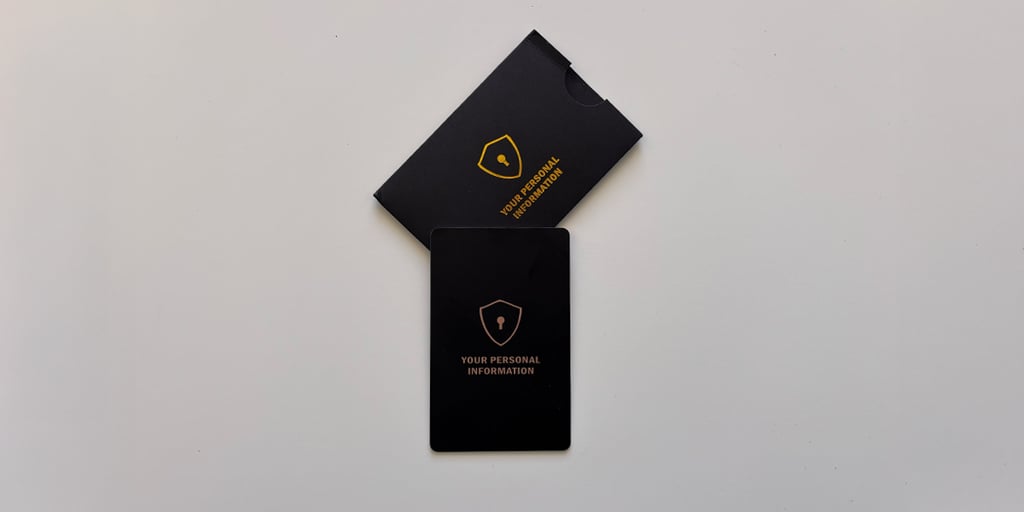
This also led to a rapid rise in RFID blockers, which sought to prevent unauthorized access to these important cards. And while most of these rely on materials like aluminum to block waves emitted by radio-frequency identification (RFID) readers, Credifence does it a bit differently.
The credit-card-sized protection device emits its own low-frequency signal that jams RFID scanners. And the best part? It does so without batteries, so you can use it for years without ever charging it.
Credifence technology
The Credifence RFID/NFC blocking card isn’t a ground-breaking invention. It’s a device that relies on a familiar idea of creating a barrier that prevents RFID skimmers from reading data from your cards. But it does handle things a bit differently from most passive RFID sleeves.
Unlike bulky sleeves, which block radio waves via specialized materials like carbon and aluminum, Credifence does so with its own signal. The compact protective card comes with a built-in microchip that automatically activates when it detects the 13.56MHz frequency used by RFID/NFC devices.
When that happens, Credifence starts emitting its own counter-signal that interferes with these radio waves. This effectively jams the RFID scanner’s signal within a two-inch radius of Credifence’s chip. As such, the card essentially protects data on all your other cards, including contactless bank cards, IDs, and passports.
Benefits of Credifence
The Credifence RFID/NFC card protector might look simple, but it offers a host of benefits, including:
- Data protection. Credifence actively blocks RFID skimmers and NFC scanners from accessing data on all your important cards in its vicinity.
- Convenience. The card protector requires zero setup, charging, or app connections. It simply blocks RFID/NFC signals as soon as you put it in your wallet.
- Durability. Although it’s just 1.1mm thick, the Credifence RFID/NFC blocking card is quite difficult to bend or break, and it’s water-resistant as well.
- Compact design. The card protector is also no bigger than your bank or ID cards, so you’ll have no problem fitting it in any wallet.
- Peace of mind. Credifence’s smart jamming technology makes commuting and traveling safer, as you’ll know no one can steal your info by bumping into you.
Credifence design and build quality
While the Credifence RFID/NFC card takes as much space as your standard credit or debit cards, it also feels much sturdier and more elegant.
As far as build quality is concerned, you’ll have nothing to worry about. The Credifence card is made from composite materials, which makes it pretty challenging to bend or break. A durable PVC coating is also present, with a frosted protective layer on top.
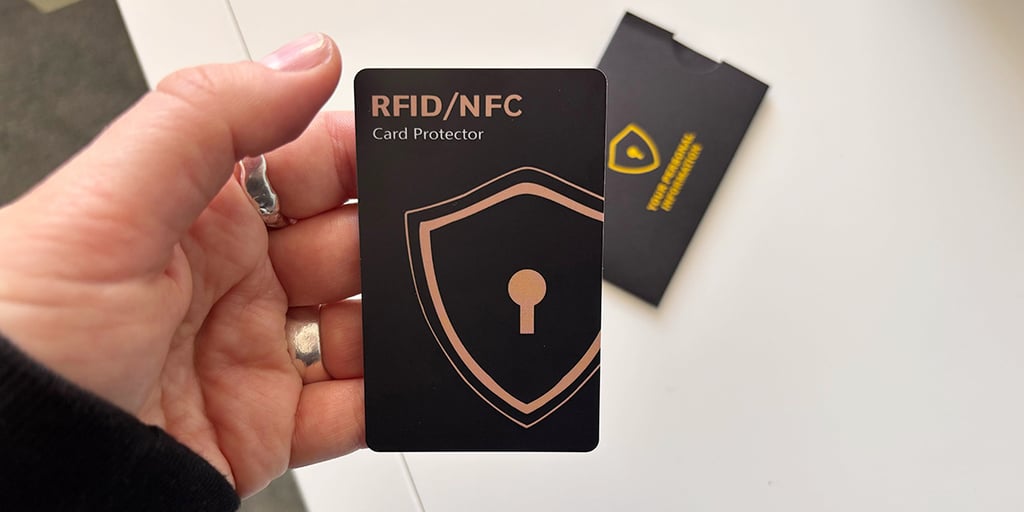
And at just 1.1mm, Credifence is also extremely thin. It’s quite light, too, weighing less than most RFID-enabled cards. Obviously, the brand behind it was going for that minimalist approach, so you won’t find much on it except the name and the logo.
Pair that with its simple yet elegant matte finish and black-and-gold color scheme, and the Credifence RFID/NFC card feels quite premium.
Key features of Credifence
Despite its simple operation and compact form factor, the Credifence card is jam-packed with features you may want to know more about:
- Active RFID/NFC blocking technology. Unlike most RFID sleeves that rely on passive signal blocking, Credifence uses a microchip that actively detects RFID/NFC radio waves in its vicinity and automatically responds with a counter-frequency.
- Battery-free operation. Although it contains a microchip, the Credifence card provides completely maintenance-free RFID/NFC signal jamming. There are no batteries to worry about here, nor any charging to be done.
- Slim wallet-friendly format. With a design that resembles most credit and debit cards, Credifence barely takes up any space. Pair that with its super slim body, and you’ll see how easy it is to fit the protector card into virtually any wallet pocket.
- Long-lasting materials. Despite its thin build, the Credifence RFID/NFC blocking card can last you a while. It uses composite materials that also make the card water- and tear-proof.
- Multi-card protection radius. While Credifence suggests adding up to 2 cards to your wallet, even a single one already emits a strong protection field that extends about 2 inches in all directions from the chip.
Credifence pricing and availability
If you’re ready to pull the trigger and protect your RFID-enabled cards from theft, the best way to get a Credifence protector is via the official website.
While you can’t buy a single Credifence RFID/NFC Protector Card, which is a drawback, you can get a pair of them or save even more by buying in bulk. Currently, 2 Credifence cards will run you $39.98 ($19.99 per card), plus $5.99 for shipping.
And if you go for a multi-pack deal to protect your entire family from electronic pickpocketing, you can get up to 10 cards for $139.50 ($13.95 per card). However, shipping costs an extra dollar in that case.
Regardless of the quantity, all purchases are covered by a 30-day money-back guarantee, so you can easily return the cards if you’re not satisfied.
Why RFID blocking matters
RFID chips in modern bank cards don’t just offer the convenience of tap-to-pay; they also introduce a host of vulnerabilities. All it takes is a tap with an RFID skimming device, and a thief can easily walk away with your credit or debit card info, as well as your ID or passport data.
This could happen on the subway, at an airport, or in any other crowded space where you’re unlikely to pay attention to someone lightly bumping into you. And while these in-person electronic pickpocketing schemes aren’t nearly as common as online identity theft and social engineering hacks, they do happen more than you think.
That’s precisely why having an RFID blocker like Credifence next to your important cards is essential. As simple as it sounds, it’s quite an effective way to stop these skimmers from stealing data from your other cards.
Credifence user reviews
At Cybernews, we always take verified customer feedback into account, and this Credifence review is no exception. Unfortunately, it’s not all cream and sugar here.
On the one hand, you have countless users praising Credifence for delivering on its promise to block RFID and NFC frequencies, with some confirming they’ve tested the card. Others appreciate its battery- and maintenance-free operation and slim 1-millimeter profile.
However, there has also been a slew of reviews calling out the company behind the product. Some are unhappy with the shipping delays, while others note they’ve had issues with its slow-to-respond customer service.
Overall, most users are satisfied with the effectiveness of the Credifence RFID/NFC Protector Card. That said, the brand’s service could certainly use a few improvements.
Credifence vs competitors
While Credifence is a great RFID/NFC-blocking card, it’s still a good idea to put it up against competing products before you pull the trigger. Let’s see how Credifence stacks up:
| Device | Credifence RFID/NFC Protector Card | Ekster RFID Blocking Card | SLNT Card Holder RFID Wallet | DefenderShield Universal EMF Protection + Radiation Blocking Cell Phone Case |
| Type | Card | Card | Wallet | Phone case |
| Price range | $ | $ | $$ | $$$ |
| Design | Ultra-slim, credit-card-sized protector | Very slim active card protector | Leather wallet with 1 RFID compartment and 2 non-RFID slots on each side | Thick phone case with 3 RFID pockets for credit cards and IDs |
| Size | 3.37” x 2.12” x 0.04” | 3.37” x 2.12” x 0.04” | 3.9” x 2.95” | 6.25” x 3.25” x 0.75” |
| Rating | 4.2 ⭐ | 4.2 ⭐ | 4.0 ⭐ | 4.1 ⭐ |
Final word: is Credifence worth it?
After compiling all the data gathered for this Credifence review, the Cybernews researchers and I have agreed that this RFID/NFC card protector is more than worth it.
The simple yet elegant-looking blocking card takes up as much space as your standard ID, while offering a 2-inch protection radius. It actively jams RFID and NFC frequencies with its own, protecting all other cards that sit beside it in your wallet.
As such, it’s a great choice for both frequent commuters and active travelers who are most at risk of having their card data stolen by RFID skimmers. It’s also a good option for anyone simply concerned about their data privacy.
If that sounds anything like you, you’ll find that Credifence is an excellent RFID-blocking solution that you can rely on in any of these situations.
Other reviews from Cybernews:
NFC vs RFID: understanding the key differences
Best RFID blocking card – protect your credit cards
Most secure cloud storage services: expert picks for ultimate data protection
Best cloud storage for photos: expert picks for 2026
FAQ
How does the Credifence RFID blocking card protect my information?
The Credifence card protector relies on its built-in microchip, which responds to nearby frequencies. If it detects 13.56MHz, which is used by RFID/NFC scanners, it reacts with a counter-frequency. This disrupts RFID skimmers, preventing them from reading data off your credit and debit cards, IDs, and passports.
Does it work with all types of contactless cards?
Yes, the Credifence RFID/NFC card protector effectively shields all contactless cards from unauthorized scans. You can rest assured that any RFID-enabled cards in your wallet, be it credit and debit cards, ID, e-passport, or transit passes, will be protected from RFID skimmers.
How many cards can one Credifence card protect at once?
A single Credifence RFID/NFC-blocking card emits a protection radius of up to 2 inches. As such, it should be more than enough to safeguard all cards in your wallet. That said, Credifence recommends using 1 protector for every 10 cards, so adding a second one can be beneficial.
Do I need to replace or recharge the Credifence card?
No, you don’t. Despite containing a microchip, the Credifence RFID/NFC blocker is a fully passive device. It doesn’t have any batteries inside, so you don’t have to worry about charging it. Even so, it can last you a while, with Credifence claiming a lifespan of 3+ years.
Where can I buy the Credifence card safely?
Buying on the official website remains the safest way to get your hands on a pair or a bulk package of Credifence cards. Most orders come through within 2 weeks, and you also get a 30-day money-back guarantee, allowing you to return the product if you’re not satisfied.