Elon Musk eyes Kardashev II-level civilization for Earth. What is it?
As debates over energy, AI, and space-based infrastructure intensify, the Kardashev scale has moved from theory into a vision, sharpened by Elon Musk’s latest SpaceX proposal.

Image by Cybernews

 Follow us
As debates over energy, AI, and space-based infrastructure intensify, the Kardashev scale has moved from theory into a vision, sharpened by Elon Musk’s latest SpaceX proposal.
When Elon Musk’s SpaceX applied to launch up to one million solar-powered satellites into low-Earth orbit last week, he said he envisions "humanity becoming a Kardashev II-level civilization – one that can harness the Sun's full power.”
Currently, Starlink has an existing network of around 10,000 satellites, with the New Scientist reporting that the company had to perform around 300,000 collision avoidance manoeuvers in 2025 alone.
The million solar powered satellites that have been mentioned, come with no timescale, but would cater for "billions of users globally”
Musk commented on his social media channel X: “The satellites will actually be so far apart that it will be hard to see from one to another. Space is so vast as to be beyond comprehension.”




The satellites will actually be so far apart that it will be hard to see from one to another. Space is so vast as to be beyond comprehension. https://t.co/oDuBtJQCHj
undefined Elon Musk (@elonmusk) January 31, 2026
What is the Kardashev scale?
While Kardashev might sound like sci-fi, it’s actually a 1960s astrophysics classification used to describe how much energy a civilisation can control.
It was proposed in 1964 by Soviet astronomer Nikolai Kardashev. It ranks civilisations by how much energy they can control.
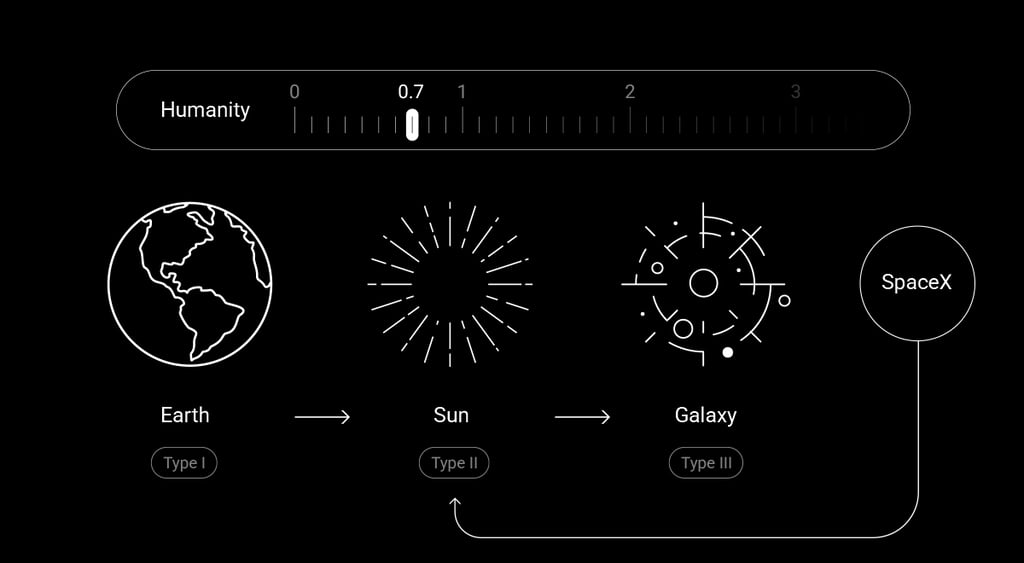
- Type I represents control of energy at a planetary scale, such as global solar, wind, and other terrestrial sources.
- Type II refers to a civilization able to capture energy at the scale of its star, typically framed through space-based solar or orbital systems.
- Type III extends the concept to galactic-scale energy use, far beyond any current technological horizon.
Humanity is typically placed at around Type 0.7, still far from fully exploiting even the energy available on Earth, let alone that of the Sun.
How does it tie in with Space X’s proposals?
SpaceX’s proposal is intended as a step toward higher energy-scale infrastructure, not a quantum leap between different types of civilization.
Musk has described the satellites as “orbital data centres,” described as a way to support the fast-growing energy demands of artificial intelligence. The timing is not accidental, with AI workloads expanding quickly, while existing data centres are already straining power grids, water supplies, and cooling systems.
Instead of pushing those systems further on Earth, SpaceX is looking elsewhere. By scaling its constellation from roughly 10,000 satellites to as many as one million, the company argues that near-constant solar exposure in orbit could help ease energy constraints. It would also depend less on water-based cooling.






From that perspective, SpaceX’s proposal treats AI less as a software problem and more as an energy and infrastructure challenge. One that may eventually run up against Earth’s physical limits.
Unlike terrestrial data centres, which must be built near cities and power infrastructure, satellites would operate in near-constant sunlight. In theory, they could form a distributed computing layer above the planet, largely unconstrained by geography and less exposed to local energy bottlenecks. Whether that vision holds up in practice remains unclear.
Can Musk actually achieve it?
Whether Musk’s vision can translate into real progress toward a higher Kardashev level is disputed. The debate can be summed up as orbital density versus sustainable human expansion beyond earth.
Stirling Forbes, founder and CEO of Forbes-Space, says Musk’s long-term architecture is better understood through Starship and off-world settlement than through a vast satellite constellation.
“I think Elon understands this architecture. I worry that the satellite proliferation now with the data centres undermines his far more important mission,” Forbes said.
Over-congestion in low-Earth orbit could well be a potential limit on the plan. “In my view a million satellites is reckless. Starlink’s already doing 800 collision-avoidance manoeuvres daily. Scale that up and you may as well be building a debris field, not infrastructure,” Forbes added.
Unlock more exclusive Cybernews content on YouTube