Sonic hedgehogs? Why ultrasound could be key to saving species from the modern world
New research suggests that ultrasound devices may help reduce the incidents of hedgehog deaths by cars and robot lawnmowers – and might even help us learn more about how they communicate with each other.

Getty Images

 Follow us
New research suggests that ultrasound devices may help reduce the incidents of hedgehog deaths by cars and robot lawnmowers – and might even help us learn more about how they communicate with each other.
Researchers at the University of Oxford who collaborated with colleagues in Denmark, have demonstrated for the first time that hedgehogs can hear high frequency ultrasound.
The study, which was published in Biology Letters on Wednesday, involved testing the auditory brainstem response of 20 rehabilitated hedgehogs from Danish wildlife rescue centres.
According to Eurekalert, during the study small electrodes were placed on the animals to record electrical signals travelling between the inner ear and the brain, while short bursts of sounds were played through a small loudspeaker.






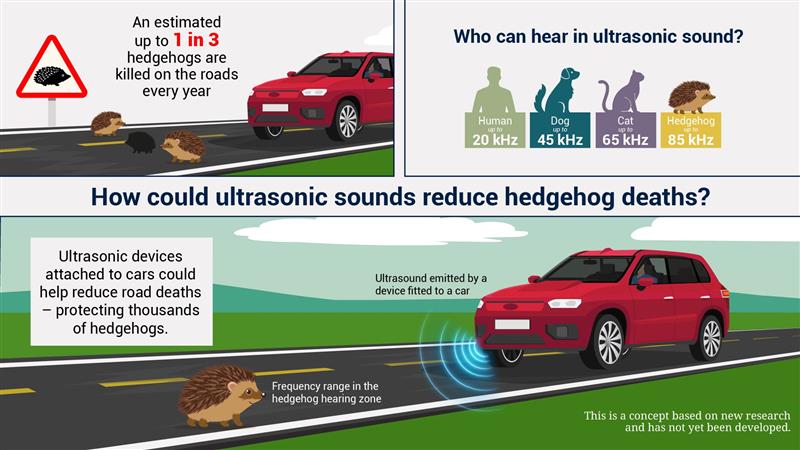
It was found that hedgehogs could hear in the ultrasound range (which starts at frequencies greater than 20 kHz), up to at least 85 kHz.
After being checked out by a vet, the animals were released back into the wild the following night.
The team also carried out high-resolution micro-CT scans of a dead hedgehog “which had been euthanized after being critically injured by a rat trap” and these scans were used to build an interactive 3D model of the hedgehog’s ear.
Scientists found that the animals’ cochleas (that’s the inner ear’s fluid-filled chamber responsible for converting sound waves into nerve impulses) were relatively short and compact, meaning that hedgehogs can “better process ultrasonic vibrations.”
The discovery spells good news for hedgehog populations, which have been listed as a “near threatened” species since 2024 by the International Union for Conservation of Nature after a decline in numbers of at least 30% over the past decade.
While being run over by cars is one of the main causes of death, an earlier study by the University of Oxford found that robot lawnmowers were responsible for a significant number of injuries and deaths to hedgehogs.
Information from the study could now be used to develop sound repellants to deter the nocturnal creatures from going near machines that can kill them – without disturbing humans or pets.
Strong password generator

Lead researcher assistant professor Sophie Lund Rasmussen said the next step would be to find collaborators within the car industry to fund and design sound repellents for cars.
The scientist also hopes to investigate whether these woodland creatures use ultrasound to communicate with each other.
“Our novel results revealed that European hedgehogs are designed to, and can, perceive a broad ultrasonic range. A fascinating question now is whether they use ultrasound to communicate with each other, or to detect prey – something we have already begun investigating."Assistant professor Sophie Lund Rasmussen, Wildlife Conservation Research Unit, University of Oxford
Unlock more exclusive Cybernews content on YouTube.