The Wow Signal – why science’s biggest alien mystery still haunts us
Astronomers are still haunted by the Wow Signal, a 72-second radio burst from 1977 that defies every earthly explanation
Nurphoto via Getty Images

 Follow us
Astronomers are still haunted by the Wow Signal, a 72-second radio burst from 1977 that defies every earthly explanation.
On a warm August evening in 1977, a radio telescope in Ohio known as Big Ear picked up something that would puzzle astronomers for decades.
The strange burst of radio energy, later scribbled with a red pen and the single word “Wow!” in the data margin, lasted just 72 seconds and was never heard again.
Unlike the repeating pulses of a quasar or the rapid chatter of a pulsar, this was a one-off, a sharp, narrowband signal that looked far too clean to be random noise.
To the researchers who saw the printout, it felt less like interference and more like a genuine transmission from deep space.






More than forty years on, no other telescope has captured anything quite like it.
Why natural explanations fall short
Over the years, scientists have searched for down-to-earth explanations.
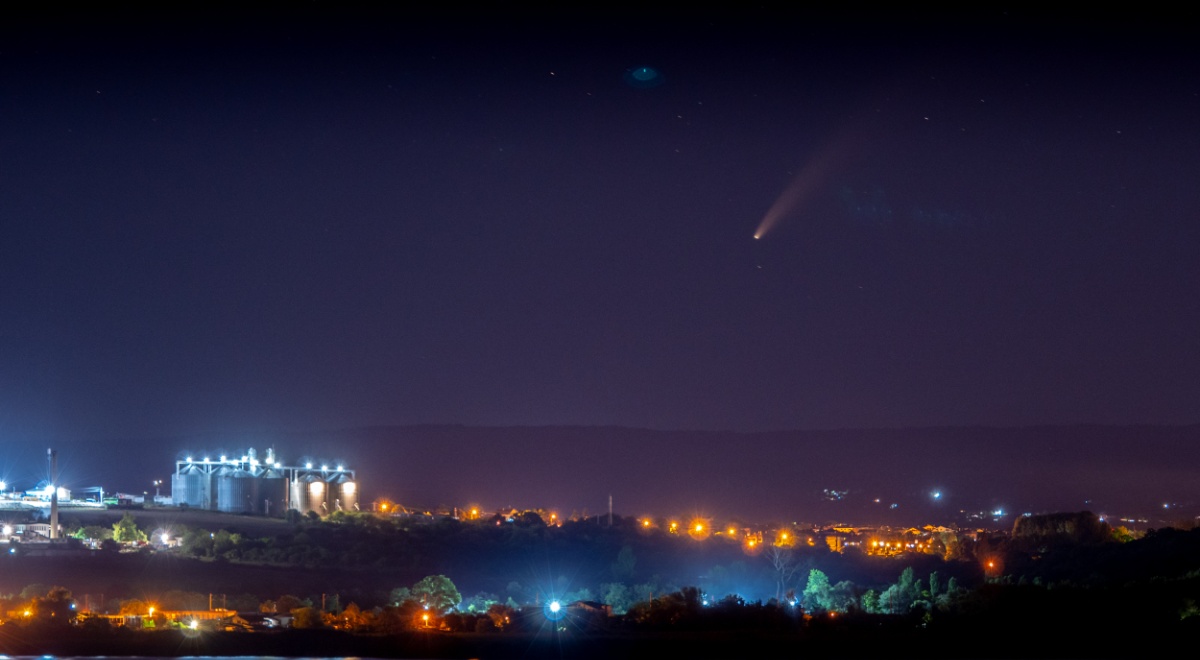
In the 1990s, one idea suggested that a comet passing through the telescope’s view might have been responsible, but the signal’s neat shape made that unlikely.
A comet would spread out a broad, fuzzy trace, not a precise spike. Satellites were also considered, but none lined up with Big Ear’s field of view at the time.
And while radio interference is always a suspect, the odds of a passing signal lasting exactly 72 seconds – the length of Big Ear’s observing window – are extremely slim.
As scientists reviewing the data concluded, the usual suspects never quite matched the evidence.

A signal stronger than first believed
Recent teams have revisited the original data using modern tools. But what they found only deepened the mystery.
The Wow Signal’s intensity was closer to 250 Janskys, which is around four times stronger than earlier estimates.
That places it in the territory of some of the most powerful radio events we know.
In the archives, they also noticed two weaker, similar signals picked up in 1977 and 1978.
These were never strong enough to make headlines but hint that some astrophysical process could have been at work, perhaps a flare from a magnetar or the brief ignition of a hydrogen cloud in space.
Yet even with new numbers, the case remains unsolved. The data answers some questions but raises even more.




The best candidate for alien contact?
No modern study has been able to prove that the Wow Signal came from extraterrestrial intelligence.
But just as important, none have been able to fully explain it away with an Earth-based cause.
That lingering gap is why many SETI (search for extra-terrestrial) pioneers, including John Kraus and Carl Sagan, described the event as “highly suggestive” of an artificial origin.
Even today, researchers call it the most convincing single candidate in the decades-long search for technosignatures – the traces of advanced life somewhere beyond Earth.
Nothing else since has matched its sharpness, its strength, or the mystery it carries.
Why the word “wow” still matters
The Wow Signal has outgrown the data sheet on which it was first recorded. It has become a cultural icon – a shorthand for the human urge to look outward and wonder who might be looking back.
It is also a reminder of how discovery often arrives. Not with fireworks or a headline-grabbing breakthrough, but in the form of a single whisper that demands attention.
Scientists keep scanning the skies, but that 1977 margin note still captures the honest reaction most of us would have had: simple astonishment.
And for now, that one word is all we have.