Zoom, IKEA, HSBC among 178 websites infected with hidden malware
Hackers exploited one website optimization platform to launch their attack.

Image by Shutterstock

 Follow us
- Malicious JavaScript targeted visitors to 178 organizations’ websites through Optimizely, a website optimization platform.
- The code tried to steal cryptocurrency payments, card numbers, cookies, and screenshots from users.
- Researchers said the scripts also attempted to plant exploit code on iPhones.
- Salesforce disabled the altered scripts; Equifax stopped using Optimizely and reported no system compromise.
Key Takeaways by nexos.ai, reviewed by Cybernews staff.
Zoom, BBC, CNN among 178 sites hit by malicious code attack in an effort to steal cryptocurrency and infect iPhones.
Hackers hijacked trusted websites of 178 organizations across various sectors to steal cryptocurrency, payment card details, and personal information.
Zoom, the BBC, CNN, Salesforce, GitLab, IKEA, HSBC, Equifax, Air France-KLM, Ledger, and Peacock were among 178 organizations whose websites unknowingly delivered malware to visitors.
The attack, discovered on November 16th, involved hackers injecting malicious JavaScript into scripts hosted by Optimizely, a platform businesses use to test website changes and personalize the experience for visitors.


The scripts attempted to replace cryptocurrency payment addresses with the attacker's wallet, skim card numbers entered by users, steal cookies, take screenshots, and plant exploit code on iOS devices.
The discovery was first uncovered by security researcher Scott Helme, founder of Report URI security firm. Findings were later elaborated by cybersecurity firm Hudson Rock.
HudsonRock also said it had found evidence that the sites had served malicious code to their visitors.
According to cybersecurity company Report URI, cryptocurrency theft has already been confirmed, with approximately $7,040 transferred to wallets linked to the attackers within around nine hours.
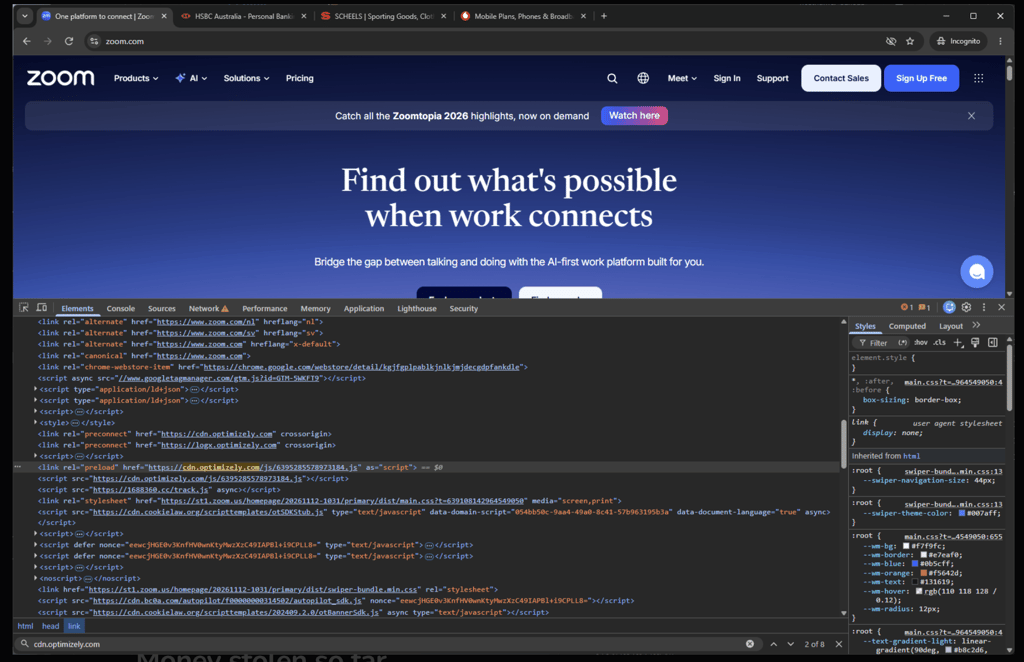
Hackers turned trusted websites against their visitors
The malware was delivered through the Optimizely Web platform. Optimizely Web allows businesses to experiment with website layouts, content, and features.
To make this work, customers load a small piece of JavaScript code from Optimizely's servers. The code runs on their websites and can include additional instructions written by the customer.
Attackers managed to insert their own malicious instructions into this additional code across hundreds of customer projects.
As a result, visitors continued downloading what appeared to be legitimate JavaScript from Optimizely's trusted domain. The original files and the platform's security certificate remained intact. However, the code running on the websites had been secretly modified.
Crypto was not the only prey. At 13:43 UTC on November 16th, the attackers added functionality to collect payment card information. The malicious code monitored website forms and outgoing requests for card numbers, expiration dates, and security codes.
The script also collected browser cookies that were not protected against JavaScript access. Cookies can contain information used to keep people logged into websites or remember their sessions.
In some circumstances, the attackers also captured screenshots of infected pages, potentially giving them additional information about what victims were viewing.
Stolen credentials may have granted access
The attackers used several ways to hide their activity. In some cases, the malicious web address was encoded, making it harder to find through a simple search. Another version included the entire malware directly in the website code, allowing it to run even if the external domain was blocked.
Report URI said it could not determine how the attackers gained access to so many unrelated customer projects. Possible explanations include a compromised Optimizely system or stolen credentials that allowed access to multiple customer accounts.
The company stressed that this was not a case of attackers poisoning Optimizely's content delivery network. Instead, the platform served modified code that had already been inserted into customer projects. Optimizely's own websites were also affected.
iPhones and iPads users at risk
The malware is targeting Apple users. The malicious script detected whether a visitor was using an iPhone or iPad and checked the device's iOS version. It then attempted to load one of two exploit kits, Coruna or DarkSword.
Exploit kits are collections of malicious tools designed to take advantage of security weaknesses in software. In this case, they targeted different generations of Apple's mobile operating system.
According to Report URI, Coruna was used against devices running iOS versions 13 through 17, while DarkSword targeted iOS 18.
A separate attack chain was also present for iOS 26, although researchers said it currently only identified the device rather than carrying out the full exploitation process.
Report URI noted that the exploit kits themselves identified newer patched versions of iOS as protected against their attacks. It also observed that devices running iOS 18.6 or earlier repeatedly reloaded affected pages every 60 seconds in an attempt to retry the exploit.
What companies are affected by the malware?
- Banking & Finance (32): Paychex, HSBC US, Equifax, SmartAsset, HSBC Hong Kong
- Technology & SaaS (23): Zoom, Bitly, Salesforce, GitLab, Optimizely
- Retail & Fashion (20): IKEA, ASOS, Mattel, American Eagle, Scheels
- Streaming & Entertainment (12): Peacock, D&D Beyond, Wizards of the Coast, NOW TV, Zattoo
- News & Media (10): CNN, BBC, Fox News, NPR, CTV News
- Airlines & Travel (9): Alaska Airlines / Hawaiian Airlines, Transavia, Air France-KLM, KLM Netherlands, Trafalgar
- Healthcare & Pharma (8): Invisalign, Takeda, Covetrus, iTero (Align), Covetrus Pharmacy
- Industrial & Manufacturing (8): Fluke, eMaint (Fluke), Fluke Networks, Vaillant Germany, Fluke Process Instruments
- Telecoms (7): Virgin Media, Virgin Media O2, Vodafone Australia, O2, TPG Telecom
- Crypto & Trading (6): Ledger, IG, OANDA / Coinpass, interactive investor, TMS Brokers
- Insurance (6): Asurion / uBreakiFix, Mutual of Omaha, Admiral, Securian Financial, eRenterPlan
- Property & Real Estate (6): Buildium (managebuilding.com), Loft Living apartments, Buildium, HireAHelper, Flytte.no (and sister comparison sites)
- Food & Hospitality (5): Restaurant ordering sites (order.online), Heineken, Home Chef, Starbucks Canada, Cinnabon
- Home & Smart Home (5): Resideo, Honeywell Home, myQ (Chamberlain), Chamberlain, First Alert
- Nonprofit & Civic (4): Change.org, ASPCA, UNICEF USA, DonorsChoose
- Gambling (4): Betsson, PokerStars, tombola, Betfred
- Professional Services (4): Freshfields, CohnReznick, Baringa, Cro Metrics
- Logistics & Shipping (3): ShipStation / ShipEngine, Stamps.com, ShipEngine
- Automotive (3): Lucid Motors, O’Brien Glass, Chevrolet dealer network (Bill Rapp and others)
- Education (3): Walden University, Perlego, Chamberlain University
The companies respond
Reuters could not immediately ascertain whether the code was successfully used in each case, or the extent of any resulting hacks.
Salesforce said it was investigating unauthorized Optimizely script changes, and had disabled them as a precaution.
The Cybernews community is talking about this. Be a part of the conversation.
Equifax also investigated the issue and ceased using Optimizely. The company said it did not find evidence of any compromise of its systems.
Zoom told Cybernews that the company is aware of the security incident. "As a precautionary measure, Zoom has disabled Optimizely across our production environments. At this time, we have not identified any impact to customer data. We continue to monitor the situation closely," Zoom stated.
Optimizely, Apple, HSBC, CNN and IKEA did not immediately respond to Reuters' requests for comment.


Stay updated with our latest stories and follow us on social media
Be the first to discover new stories, ideas, and updates from our team.