Supersized dataset of 2 billion records, including passwords and emails, surfaces online
The leak goes beyond passwords: someone amassed a vast trove of accounts and digital identities.

By Cybernews

 Follow us
- An unsecured database exposed about 2 billion credential records, but duplicates mean fewer people may be affected.
- The data includes passwords, emails, cookies, session tokens, device details, and saved app credentials.
- Gmail and Google accounts made up the largest share, with hundreds of millions of exposed records.
- Experts urge users to update devices, use trusted software, and enable multi-factor authentication.
Key Takeaways by nexos.ai, reviewed by Cybernews staff.
A massive, unsecured database, aggregating leaks from multiple data breaches, was left publicly exposed, containing 8,471 folders with credentials and account information in plaintext.
Security researcher Jeremiah Fowler has discovered an exposed database on a publicly accessible server with zero protection: no password, no encryption.
A limited sampling revealed that the collection goes beyond email, login names, and password combinations. It includes session tokens, cookies, device data, saved application credentials, browser passwords, authentication artifacts, device information, logs, and other application identifiers.
The dataset is a collection of infostealer logs and other data leaks from multiple suspected cybercriminal data sources and underground credential operations.






Cybercriminals can use this data to build near-complete profiles of their victims, including credentials for major online services, such as email, corporate web portals, banking and financial services, cryptocurrency platforms, social media accounts, streaming services, online shopping accounts, government portals, and many other websites and applications.
“Some documents were segmented by country and included abbreviations in the file names, such as US, UK, FR, DE, ES, and MX,” Fowler said in a report on ExpressVPN’s website.


Stay updated with our latest stories and follow us on social media
Be the first to discover new stories, ideas, and updates from our team.
Massive data leaks spilling billions of records have become somewhat of a norm. Cybernews researchers discovered an even larger exposed cluster this summer, containing 24 billion records, and another leak of 8.7 billion Chinese records earlier this year.
What’s in the new dataset?
The leaked data was scattered across 8,471 folders, and some accounts appeared in multiple documents – the total count of 2 billion records includes duplicates.
The total count doesn’t represent individual victims – a single infected device can yield attackers dozens of accounts and other data. Some credentials may already be expired or have been rotated.
The most numerous exposed credentials are Gmail accounts (608 million records) and other Google services (114,3 million records). However, the leak also exposes tens of millions of accounts from Facebook, Instagram, Amazon, Roblox, Yahoo, Microsoft, X, and others.
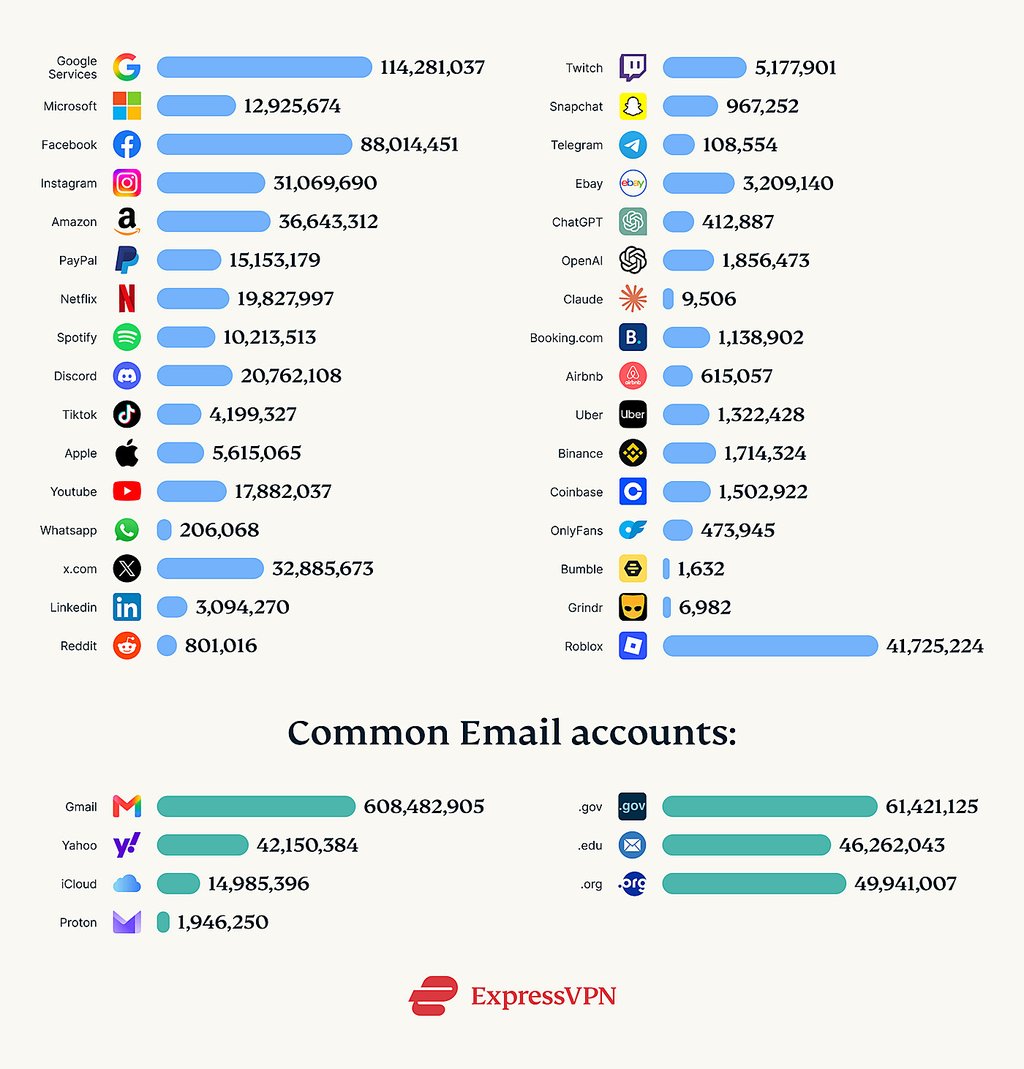
It also includes over 61 million government (.gov) email accounts, 46 million education (.edu) email accounts, and almost 50 million .org email accounts.
Fowler highlighted 400,000 documents that appeared to come from a sophisticated malware that profiled individuals by creating separate folders. Other logs appeared to be from other malware strains.
“These included folders named applications, cookies, edge, important files, and operating systems, as well as .txt documents labeled system, process, clipboard, brute force, passwords, and more. Together, these could provide a detailed profile of each victim,” Fowler said.
Cybercriminals might also be exposed, because the data includes thousands of Tor .onion addresses with corresponding account names and passwords.
This is the first time I have seen a large number of dark web accounts in breached credentials,the researcher said.
“This is the first time I have seen a large number of dark web accounts in breached credentials,” the researcher said.
The origins are unclear – the massive dataset could be used by cybercriminals underground, or it might have been accidentally left unprotected by other researchers.
The researcher suspects the data might’ve been aggregated for a criminal marketplace or other stolen-data resale operation. Alternatively, it could’ve belonged to an individual reseller or private data archivist.
Leaked credentials are also often collected by threat-intelligence companies, anti-fraud organizations, security researchers, and others. The server’s owner couldn’t be identified.
The researcher reviewed only a limited number of samples to verify the exposure and responsibly notified the relevant parties.

Check if your data was exposed
Find out if your email and related personal information have appeared in known data breaches.
Protect your devices and data
Fowler’s report once again highlights the dangers posed by infostealer malware, keyloggers, and similar threats.
Sensitive information, credentials, and other personally identifiable information (PII) can give cybercriminals a broad overview of an individual’s digital life.
The risks range from direct theft of money and cryptocurrency, account hijacking, and scams and phishing targeting the victims or their contacts.
The researcher urges users to ensure their devices are safe: kept up to date, run only trusted software, and protected by endpoint security solutions. Accounts should be protected with multi-factor authentication wherever possible.
Advanced malware often shows no obvious symptoms of infection, and its removal is often not enough – attackers can still have control of accounts and sessions. The researcher recommends seeking professional help if an infostealer infection is suspected.