Biggest data breaches ever: scale, consequences, and why they still matter


Some of the largest data breaches in history have disclosed the personal details of billions – a lot of people put at risk with one leak. From Yahoo's 3 billion-account leak to the 2024 MOAB releasing over 26 billion records online, these events aren't just outliers – they mark key points in a rising trend of digital disasters.
Despite their magnitude, massive breaches have become so frequent that we barely flinch anymore. Research from the Business Digital Index reveals that 75% of the US government departments and agencies have been affected by data breaches; around 54% have had corporate data stolen, and 27% have employees reusing compromised passwords. As shocking as it is, this data shows us a deeply concerning picture of a failure to prioritize cybersecurity.
In 2023 alone, malicious hackers exposed over 6 billion records worldwide, and old leaks keep fueling phishing scams, identity theft, and dark web markets. The effects last long and often stay hidden. Until they don't.
In this article, I look at the most infamous data breaches ever recorded, explore the fallout they caused, and explain why they remain relevant today.
Scale of modern data breaches
Modern data breaches are blowing up in size, pace, and complexity. Now, they often impact entire platforms, reveal private information, and can strike entire industries or countries. To grasp how serious this threat is, I first define what makes a breach major and analyze the figures driving this crisis.
What counts as a major breach?
A data breach happens when someone gets their hands on private, protected, or sensitive information. It's not always malicious hackers who are behind these incidents. Many big breaches come from setting the wrong settings, human error, or weak spots in third-party systems.
A major breach checks one or more of these boxes:
- Massive numbers (hitting millions or billions of records)
- Sensitive data exposed (passwords, Social Security numbers, money, or health details)
- Far-reaching impact (messed up services, legal battles, governments stepping in)
What sets apart today's data breaches from previous ones isn't just their size, but their depth. Threat actors don't just get your email address – they access your location history, biometric ID, private messages, or health records. But how many users are actually being affected, and how often?
Numbers behind the nightmare
The amount of exposed data has grown to record-breaking levels.
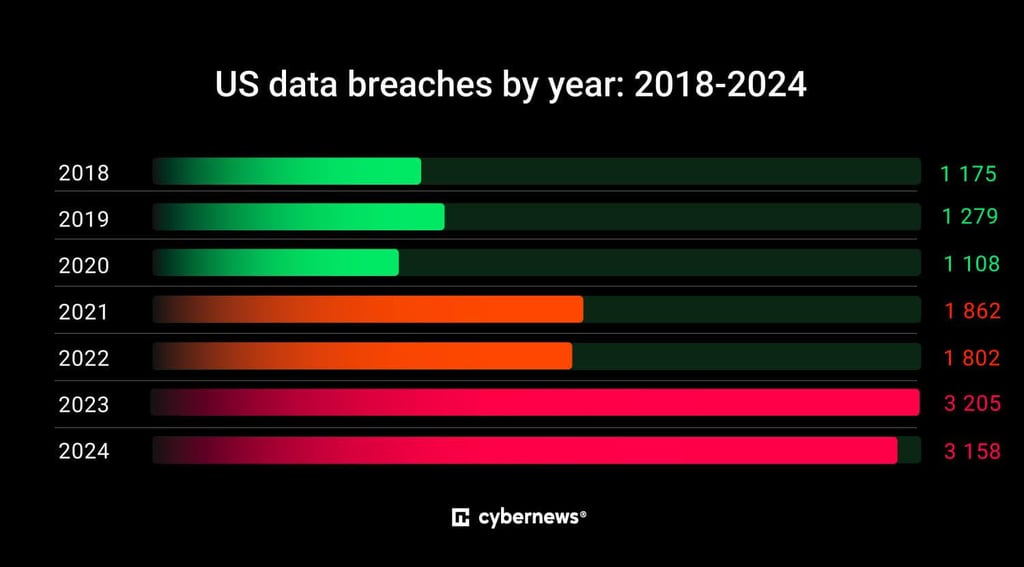
- In 2023, the Identity Theft Resource Center noted a 78% rise in public data compromises compared to the year before, which had an impact on 353 million people.
- In early 2024, a massive leak was discovered by security researcher Bob Diachenko and the Cybernews research team, known as the Mother of All Breaches. It exposed an enormous 26 billion records. Many of these came from earlier breaches of platforms like Twitter, LinkedIn, and Dropbox.
- IBM's 2024 report estimated the average cost of a breach at $4.88 million, while the broader cost of cybercrime could reach $10.5 trillion this year.
Having closely followed the cybersecurity space, I see that breaches are no longer just one-off incidents. They’re widespread breakdowns, speeding up faster than most companies can keep up with.
Most notorious data breaches and their fallout
The most infamous data breaches I go over below didn't just grab headlines, they raised debates on laws, destroyed reputations, and showed how fragile some modern digital systems are. Each breach reveals how threat actors adapt quicker than those trying to defend against them.
1. MOAB (Mother of All Breaches)
| Year | 2024 |
| Records exposed | 26 billion |
| Breach discovered by | Cybernews researchers and Bob Diachenko |
| Data type compromised | Logins, passwords |
| Breach method | Aggregation of previous breaches in an open database |
Picture every big breach from the recent decade or so tossed into one unprotected pile – that's MOAB (Mother of All Breaches). Discovered in early 2024 by Cybernews researchers and SecurityDiscovery.com owner Bob Diachenko, this database combined about 26 billion records from old leaks (Twitter, LinkedIn, Adobe, Canva, and other major platforms).
By itself, it wasn't new, but its scale is definitely mind-boggling. This MOAB really showed that stolen data doesn't just disappear. It gets recycled, weaponized, and easily accessible.
2. Chinese surveillance database
| Year | 2025 |
| Records exposed | 4 billion |
| Breach discovered by | Cybernews researchers |
| Data type compromised | Residential and financial data, WeChat logs, Alipay data |
| Breach method | Misconfigured government-linked database |
In May 2025, our Cybernews researchers unveiled an exposed database linked to Chinese government systems leaking over 4 billion records. In it, you could find chat logs, residential and financial information, and even movement patterns.
This data breach ranks as one of the biggest in China's history and was potentially kept for surveillance or profiling.
3. Yahoo
| Year | Occurred in 2013, disclosed in 2016 |
| Records exposed | 3 billion |
| Breach discovered by | Yahoo's security team |
| Data type compromised | Names, emails, hashed passwords, security Q&A |
| Breach method | Credential theft and forged cookies |
Yahoo experienced the largest data breach involving a single company between 2013 and 2014, impacting 3 billion user accounts in total. Moreover, Yahoo didn't reveal this breach until 2016. Malicious hackers were able to obtain hashed passwords, security questions, email addresses, and names.
Yahoo's slow response and old-fashioned encryption (MD5) made the situation worse. This breach had an impact on Yahoo's sale price to Verizon, knocking off $350 million. The Yahoo incident is now a textbook example of poor data security practices and the consequences of delayed disclosure.
4. Real Estate Wealth Network
| Year | 2023 |
| Records exposed | 1.5 billion |
| Breach discovered by | Cybersecurity Researcher Jeremiah Fowler |
| Data type compromised | Property ownership data, addresses, user logs |
| Breach method | Misconfigured database |
In 2023, experts found a 1.16TB cloud database without protection which belonged to the Real Estate Wealth Network (REWN). This database held 1.5 billion records, including property ownership details, tax information, names of famous people, and internal usage logs.
Though not as high-profile as big company leaks, it showed the huge privacy dangers linked to real estate technology platforms that handle public data and sensitive background information.
5. Aadhaar (India)
| Year | 2018 |
| Records exposed | 1.1 billion |
| Breach discovered by | Rachna Khaira, journalist reporting for the Tribune India |
| Data type compromised | Biometric data, Aadhaar numbers, personal data |
| Breach method | Data leakage and security issues |
India's Aadhaar program, the biggest biometric ID system in the world, faced several security breaches in 2018. Researchers and journalists discovered that an anonymous service was offering access to Aadhaar-linked personal data of Indian citizens for as little as ₹500 (around $10), exploiting unprotected APIs.
Names, fingerprints, iris scans, and bank-linked ID numbers were made public by these leaks, which infuriated those affected and triggered lawsuits. This breach has really spurred strong debates concerning data protection regulations.
Biggest breaches and consequences: wrap up
These are just the top 5 data breaches the digital world has witnessed. Though the scale of these data breaches differs, they all share a common thread – the kind of info that gets exposed.
We're talking about login details, personal data, and financial credentials that now fuel a whole underground market. Below, you’ll see what kind of data gets stolen the most often.
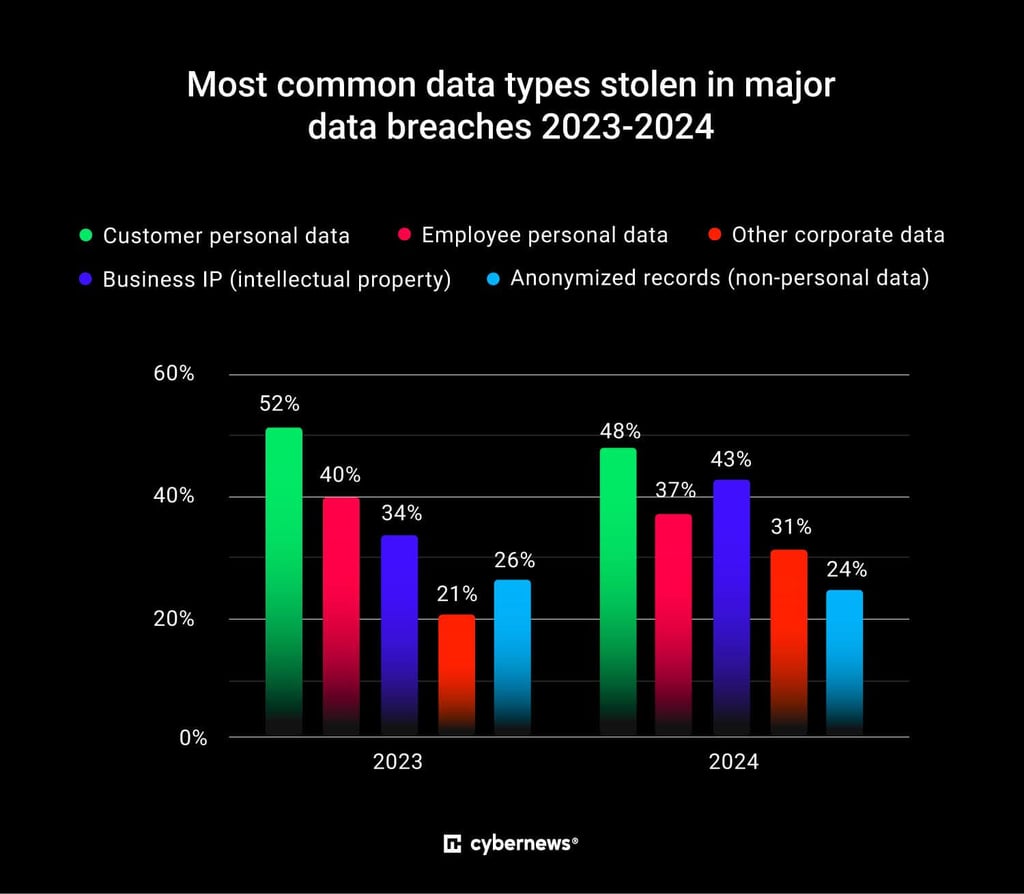
You might be thinking – what happens after this data gets exposed? The data breach fallout doesn't stop with leaked logins. It spreads out, often ends up on the dark web, and can be reused for various malicious purposes. Let's take a closer look at the whirl of aftermath and the chain reaction that follows.
Consequences beyond the headlines
Of course, the impact of major data breaches can’t be easily measured. We tend to gauge data breaches by counting stolen records or looking at fines, but this only scratches the surface. The actual impact of a big data breach goes deeper, touching companies and even governments. The effects often take months or even years to fully emerge after a breach is uncovered.
While big breaches cost millions of dollars, money isn't the only concern. As I outlined above, 70% of people affected by data breaches face fraud attempts or online harassment after the initial breach, and companies, at the same time, may suffer the irreversible repercussions to their reputation.
To grasp the full scope of the damage, I explain the 10 key widespread effects that follow a major data breach:
| Consequence | Brief description |
| Financial loss | Companies face remediation costs, legal action, PR damage control, fines. Individual users can face drained accounts, unauthorized charges. |
| Reputational damage | Companies face loss of trust among customers, vendors, investors, the public, and it can result in loss of integrity. |
| Customer churn | Users tend to leave platforms that fail to secure their data. |
| Regulatory fines and lawsuits | Companies may be subject to class-action lawsuits from impacted users as well as fines under the CCPA, GDPR, and HIPAA. |
| Drop in company value | Companies listed on the stock market see their share values take a hit after a data breach comes to light. When Yahoo was bought out, its price tag dropped by $350 million. In Equifax's case, its stock value plummeted by more than 30% after its data leak. |
| Disruptions in operations | Responding to breaches often means stopping or pausing operations, which interrupts work, customer support, supply chains. |
| Identity theft | Stolen personal data, such as Social Security numbers or birthdates can be exploited to start new bank accounts, request loans, or even steal identities. |
| Phishing and scams | Hackers can use stolen data to carry out scam attacks to gather even more personal or financial details. |
| Biometric vulnerability | Our biometric data, unlike passwords, can’t be altered. So, it can become a lifelong vulnerability. |
| Industry-wide ripple effects | A single security breach (like MOVEit or SolarWinds) reveals flaws that impact thousands of downstream businesses, illustrating issues with software updates and access control that are common to the industry. |
Why do these breaches still matter today?
The thing about massive data breaches is that their consequences don’t just vanish after the data breach has been dealt with. It can very likely be that your data lingers online for years after the initial disclosure. Even in 2026, breaches from previous years continue to threaten privacy and digital security through various sorts.
Long-term exposure of personal data
Businesses take a long time to recover, and users continue to be at risk for some time following data theft. The financial effects of data breaches extend far beyond the original incident. The first year accounts for 51% of costs, with the remaining 49% being distributed over the following years.
Reuse of stolen credentials in new attacks
Credential stuffing, an automated injection of stolen usernames and passwords into website login forms, remains a primary attack vector in 2026.
This problem persists due to widespread password reuse. I know how convenient it is to just use the good old “12345” everywhere. Sadly, when credentials from one breach are tested against other services, they often grant access to multiple accounts that belong to the same person.
Delayed discovery and response
You’ll probably be surprised that 66% of breaches take months or even years to discover, giving attackers ample time to exploit stolen information. For instance, the WebTPA healthcare breach remained undetected for 8 months and wasn't publicly disclosed until nearly a year after the attack.
In some cases, breaches are only discovered when external parties, such as credit card issuers or customers experiencing fraud, notify you about it.
Data aggregation and resale on the dark web
Once breached, personal information rarely remains isolated. The MOAB really exemplified this problem, containing 26 billion records distributed across 3800 folders (a combined repository of previously stolen data).
Unlike regulated sites, the dark web isn't governed by takedown policies. Once information appears on these platforms, it's copied, redistributed, and stored across multiple anonymous networks. This, as you can imagine, creates quite a permanent digital shadow that can follow you indefinitely.
Use our free tools to see if malicious hackers leaked your personal data or passwords online. Cybernews Personal Data Leak Checker shows if your email, phone number, or other details have popped up in known breaches. The Password Leak Checker can tell you if your password is on public record.
10 expert tips to protect yourself and your company
The truth is, we can’t be immune to data breaches or avoid them entirely. What we can do is take every step to prevent our data from being used for malicious purposes. Many breaches exploit quite simple security flaws that can be addressed by adhering to proven safety measures. After several years of work in a leading cybersecurity-focused outlet, I can share the 10 best security practices we recommend both for companies and personal users:
- Create a strong and unique password for each account. Password reuse remains the #1 cause of unauthorized access to accounts. Get a trustworthy password generator and password manager to help generate and keep track of complex login credentials.
- Activate multi-factor authentication (MFA) on your accounts. MFA adds a crucial security layer. It safeguards your account even if someone gets hold of your password in a data leak.
- See if your information or passwords have been compromised. Use the Cybernews Personal Data or Password Leak Checker to look for known data breaches that might involve your details. If you find your data there, it’s best not to ignore it. Take all precautions to change your passwords and check all boxes from this list.
- Don't put off installing updates and security fixes. Malicious hackers often target old software. Update operating systems, applications, and add-ons. Those often have security patches or can tighten your protection even more.
- Control access to sensitive information. Use the least privilege rule – grant access to what's necessary only, and only for the time being.
- Educate staff about phishing and social engineering. Most successful attacks happen due to human mistakes. Basic training can stop many intrusion attempts.
- Protect sensitive data with encryption. Encryption helps keep data unreadable if hackers break into your system. Use secure, encrypted messaging apps, avoid unencrypted public Wi-Fis, and consider getting a VPN.
- Check your suppliers and third-party connections. Weak links in the supply chain often lead to breaches. Check access often.
- Be alert for unusual behavior. Set up logging and alerting systems to spot odd access or behavior. Don’t ignore if anything out of the ordinary occurs.
- Create a plan to respond. Or, in other words, have a solid contingency protocol. Know what actions to take when a breach occurs. Speed isn't a technical measurement here. How fast you respond can actually make or break your recovery.
Final thoughts: are breaches inevitable?
The current cybersecurity climate has pointed us towards a key insight: data breaches will continue throughout 2026 and beyond. We’ve learned that many of the famous data breaches didn't stem from complex government attacks. They boiled down to people using the same old passwords, failing to update software, or leaving databases open for years.
Moreover, businesses still hold off on telling people. Users still type in passwords from hacks that happened years ago. IBM's 2024 data shows that spotting and containing breaches can cut costs by over $1 million.
For everyday users, simple habits like using unique passwords and staying alert to phishing attempts offer some of the most effective protection. While breaches are inevitable to some extent, what truly matters is how we prevent them – and how we minimize their impact when they do occur.