Malware found on the Microsoft Store, delivering a powerful remote access trojan
Phishing redirects lead victims to the Microsoft Store, where they install malware.
Microsoft Store. Image by Cybernews/ Shutterstock / aileenchik.

 Follow us
- Hackers published a signed Setup Assistant app on Microsoft Store to deliver the Vinci RAT backdoor.
- Phishing sites sent users searching for Snipping Tool, Teams, or Roblox to the malicious installer.
- Vinci RAT can profile infected computers, run attacker commands, and launch more malicious files or scripts.
- Researchers warn Microsoft Store availability does not prove an app is safe.
Key Takeaways by nexos.ai, reviewed by Cybernews staff.
Hackers have slipped a malicious app with a valid digital signature onto the Microsoft Store. They target users searching for popular downloads such as Snipping Tool, Teams, or Roblox.
eSentire, a cybersecurity company, found malware hosted directly on the Microsoft Store, which led to infections with a previously undocumented, feature-rich remote access trojan named Vinci RAT.
The malicious application, dubbed “Setup Assistant”, was published by an entity named “ETPS Ltd.” The installer is downloaded as a file named “Snipping-Tool.exe” and, once installed, it acts as a backdoor and malware loader, awaiting commands from an attacker-controlled server.
However, the operator does not expect victims to stumble upon the app directly on the Microsoft Store. Instead, the threat actor uses phishing sites to redirect users to it.




One of the phishing URLs mimicked the Snipping Tool, a popular Windows utility for taking screenshots. The researchers also found other subdomains suggesting that hackers also impersonated Microsoft Teams and Roblox.
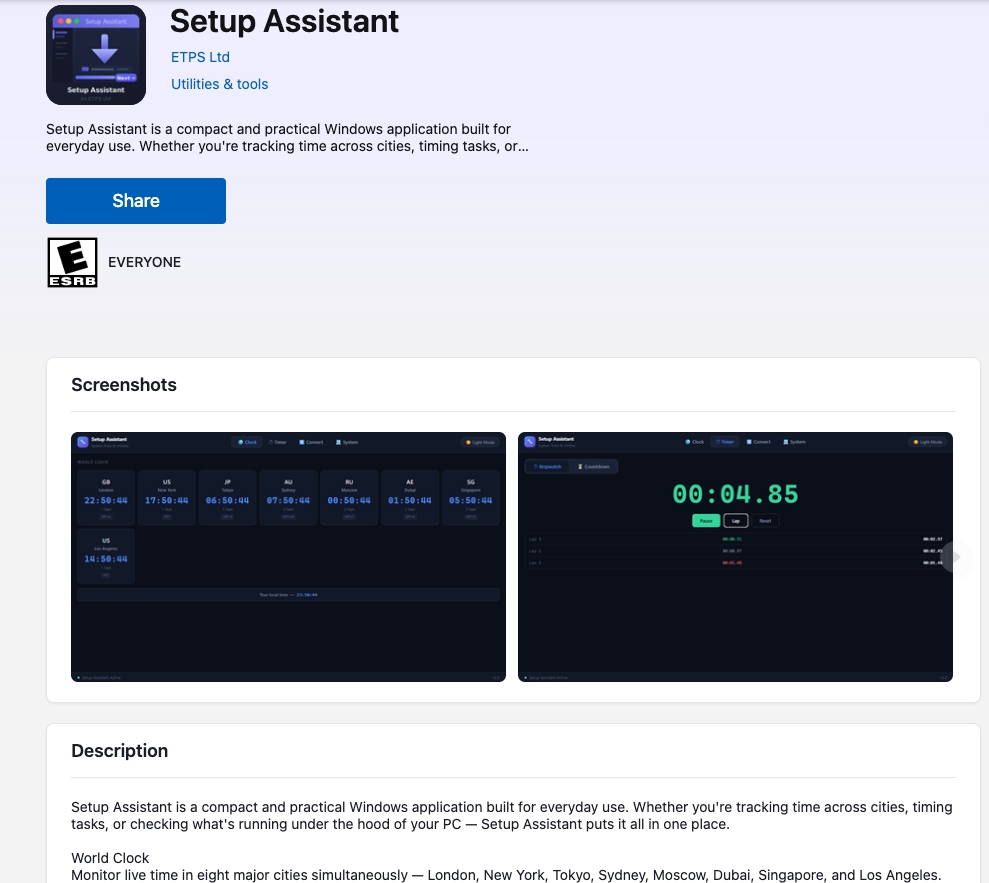
“Initial access began when the victim searched for a snipping tool and was redirected to a fake installation site, snipp.codes-team[.]com, which downloaded a Microsoft-signed store installer,” the report by eSentire explains.
The app on the Microsoft Store was heavily obfuscated. Its job is to maintain communication with command-and-control (C2) infrastructure, monitor the victim’s Downloads folder, and support execution of the supplied scripts.
The hackers were observed using this app to launch a PowerShell stager, schedule tasks for persistence, and ultimately retrieve Vinci RAT.
“Setup Assistant executed embedded, obfuscated JavaScript that allowed the C2 server at setup-assistant[.]com to supply and run arbitrary PowerShell / JavaScript. The C2 then delivered a command to execute the Vinci RAT stage,” the report explains.


Stay updated with our latest stories and follow us on social media
Be the first to discover new stories, ideas, and updates from our team.
The researchers reported the malicious app via the Store’s abuse form, however, they only got an automated response stating that the application did not violate Microsoft’s terms.
What is Vinci RAT capable of?
Vinci RAT is only around 800 lines of PowerShell scripts, but is plenty capable. It fingerprints the system by collecting computer name, username, Windows version, locale, time zone, installed security tools, and Active Directory domain.
It also checks privileges, including whether it can edit registry values.
It maintains a persistent connection to the C2 server via a reverse shell, executes supplied commands via cmd.exe, and relays standard output back to the attackers.
Operators can choose to write EXE payloads to %TEMP% and launch them directly, or use WMI, in-memory execution, or the Windows CreateThread API. They can also run DLLs or execute other PowerShell scripts.

Check if your data was exposed
Find out if your email and related personal information have appeared in known data breaches.
Vinci RAT can detect major security tools and uses AMSI (Antimalware Scan Interface) techniques to evade detection.
“Microsoft Store availability should not be treated as proof that an app is safe. Enterprises should restrict Microsoft Store app installation through GPO, AppLocker, WDAC, or Intune, and require security review before approving unknown, low-adoption, or low-reputation apps,” the report recommends.
The researchers also listed several malicious domains, an IP address, and other indicators of compromise.