Ukrainian man catches Electrolux water heater connecting to Russian cloud
The user in Ukraine had to block his smart water heater from sending “data to Moscow.”

Image by Shutterstock

 Follow us
- A Ukrainian user found his Electrolux EWH 80 water heater contacting mqtt.cloud.rusklimat.ru.
- The domain resolved to Yandex Cloud, a Russian cloud provider, according to a WHOIS lookup.
- IoT devices can reveal home routines through telemetry such as temperature, energy use, and on/off status.
- The owner blocked the appliance from the internet and said replacing it would be difficult.
Key Takeaways by nexos.ai, reviewed by Cybernews staff.
A Ukrainian man who bought a smart water heater, the Electrolux EWH 80, from a local retailer says the device is attempting to connect to a Russian IP address hosted on Yandex Cloud.
Cybersecurity experts have long been warning about the risks posed by IoT devices – even a water heater can’t be trusted.
“I caught my ‘smart’ Electrolux EWH 80 water heater attempting to send data to Moscow,” one man in Ukraine posted on Facebook.
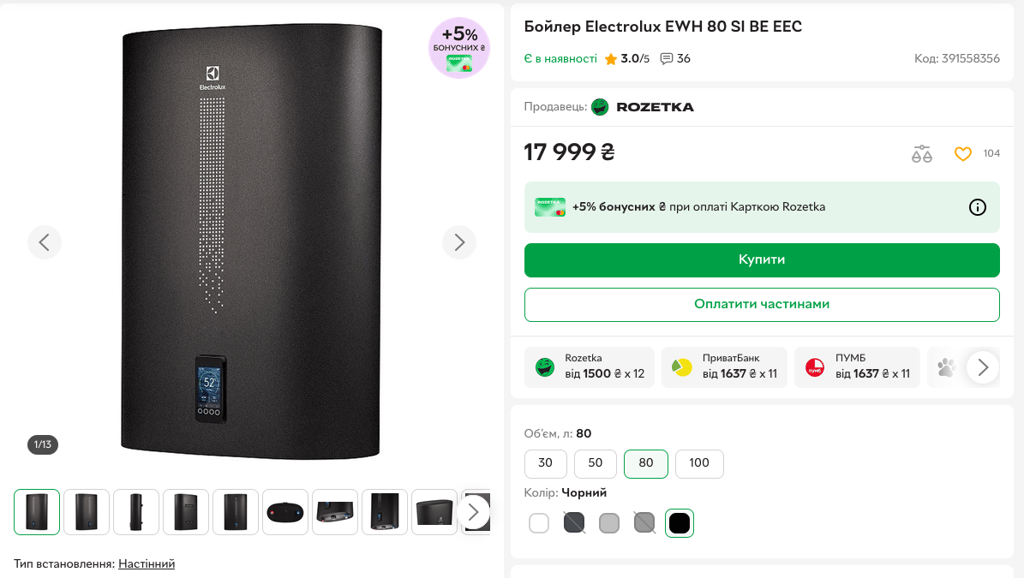
He bought the water heater from the Ukrainian retailer Rozetka last year. The Electrolux brand is Swedish, and nothing on the product pages indicates any links to Russia.





The user explains that he monitors his network because his smart home includes many devices segmented across several subnets.
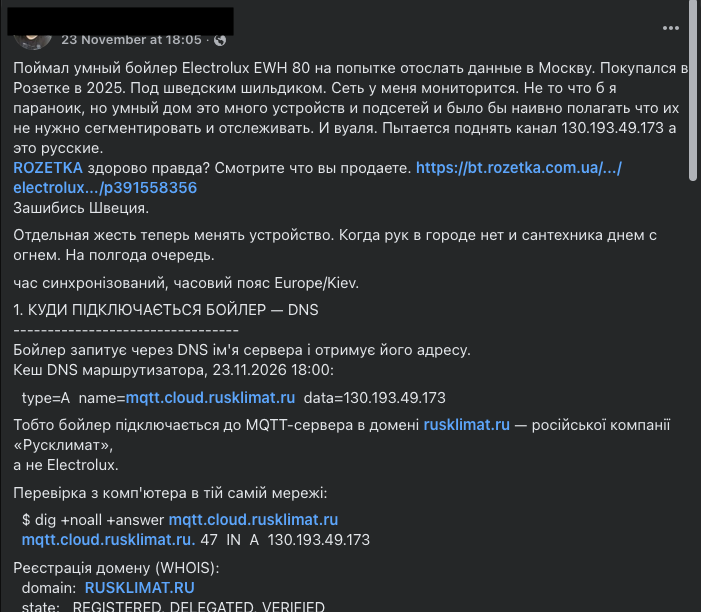
Soon afterward, the man noticed strange DNS requests.
The water heater requested a server name, mqtt.cloud.rusklimat.ru. Its top-level domain is a storefront operated by a Russian company specializing in climate control, heating, and other engineering solutions.
The DNS request resolved to an IP address belonging to Yandex Cloud, a Kremlin-aligned cloud provider in Russia, as revealed by a WHOIS lookup.
“The water heater connects to an MQTT server under the domain ‘rusklimat.ru,’ belonging to the Russian company ‘Rusklimat’, not Electrolux,” the post on Facebook reads.
Cybernews reached out to Electrolux for a comment and will update the story with a response.
The data might be useful to occupiers
MQTT is a lightweight messaging protocol used by IoT devices to talk to their cloud services. The MQTT server, also known as a broker, is used to issue remote commands, such as setting the temperature and turning the device on or off, and to relay telemetry, such as its on/off state, water temperature, settings, errors, energy use, and other metrics.
If other units report to the same server, thousands of homes could potentially leak sensitive occupancy patterns. The device with advertised remote-control features is also sold in other countries across Central and Eastern Europe.
The author finds this situation unacceptable, especially in the context of the Russian invasion of Ukraine.
“The real nightmare now is having to replace the unit, especially since there’s a shortage of labor in the city, and finding a plumber is like looking for a needle in a haystack. There’s a six-month waiting list,” said the owner.


Stay updated with our latest stories and follow us on social media
Be the first to discover new stories, ideas, and updates from our team.
He also blocked the water heater from accessing the internet.
The man lists a place in Luhansk Oblast, which has been occupied by Russia since 2014, as his hometown. His current location was specified as Kyiv, the capital of Ukraine.
Some commenters raised concerns that appliances from other brands might also ship with Russian cloud configurations, and that retailers are unlikely to audit their software.
“I use a stupid boiler. It’s all very simple: I flip the little switch up – it heats, flip it down – it rests. And it doesn’t transmit any data at all,” the most upvoted comments read.
Check if your data was exposed
Find out if your email and related personal information have appeared in known data breaches.
“This is so the damn FSB [Russia's Federal Security Service] will know when the boiler's owner has washed his ass,” another comment reads.
Others suggested using AI assistants to modify the device’s firmware and replace the Russian backend with a local alternative.
A recent report by Bitdefender and Netgear found that the average household has 24 smart devices, creating a wide attack surface. Attackers can compromise vulnerable devices, recruit them into botnets, gain visibility into the entire home network, steal data, and use the foothold to launch attacks on other targets.