McDonald’s Amazon servers attacked, hackers say they stole customer data
Nearly one million email addresses were allegedly exposed.
McDonalds Indonesia suffered a data leak. Image by Cybernews.

 Follow us
- Hackers claim they stole 293GB of data from McDonald's Amazon Web Services storage and internal tools.
- Inception says the files include 938,667 unique emails, including about 370,000 tied to employees.
- The alleged customer data includes names, phones, loyalty IDs, birth dates, and partial payment card details.
- McDonald's has not yet confirmed the breach
Key Takeaways by nexos.ai, reviewed by Cybernews staff.
McDonald’s may have suffered a major data breach. A hacker group says they stole 293GB of data from the fast-food giant’s systems, exposing hundreds of thousands of people.
The cybercriminals, operating under the name Inception, have listed McDonald’s on their dark web leak site.
So far, the attackers have not provided data samples; however, they claim that the stolen data includes customer records.
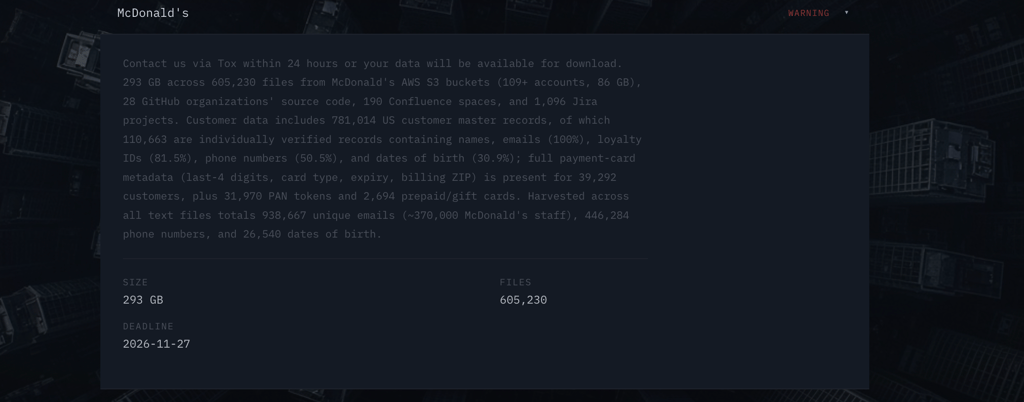
Inception claims to have collected 938,667 unique email addresses from the stolen files, including approximately 370,000 belonging to McDonald's employees.



The gang threatens to release the allegedly stolen McDonald’s files unless the company contacts them within 24 hours.
Cybernews has reached out to McDonald’s, and we will update the story once we receive a response.
Nearly a million emails exfiltrated
According to the attackers, the stolen data comprises 605,230 files totaling 293GB, collected from McDonald’s Amazon Web Services (AWS) S3 storage buckets, GitHub, Confluence spaces, and Jira projects.
The gang claims that among the stolen customer data are such sensitive information as:
- Names
- Email addresses
- Loyalty program IDs
- Phone numbers
- Dates of birth
- Partial payment card details: last four digits of a card, card type, expiration date, and billing ZIP code.
- Payment account number (PAN) tokens
- Prepaid or gift card records
Malicious actors could exploit stolen details to craft highly convincing phishing campaigns. Imagine getting an email from McDonald’s listing your contact details, your loyalty program ID, and even the last 4 digits of your bank card.
This would greatly increase the likelihood of trusting the fraudulent message, clicking malicious links, or providing additional information.


Stay updated with our latest stories and follow us on social media
Be the first to discover new stories, ideas, and updates from our team.
McDonald’s has been targeted before
This is not the first cyber incident that has hit McDonald’s. At the beginning of 2026, the Everest ransomware gang claimed to have stolen 861GB of data from McDonald’s India, including customer and employee information and internal financial documents, and threatened to publish it.
In August, an attacker calling themselves “TheHatman” offered allegedly stolen Azure and Entra directory datasets from several large companies, claiming 1.7 million records associated with McDonald’s.
Some of the incidents involve the company’s own security loopholes. In September, Cybernews’s researchers discovered an exposed McDonald’s Indonesia database containing more than 40 million records.
The data leak involved approximately 28 million customer records containing combinations of names, emails, phone numbers, and device IDs, along with loyalty and other business data.
Last year, researchers accessed McDonald’s McHire recruitment platform using the default credentials 123456, potentially exposing more than 64 million applications, including applicants’ contact details and chat messages.