Can a data leak steal the papal conclave 2025?
As the papal conclave begins and cardinals enter total lockdown to choose the next pope, the Vatican’s centuries-old secrecy faces a modern test. In a world of spyware, deepfakes, and digital espionage, could the unhackable actually be hacked?

Image from Gettyimages

 Follow us
As the papal conclave begins and cardinals enter total lockdown to choose the next pope, the Vatican’s centuries-old secrecy faces a modern test. In a world of spyware, deepfakes, and digital espionage, could the unhackable actually be hacked?
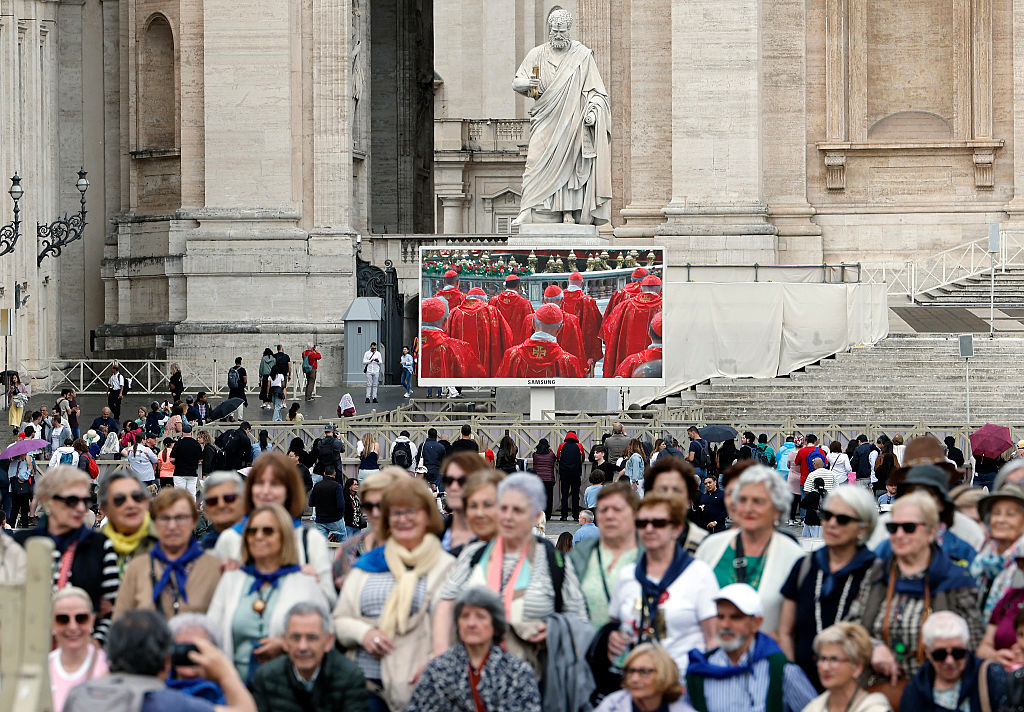
Pope Francis, the 266th pope of the Roman Catholic Church, has died, and the conclave to elect his successor has officially begun. 119 cardinals under the age of 80 have locked themselves behind centuries-old doors of the Sistine Chapel to elect the next pope.
The papal conclave is a mix of medieval tradition and modern logistics. The cardinals vote in secret ballots up to four times a day, and to prevent leaks, they are cut off from society while the world waits for white or black plumes to rise over the Vatican.
While the conclave, watched by millions worldwide, is arguably the most low-tech event on the planet, and cyberattacks are unlikely to literally steal the papacy, let’s entertain some high-stakes hypotheticals about how it could all go sideways.




How to hack a conclave?
Each cardinal casts his vote on a simple card that says, in Latin: "I elect as Supreme Pontiff," to which they add the name of their chosen candidate.Now imagine, somewhere in a warehouse outside Rome, a shipment of ballot paper gets loaded onto a truck. But what if that paper was carrying more than just papal ambition? Let’s say a tiny RFID tag is embedded in a few of the sheets. The tags use radio frequency and do not need the internet.
They could quietly track who handled which ballots before the lockdown. And if a hidden reader, perhaps disguised as a lamp or tucked inside a relic, slipped past security, it could grab that data up close, revealing movement patterns or voting activity without ever needing a live network.
Tech doesn’t have to be high-end to be dangerous. It just has to be there. Maybe a smart lightbulb in a cardinal’s temporary room is the mole. Or imagine a “Click to Pray” eRosary, a smart prayer wearable developed by the Vatican, loaded with Trojan and logging audio and location data.




Let’s say you can’t breach the chapel. Fine. You don’t need access, you just need chaos. Imagine a hacked Vatican livestream suddenly shows white smoke rising from the chimney. "Habemus Papam!" screams every headline. Crowds flood St. Peter’s Square. World leaders tweet their congrats. Except, inside the chapel, the vote hasn’t even finished, and the video was created using the AI.
To cast the chaos, you don’t even need to hijack the Vatican’s live stream. With the rise of artificial intelligence (AI)-generated content on social media, fake information will most definitely spread online, making the users of popular social media platforms believe what they want to believe.
Already before the conclave, the US president, Donald Trump, stirred controversy when an AI-generated image of him in papal regalia was posted on his Truth Social account.

How the Vatican protects its cybersecurity
Still, scenarios of hacking the conclave are highly unlikely. A cybersecurity firm, Flashpoint, released a threat assessment stating that it does not identify any specific or credible cyber threats targeting the 2025 papal conclave.
Inside the Vatican, the conclave operates under strict isolation protocols designed to block all external communication. Phones are banned, opaque privacy films seal off windows, and the cardinals are forbidden even from glancing outside during voting.
More than 650 CCTV cameras watch over the city-state's streets, while Swiss Guard monitors for any suspicious activity. Signal jammers saturate the area, preventing potential remote attacks via Bluetooth, WiFi, or cellular networks.
The Vatican's cybersecurity division has ramped up digital shielding using encrypted messaging protocols, endpoint monitoring tools, air-gapped systems, and AI-driven surveillance to detect and neutralize threats before they manifest.
However, the confidentiality of the papal conclave faces modern threats from military-grade satellites, AI-powered surveillance systems, and even microscopic microphones, each capable of breaching what was once considered one of the most impenetrable events on Earth.
The Vatican has already been attacked
The Vatican isn’t relying solely on divine intervention. In May 2020, a Chinese hacker group called RedDelta allegedly breached Vatican computer networks, right around the time Beijing was trying to muscle in on negotiations over the appointment of bishops in China.
Internal leaks in 2012 and 2015 exposed sensitive documents revealing corruption, financial misconduct, and a Church hierarchy devouring itself from within.
Since the cyberattack, the Gendarmerie’s cybersecurity division, led by Gianluca Broccolett, has dramatically hardened its digital infrastructure. From encrypted messaging protocols and air-gapped systems to AI-driven threat detection and endpoint monitoring, the Holy See has transformed its approach from reactive to preemptive.