I boarded an Air Baltic flight to Tallinn and found luxury where I least expected it
Starlink brings fast WiFi onboard aircraft as the last quiet space in travel disappears.
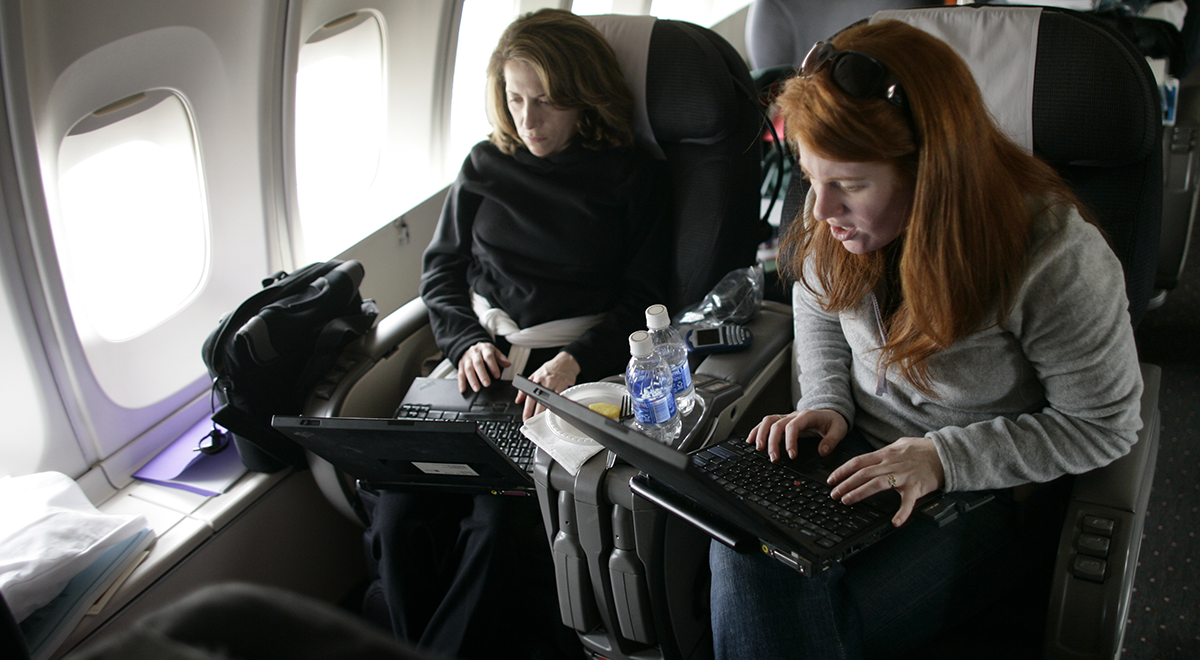
Photo by Brooks Kraft LLC/Corbis via Getty Images

 Follow us
Starlink brings fast WiFi onboard aircraft as the last quiet space in travel disappears.
I recently boarded an Air Baltic flight to Tallinn for a tech conference and was pleasantly surprised by SpaceX's Starlink in-flight internet. Although the upload speeds were modest at 15 Mbps, the free 100 Mbps download speeds more than made up for it. But where will this new expectation for fast speeds in the sky take us?
Most passengers want a connection in the skies without logins, pop-ups, expensive charges, or attempts to capture their personal data. Over the last few months, Qatar Airways, Air France, and United Airlines have all announced plans to equip their fleets with Elon Musk's Starlink internet.
Recently, British Airways and Iberia announced that they too will be offering a satellite-powered service as part of a £7 billion "transformation," which will be available on more than 500 aircraft operated by BA, Iberia, Aer Lingus, and Vueling from next month.






BA proudly states that "lightning-fast" connection will allow passengers in all classes to stream, browse, and message seamlessly from take-off to landing, including over oceans. CEO Sean Doyle called the deal "game-changing," adding that this would elevate the onboard experience.
However, the elephant in the room is beneath the promise of improved productivity. Are we sacrificing the last space where we can truly go offline?
The good: connection at last
In-flight WiFi has a reputation for being patchy and overpriced. Even if you are one of the lucky ones who succeeded in getting online, the frustratingly slow speeds make it impossible to complete even basic tasks. But Starlink is changing that with its high bandwidth on long-haul flights. This means passengers can browse on a tablet, send emails from a laptop, and listen to music on their phones for free.
Presentations can be polished, files uploaded, meetings joined, and cloud dashboards monitored. It's everything that passengers have been wishing for decades. Productivity continues, entertainment never stops, and families stay connected. For the airlines, it creates differentiation and brand appeal. Everyone is happy.
The bad: when productivity turns into pressure
Predictably, there is a flip side. Flights were one of the last places on the planet where it was possible to escape digital noise and go off-grid. Your friends, colleagues, and family knew you were offline, leaving you to think, read, or stare out the window. But that privilege is slowly slipping away.
The moment WiFi becomes reliable enough to support video calls, the expectation to stay connected follows. The same manager who once respected your "in transit" status now sees no reason you can't join the meeting.
The quiet time that once belonged to you becomes another work window, another opportunity for productivity. It's also changing behaviour in subtle ways. Frequent travellers now report a growing sense of digital fatigue on connected flights. When every notification pings in real time, you never quite switch off.
The ugly: when the sky gets noisy
Regulators have long banned cellular calls in flight. But the European Commission recently announced that 5G connectivity will soon be permitted on EU flights, removing the technical barrier that has prevented phone conversations in the sky.
The thought of multiple Zoom calls running simultaneously or listening to the person next to you saying, "Dave, you are on mute," is the stuff of nightmares. Trains and buses already suffer from this lack of etiquette. But the difference at 35,000 feet is that you cannot move seats.
The unspoken code of quiet that defines long-haul travel may give way to a new normal of constant conversation. The plane becomes another office, another coffee shop, another loud shared space where silence feels like an accident.
There are also privacy implications. When hundreds of people are online simultaneously, the opportunity for data collection increases. Every click, stream, and login can feed into analytics that help airlines refine advertising and personalize offers. United's marketing chief admitted as much, noting that "real-time ad decisions" could soon be made mid-flight thanks to Starlink's low latency. Connectivity has value, but data is the real currency.






What happens next
By 2026, Starlink expects to serve thousands of aircraft across more than 40 airlines. The technology works, and the adoption curve is steep. Within a few years, it will be normal to stream Netflix from take-off to landing, to message family mid-flight, and to access cloud storage at cruising altitude. But rules of behaviour and regulation are still catching up.
It is tempting to celebrate fast in-flight WiFi as another technological victory. It feels like progress, a step toward seamless connection everywhere we go. However, progress tends to erase the spaces that make us human.
From the moment the seatbelt sign goes off, the fast WiFi connects, and passengers find themselves returning to their dopamine feedback loop, scrolling, replying, and reacting to posts while staring at their phones. Daydreaming is replaced with the ability to be connected at every altitude, yet somehow less present wherever we are.
Productivity gains are easy to measure. Peace of mind is not. So yes, the technology is extraordinary. The engineering behind low-Earth orbit satellites and the ability to stream video 36,000 feet above the ocean is exciting. But if the last refuge from the world's endless noise becomes another open office, we might look back and wonder whether good old-fashioned silence was the better innovation.
We are experiencing a moment in time where connection defines progress, but choosing to disconnect or simply getting through an 11-hour flight is rapidly becoming the only radical act left.