HAL 9000 to ChatGPT: how AI went from fantasy to reality
Until ChatGPT made it clear that the AI revolution was finally just around the corner, fictional devices did the mind-bending necessary to convince us it was on its way.

Image by Shutterstock.

 Follow us
Until ChatGPT made it clear that the AI revolution was finally just around the corner, fictional devices did the mind-bending necessary to convince us it was on its way – and sometimes scare the living daylights out of us.
With the emergence of ChatGPT, a chatbot created by US startup OpenAI, discussions on AI hallucinations’ impact on the real world have become mundane.
However, not so long ago, devices concocted in the minds of creative writers were among the main catalysts for discussing the role that – then seemingly futuristic – technology would have on the world.
HAL 9000
The Heuristically programmed ALgorithmic computer, or HAL 9000, is best known for its appearance in Stanley Kubrick’s 1968 epic film 2001: A Space Odyssey. In the film, HAL is a sentient computer that controls Discovery One, the spacecraft bound for Jupiter.





The computer’s gradual descent into insanity has established HAL as a cautionary tale of AI gone mad. A discussion that has since been fueled by the progress of advanced neural networks such as ChatGPT.
HAL’s influence has been far and wide. For example, a member of the “1977 Trinity” and one of the most influential personal computers (PCs), the Commodore PET 2001, was named after the digital villain of Kubric’s film.
“If you think about it in 1977, that was the futuristic thing people talked about. […] There wasn’t a Star Wars movie yet, and there wasn’t a Star Trek movie. Go back to that time, and you’ll see that 2001 implies a successful future,” Chuck Puddle, a key engineer at Commodore, recalled.

Skynet
Apocalyptic AI first caught the attention of the public in 1984, after the debut of James Cameron’s science-fiction blockbuster The Terminator. Skynet serves as yet another manifestation of AI gone round the bend, turning against the beings that created it.
Unlike HAL 9000, Skynet was never meant to be self-aware. The fictional device was only supposed to respond autonomously to a threat against the United States. However, a computer bug made the machine conscious, leading it to decide the whole human race was a threat to itself.
Skynet has become almost synonymous with dangerous AI. Some thinkers have even pointed out the drawback of using such a comparison, as officials can become overly dismissive of the dangers autonomous weapons pose, viewing such concerns through the lens of a fictional, and therefore fantastical, story about a sophisticated computer gone wrong.
Interestingly, the National Security Agency (NSA) runs a machine-learning program for identifying terrorists and operating military drones called SKYNET.

KITT
Unlike previous selections, Knight Industries Two Thousand, or KITT for short, was not the story’s villain. Depicted in the action-packed ‘80s TV series Knight Rider, KITT was the main sidekick of the show’s protagonist, played by David Hasselhoff.
KITT, a fully conscious AI installed in a car, depicted a future with smart self-driving vehicles capable of operating autonomously. While there’s no proof Elon Musk’s Tesla drew inspiration from KITT, the similarities are uncanny.
As tech fanatics note, Tesla’s Model S and KITT are both self-driving, greet drivers upon approach, respond to verbal commands, and employ video display monitors, anamorphic equalizers, programmable window tinting, and many other similar features.
While today’s automakers still can’t produce vehicles as advanced as KITT, the fictional car-bound AI cemented that as a possibility, at a time when self-driving cars were still a far-fetched fantasy rather than something an average consumer could buy.
Max Headroom
While not a world-ending artificial intelligence, Max Headroom, the fictional “computer-generated TV presenter,” left a solid imprint in the real world.
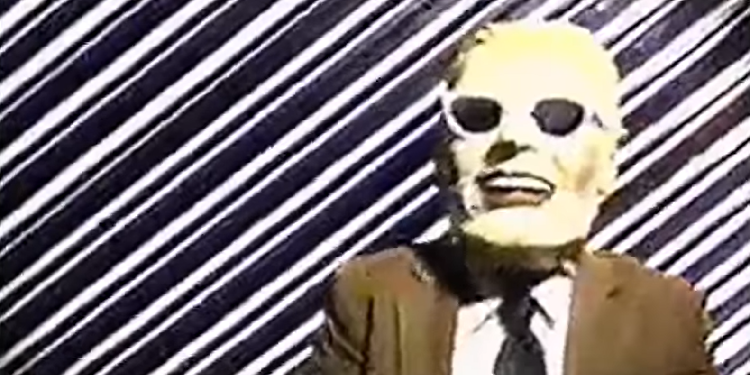
On the evening of November 22, 1987, a masked person, imitating Max Headroom, twice took over the transmission of Chicago’s WGN-TV network. A ten-second black screen interrupted the broadcast, followed by a creepy-looking masked person in front of a corrugated metal background.
A second interruption lasted 90 seconds, with the attacker transmitting a series of cryptic messages followed by digitized laughter akin to the one heard in the original Max Headroom show.
Even though the attack received nationwide attention in the US, with engineers claiming the culprit likely used sophisticated equipment, the authorship of the stunt remains a mystery to this day, sparking numerous theories in the hacking community.
