Could crewed interstellar travel become a reality?
As part of a competition, teams have put forward detailed plans for 'generation ships' that could travel to a nearby star.

Image by Cybernews.

 Follow us
As part of a competition, teams have put forward detailed plans for 'generation ships' that could travel to a nearby star.
With faster-than-light travel not looking like a reality any time soon, some scientists are looking at alternative ways to reach the stars — including a 36-mile-long spacecraft containing farms, hospitals, and tropical forests.
The idea is that it's still possible for humans to reach another habitable planet with existing or near-future technologies just so long as they don't mind a rather long journey.
So-called 'generation ships' would see the descendants of the original passengers living out their entire lives on board until, eventually, a later generation reaches the destination.
The ships would, obviously, need to be self-sustaining, with closed-loop life support systems and artificial ecosystems. There would also be a need for strong social structures to maintain stability over centuries.






Winning design
And the latest proposal for such a ship is Chrysalis — the winner of an international competition, Project Hyperion, organized by UK-based non-profit organization the Initiative for Interstellar Studies (i4is).
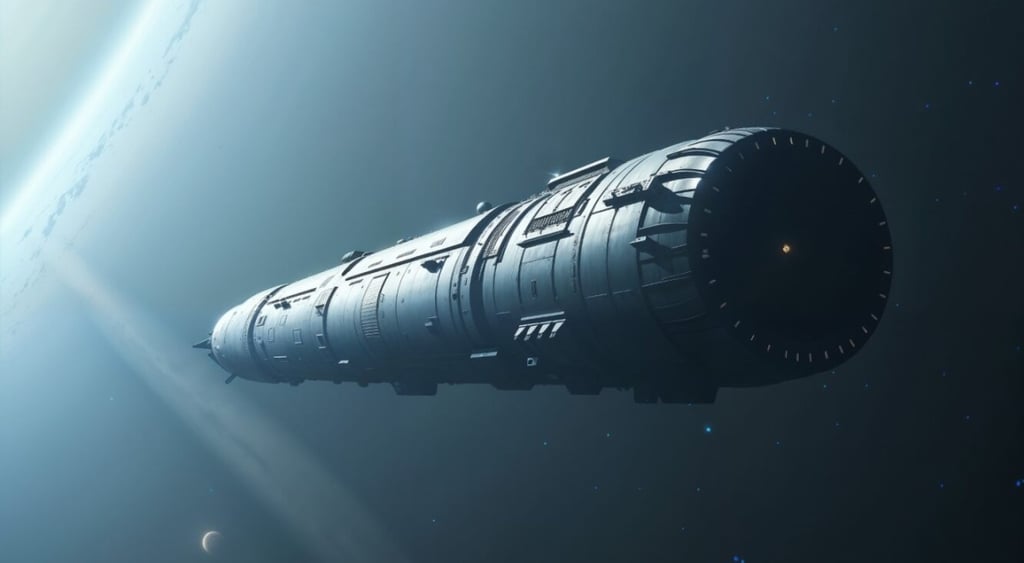
Entrants were asked to design a crewed interstellar spacecraft that could make a centuries-long journey to a habitable planet, carrying between 500 and 1,500 people.
The competition rules specified that the ship should be based only on existing technologies, or those expected to become realities in the near future.
It should have artificial gravity via rotation, and robust life support systems for food, water, waste, and the atmosphere. It should also provide good living conditions, including essential provisions such as shelter, clothing, and other basic needs, as well as some sort of way of preserving and transmitting knowledge, to make sure that culture and technologies aren't lost on the way.
“Project Hyperion wasn’t just a design contest — it is part of a larger exercise to explore if humanity can travel to the stars one day. It envisions how a civilization might live, learn, and evolve in a highly resource-constrained environment, and may also provide valuable insights into our future on Earth,” says Dr Andreas Hein, i4is executive director.
“We asked participants to integrate architecture, technology, and social systems to conceptualize a functional society spanning centuries — and the outcome was beyond expectations.”
The 100-odd entries were judged by a jury of experts in fields including architecture, engineering, and social sciences.
The winner was Chrysalis, designed for a trip to the planet Proxima Centauri b — a super-Earth exoplanet, slightly larger than Earth, that's within the habitable zone of the star Proxima Centauri.
Essentially a 36-mile-long cylinder, it would be built in a series of layers or shells, with one, for instance, a residential layer, one for communal spaces such as schools, parks, hospitals, and libraries, and another dedicated to food production. Others would house industries and warehouses.
At the core would reside the ship's communication systems, as well as the shuttles to take people down to Proxima Centuri b.
Chrysalis would have a direct fusion drive for propulsion — not yet a reality, but a technology that's expected to become one in the next few years.
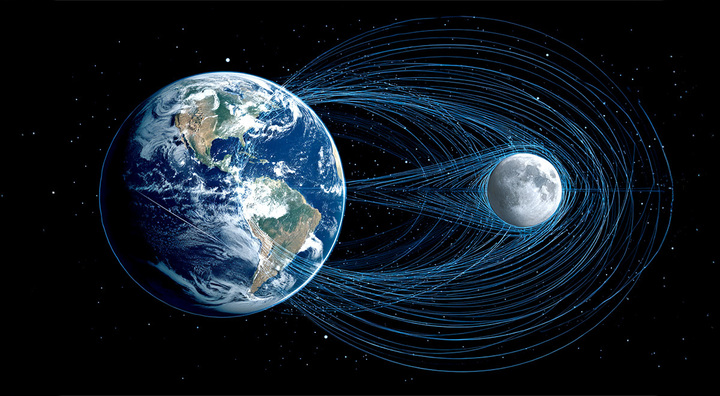
It would be constructed at the L1 Lagrange point — the point at which centrifugal force and the gravitational forces of the Earth and Moon balance each other out, making for much less gravitational stress during the build. And it wouldn't be a quick build, taking up to 25 years.
Before setting off, the first 'settlers' would have an acclimatization process — and rather a long one. They'd train in Antarctica for 70 to 80 years, adapting to an isolated, self-contained environment.
During the journey, births would be carefully managed to keep the population stable at around 1,500 people at any given time — about 600 fewer than the ship's theoretical capacity. Governance would be shared between humans and advanced AI.
"We hope that Chrysalis can be seen as a research baseline for further studies and design explorations," says the team.
Second-placed design Hyperion has a fairly conventional appearance based on two rings, designed to generate an Earth-like magnetic field.




"We deliberately kept the scale of the ship and its living spaces minimal, while still ensuring comfort, safety, and adaptability. Our calculations for size, structure, mass, and energy — although general — were intended to place our design within the realm of possibility rather than pure science fiction," says the team.
"In the end, we believe our concept balances a human-centered vision with practical engineering, offering a glimpse of interstellar life that is both inspiring and grounded in reality."
Flying jellyfish
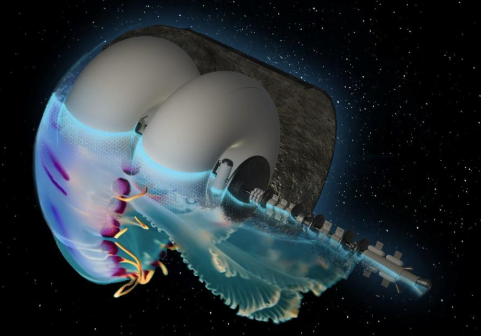
However, other proposals were rather more, well, far out. In third place, for example, Systema Stellare Proximum is modelled on a jellyfish, with swarms of autonomous drones mimicking its tentacles and supporting precise navigation and control.
Many of the principles behind a generation ship are solidly established. In 2019, for example, a team of French researchers calculated that the crew could be as small as 98 people and still arrive at Proxima b in a healthy state.
Artificial gravity through centrifugal force is theoretically perfectly doable, and direct fusion drives look set for reality in the next few decades.
Many potential problems remain — not least the enormous cost. But progress is steadily being made.
"We tried as much as possible to work with the understanding that it would have to become a technologically and industrially feasible project. For example, the costs and project life-cycle for building Chrysalis were not part of the contest objectives, but we tried to evaluate the final design taking these aspects into consideration as well," says the Chrysalis team.
"We worked with the constant awareness that Chrysalis could become a coherent and real construction project in the future, and not just a speculative concept study."