How drone defense is evolving to outthink the machines
Autonomous and smaller drones are forcing defenders to build smarter, faster countermeasures. Sensor fusion and artificial intelligence are turning drone defense from isolated systems into adaptive, networked weapons capable of outsmarting the next generation of drone threats.


 Follow us
Autonomous and smaller drones are forcing defenders to build smarter, faster countermeasures. Sensor fusion and artificial intelligence (AI) are turning drone defense from isolated systems into adaptive, networked weapons capable of outsmarting the next generation of drone threats.
From cheap commercial reconnaissance quadcopters to weaponized swarms operating on the battlefield, drones are forcing militaries and security agencies to rethink how to protect their airspace.
“The days of relying primarily on hardware-based defenses are over,” Ash Alexander-Cooper, VP Europe, EMEA, APAC at Dedrone by Axon, tells Cybernews. “Open-architecture platforms that can seamlessly integrate multifarious sensor inputs and modalities, deliver a true picture of the sky, and deliver prioritised threat responses via software are now setting the pace.”
In the same vein, Brett Feddersen, VP of Strategies & Government Affairs at D-Fend Solutions, shares that he sees the rise of AI-powered, layered defenses as the industry’s defining shift.
“The biggest game-changer is the shift to a System-of-Systems approach that integrates counter-drone systems and leverages AI to detect and mitigate the drone threat safely,” says Feddersen, who is also the chair of Security Industry Association’s (SIA) Drone Security subcommittee.





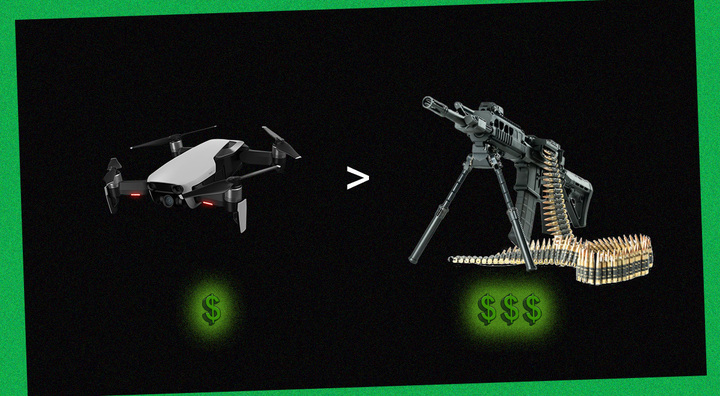
However, in an email exchange with Cybernews, Patrick Tynan, Director of Strategy and Growth at PBS Aerospace, argues that the real breakthrough isn’t a single technology. “The biggest innovation is simple: building at scale,” he says. “The world has realized you can’t counter cheap attack drones with exquisite, high-cost interceptors.”
For him, the turning point came when the big defense contractors began borrowing ideas (and personnel) from consumer electronics manufacturing with modular designs, streamlined supply chains, and production runs in the thousands instead of dozens.
Smarter drones push smarter defenses
Drone defense systems need an upgrade as drones themselves are constantly evolving.
“Advances in autonomy and miniaturisation have further deteriorated the efficacy of the traditional models and assumptions about airspace defence,” says Alexander-Cooper. “Drones can now operate without radio emissions or GPS, using LiDAR, optical mapping, or inertial navigation to fly undetected. Their smaller signatures make radar and RF-only detection increasingly unreliable.”
Tynan agrees that drone autonomy has forced defenders to rethink counter-drone strategy, rebalancing between kinetic [physical weapons like missiles] and non-kinetic [electronic means like jamming] systems.
He says recent conflicts have shown, for instance, the limits of electronic jamming. “Autonomy and miniaturization have narrowed the window for traditional non-kinetic defenses,” he says. “Directed energy and RF jamming still matter, but Ukraine proved a hard truth: when drones use cheap workarounds, like hard-wired fiber control lines or pre-programmed routes, Electronic Warfare (EW) can be neutralized. EW works until it doesn’t.”
That’s led to new interest in low-cost kinetic systems, including interceptors and effectors, which can be fielded in numbers. “The new rule is layered defense: keep non-kinetic tools in the stack, but anchor them with ‘cheap, ready, many’ kinetic countermeasures that don’t care if a link is jam-proof because physics is harder to spoof than signals,” Tynan says.
Feddersen explains how sensor fusion and machine learning are also changing the detection game:
“Counter-drone systems moved away from single sensors and now fuse data from multiple passive sensors, like acoustic sensors (which can hear the unique buzzing of rotors) and Micro-Doppler Radar, specifically designed to detect the subtle movement of rotor blades and distinguish drones from birds.”
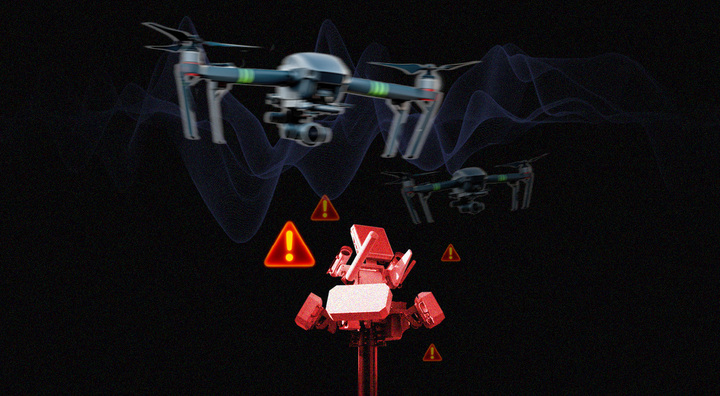
Machine learning then helps analyze sensor data to identify and classify new or DIY drone threats in real-time, without needing to match them against a list of known models.
Breaking the bottlenecks
Despite the fast innovations, there are still several technical limits. “The greatest bottleneck remains the speed of adaptation,” says Alexander-Cooper. “Drone technology evolves faster than traditional defence acquisition can respond.”
He says Dedrone is addressing this through AI-driven, software-defined architectures that can integrate with existing hardware. “Our systems can update threat signature recognition algorithms and integrate a wide array of sensor types without replacing hardware,” he says. “That flexibility ensures defenses remain current even as drone designs shift.”
Another issue, he adds, is interoperability as many Counter-Unmanned Aerial Systems [CUAS] deployments operate as standalone units, creating what he dubs as “intelligence blind spots.” He says Dedrone’s networked model helps cure this by connecting detection nodes “across cities, organisations, critical infrastructure, or borders, to create a shared real-time view of the airspace.”
However, the biggest constraint Tynan believes is range. “You can’t defend what you can’t reach, and most low-cost interceptors still trade range for price,” he says.
Tynan points to gas-turbine propulsion as the next leap forward: “Gas-turbine propulsion changes that math. Compared with solid rockets (great burst, poor endurance) and propellers (efficient, but slow and range-limited under combat loads), small turbojets deliver the rare combo we need: speed, reach, and affordability per shot.”
The next phase
All three experts agree the next stage of innovation will continue building on automation and integration.
“The next five years will see the decision layer advance at the fastest pace,” believes Alexander-Cooper. “As automation and AI mature, systems will move from human-in-the-loop to human-on-the-loop [that is] machine-speed decision-making, where detection and neutralisation are linked through intelligent networks to lighten operator cognitive load and improve response accuracy and shorten response time.”
Tynan expects the fastest innovation to come in neutralization with “platforms capable of engaging multiple targets at longer ranges, faster, and at dramatically lower cost per shot.”
Feddersen says we'll see an even broader transformation: “In five years, drone defense will evolve from a collection of point solutions into a truly integrated, autonomous air domain ecosystem–a ubiquitous, networked layer of airspace security.”
The ultimate goal, he says, is for counter-drone technology to underpin unmanned traffic management systems, “enabling safe large-scale integration of drones, air taxis, and manned aircraft.”
Unlock more exclusive Cybernews content on YouTube.