Google accused of grooming kids after child receives this email
The LinkedIn community was shocked to learn that Google sends emails to 13-year-olds letting them know that they can remove parental controls.

Image by Cybernews.

 Follow us
The LinkedIn community was shocked to learn that Google sends emails to 13-year-olds letting them know that they can remove parental controls.
“Google emailed my youngest child today to tell him he is almost 13 and eligible to remove parental controls,” Melissa McKay, president of the Digital Childhood Institute, wrote via LinkedIn.
“Read that again. Slowly,” she urged her LinkedIn followers.
McKay went on to say that a trillion-dollar corporation is contacting children directly, letting them know that they can “graduate” from parental supervision when they turn 13.
“The email explains how a child can remove those controls themselves, without parental consent or involvement,” the president of the non-profit that protects children online said.






The disgruntled mother continued by saying that Google is essentially grooming children for engagement, data, and profit, stating that the big tech company is “asserting authority over a boundary that does not belong to them.”
By sending these emails directly to children, Google undermines parental authority and potentially contradicts parental controls online, McKay argued.
These emails reframe parents as a “temporary inconvenience to be outgrown and position corporate platforms as the default replacement.”
McKay, who has been an online safety advocate for almost ten years, called the practice “reprehensible” and concluded by saying that “corporations should stay the hell away from our kids.”
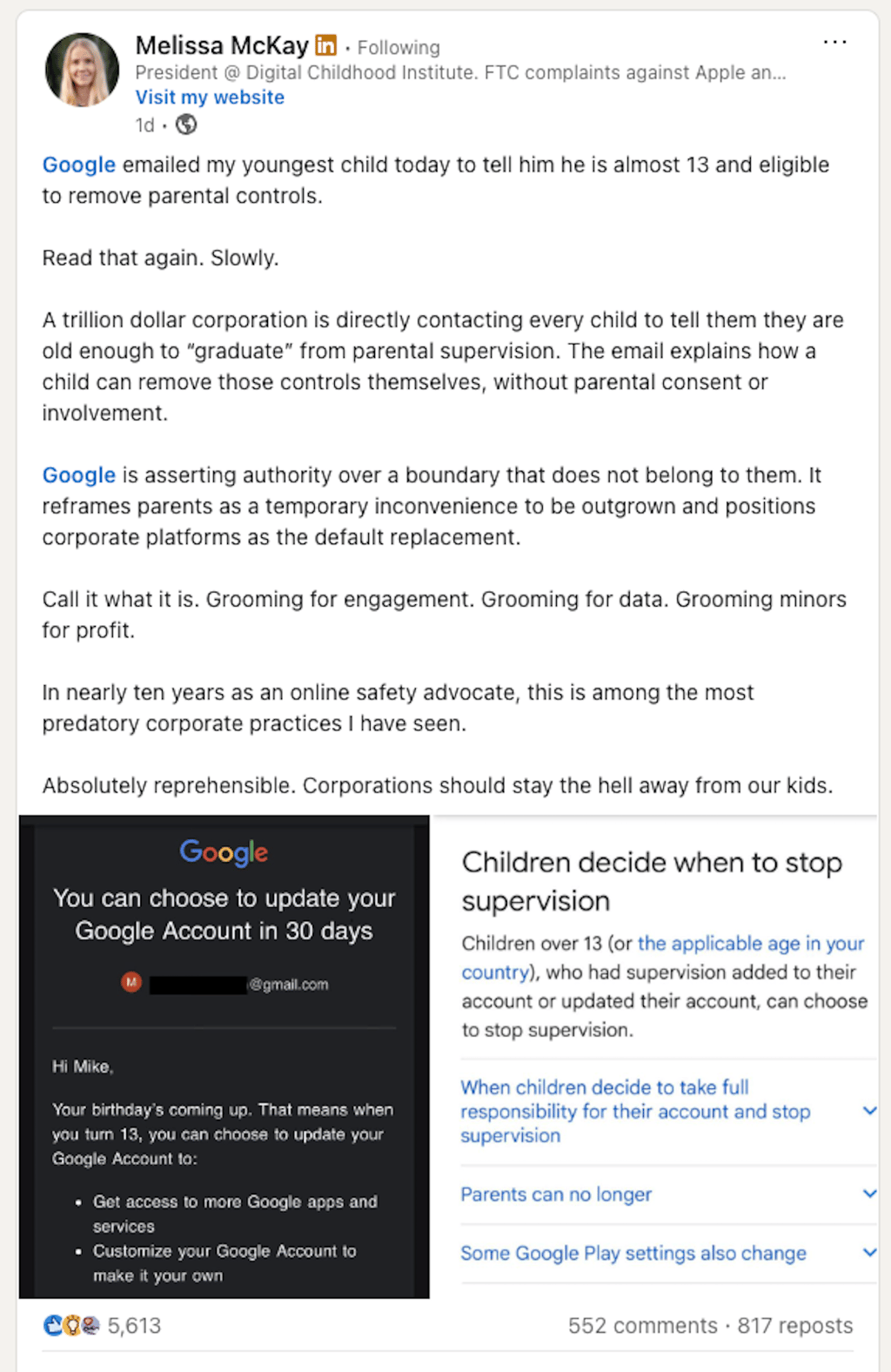
A representative from Google told Cybernews that Google is “making a planned update to require formal parental approval for teens to leave a supervised account.”
“These changes better ensure protections stay in place until both the parent and teen feel ready for the next step. This builds on our existing practice of emailing both the parent and child before the change to facilitate family conversations about the account transition."
Google claims that this move is “building on our commitment to family safety.”
What is Google’s Family Link?
When children are under the control of Google’s Family Link, the company’s own parental control service, it allows parents to check in on their children’s browsing habits and history, while also giving them the option to restrict certain sites.
Google positions Family Link as an “easy-to-use tool” that “allows you to understand how your child is spending time on their device.”
However, what most parents don’t know is that Google will send emails directly to their children when they come of age.
While the age at which minor Google users can disable parental controls differs from country to country, the oldest age at which users can freely roam the internet is 16.
Google does specifically state that “when a child turns 13 (or the applicable age in their country), they get an email to inform them that they’re now eligible to update their account.”
Google also claims that the parent who managed the account will also receive an email.
Parents have no control over their kids' online habits past 13+
Once a child decides to end parental supervision on their Google account or devices, they’ll be able to do a multitude of things.
This includes setting up payment cards to be used via Google Pay, as well as paying for items in the Google Play Store, YouTube, and other services.
However, Google does note that any payment method added before a child turns 13 will require a one-time CVV code confirmation, meaning that kids can’t freely spend their parents' money if the parents' card was formerly attached to their child’s Google account.
If the child decides to terminate parental supervision, parents can no longer track their child’s location, control their screentime, or block certain sites and applications, Google said.






Unlock more exclusive Cybernews content on YouTube.