Military pros seriously doubt Russian warfare pigeons’ ability to strike
Rumours surround a mysterious technology project in the Eastern hemisphere, with innocent birds being “trained” for warfare.

Image by Cybernews.

 Follow us
Rumours surround a mysterious technology project in the Eastern hemisphere, with innocent birds being “trained” for warfare.
Birds aren't real, the famous GenZ conspiracy theory claiming that the government has killed all pigeons and replaced them with drones, just got a little bit closer to reality.
While it has nothing to do with the alleged avian mass murder, one likely suspect is actually developing remotely controlled pigeon drones for a much more sinister reason.
The startup Neiry Group claims it has attracted “funding on a scale Russian neuroscience has never seen” and is tied to the MSU Institute of Artificial Intelligence, led by Katerina Tikhonova, who is considered to be Vladimir Putin’s daughter, according to T-Invariant.












There are currently no published scientific papers proving the effectiveness – or existence – of Russia’s pigeon biodrones PJN-1.
However, one of the startup’s scientific advisors is Mikhail Lebedev, a specialist in brain–computer interfaces, who co-authored studies published in top-tier journals like Nature and Science Translational Medicine.
Have thoughts about this topic? Others do, too. Join them in the discussion.
The startup shared test videos of the biodrones in late 2025, where pigeons appear to be flying according to the tester’s instructions.
On its website, Neiry Group describes itself as “an international deeptech company” with offices in Dubai and Moscow.
The company claims it uses live birds equipped with implanted neural interfaces, which also carry “compact electronic imaging modules in a small backpack-style unit.” They could be applied in situations “where mechanical drones face range, weight, or other limitations.”
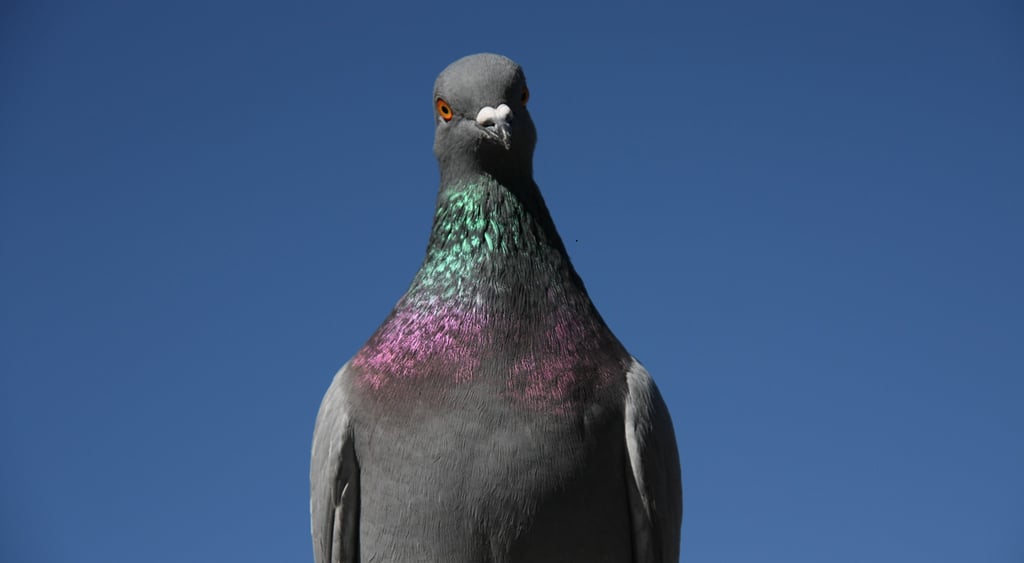
Neiry Group says the interface provides mild stimulation to selected brain regions, prompting the bird to prefer a certain direction, but otherwise, the bird behaves naturally. Such a biodrone doesn’t require a battery and can fly up to 400km a day without stopping.
According to the website, the company’s subsidiary is also testing neurochips for cows to increase milk yield.
Missile-guiding pigeons failed
Without peer-reviewed scientific studies available, it is difficult to evaluate whether the technology actually works.
Thus far, Russia’s biodrones sound much like the satirical movement, “The birds aren’t real,” which claims that the US government replaced all birds with identical drone replicas designed to spy on the American public.
Around the time when the first videos of Russian “pigeon drones” appeared, the movement posted on X that the team considers the videos “AI-generated.”
However, the conspiracy may have been at least partially inspired by a real Cold War project led by a behavioral scientist, Burrhus Frederic Skinner, called Project Pigeon, which aimed to turn the birds into devices for guiding missiles.
Skinner built a nose cone for a missile fitted with three small electronic screens and three tiny pigeon cockpits, according to Smithsonian Magazine. He trained to recognize the target's pattern and peck it.
Despite initial funding by the National Research Defense Committee, Skinner’s idea eventually failed.
Meanwhile, a 2024 study published in Science describes a bioinspired aerial robot that consists of a biomimetic skeleton and real pigeon feathers, which form wings and a tail that can spread and perform other bird-like movements.
Pigeon drones are “a dead end”
According to the “Eyes in the Skies” blog post, authored by a defense policy expert who goes by Mark K, the idea of pigeon biodrones is a “dead end” because it wouldn’t work at scale or survive operational conditions.
While there is legitimate research demonstrating that neural stimulation and implanted systems can influence avian movement, he emphasized that “influence is not precision control.”
“In the drone warfare environment, close enough is not a standard. Missions require reliable waypoint adherence, predictable loiter, consistent sensor pointing, and stable data transmission,” the blog post reads.
The author argues that modern unmanned warfare is moving toward cheap, scalable, disposable systems, whereas biodrones are the opposite, being “fragile, bespoke, ethically explosive, and operationally inefficient.”
In the drone warfare environment, close enough is not a standard. Missions require reliable waypoint adherence, predictable loiter, consistent sensor pointing, and stable data transmission.Mark K.
“Coffin with funny fans”
Russia has recently unveiled a robotic system, Depesha, to fight against kamikaze drones, KyivPost reports.
The footage shown on the state-owned channel Rossiya-1 introduces a vehicle covered in steel, with shafts carrying thin cables extended from all four sides. When rotating, these shafts – that look a lot like fans – are meant to create an additional protective layer.
Depesha, first unveiled at the Army-2024 defense forum, is built on an all-wheel-drive wheeled chassis with independent suspension, with each wheel powered by a separate electric motor.
Defense Express previously reported that Russia patented a similar concept that uses blades instead of cables in May 2025 to protect light vehicles.
Critics expressed doubt about the system’s effectiveness, suggesting that one rocket-propelled grenade would be sufficient to tear it apart, making it a mass grave.” One observer on Telegram called it a “coffin with funny fans” in modern warfare.
Unlock more exclusive Cybernews content on YouTube