Anthropic releases Claude Fable 5 – the Mythos AI model once deemed too risky for public use
Anthropic unveils Claude Fable 5 on Tuesday – its first publicly available Mythos-class AI model after restricting access for months over major cybersecurity and safety risks.
Anthropic's Claude Mythos AI model. Algi Febri Sugita/SOPA Images/LightRocket via Getty Images

 Follow us
Anthropic unveils Claude Fable 5 on Tuesday – its first publicly available Mythos-class AI model after restricting access for months over major cybersecurity and safety risks.
- Anthropic has publicly released Claude Fable 5, the first widely available version of its powerful Mythos AI system.
- The company says risky requests tied to cybersecurity, biology, and chemistry are automatically restricted or rerouted to older AI models.
- The launch comes days after Anthropic warned that frontier AI systems may be advancing faster than society can safely control.
Key Takeaways by nexos.ai, reviewed by Cybernews staff.
The AI start-up announced the launch alongside its upgraded Mythos 5, first introduced as a preview model on April 7th, upending the cybersecurity industry with its ability to find and fix software flaws at lightning speed.
While considered a boon for defenders, the preview model also raised fears that attackers could use the same capabilities to launch AI-powered attacks with similar speed and precision – leaving security teams unprepared to respond.






This led Anthropic to form Project Glasswing, a consortium of about 50 major tech and AI firms to test the models' full capabilities, while it readied an updated model with built-in guardrails to rein in the AI's power.
Sally Vincent, Senior Threat Research Engineer at Exabeam, says one of the more interesting aspects of Anthropic’s unveiling is the deployment model rather than the model itself.






“The industry increasingly appears to recognize that safety isn't just a model-training challenge. Access controls, monitoring, user vetting, and governance are becoming important layers for managing risk, particularly as AI systems become more capable in cybersecurity and other high-impact domains,” she said.
Cybersecurity concerns remain top priority
Anthropic says it will continue to gatekeep the fully loaded Mythos 5 for the trusted partners and cyber defenders of Project Glasswing, which also includes the US government.
Vincent says that although Anthropic’s tiered access approach is not entirely new, she believes layered privileges are becoming "more formalized, especially around advanced cyber capabilities."
“AI providers are making more deliberate decisions about who can access the most capable systems and under what conditions,” she explains.

Through Project Glasswing, Anthropic says Fable has already been used to help security teams identify and secure critical software vulnerabilities, citing this as the reason for deploying the model now, despite the risks.
Although Claude Fable 5 and Claude Mythos 5 share the same underlying frontier AI model, Anthropic says that Fable 5 was created with different safety restrictions that can block or redirect responses in high-risk areas.
To ensure users cannot exploit the model's capabilities – whether maliciously or by accident – Anthropic designed Claude Fable 5 to automatically revert to an older Claude Opus 4.8 chatbot if asked for assistance involving vulnerability discovery, offensive cyber activity, biology, chemistry, or other dangerous requests.
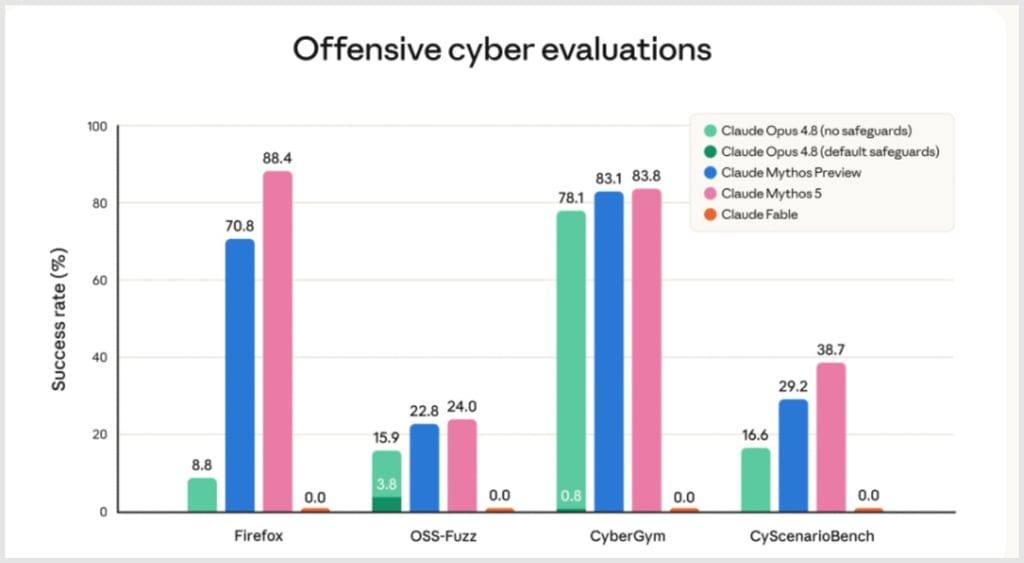
However, even with the deliberate and overly cautious addition of built-in safety guardrails, Anthropic says that more than 95% of sessions should remain on Fable 5 without triggering any restrictions.
Anthropic claims the “AI-powered safety classifiers” successfully blocked harmful cyber requests during extensive internal and external testing, including thousands of hours of jailbreak attempts.
“Fable 5 complied with zero harmful single-turn requests relating to planning a cyberattack, exploit development, or defense evasion – even against requests using 30 different public jailbreak techniques,” the company said.
Still, Vincent says that jailbreak-resistance claims should be viewed with appropriate caution as “strong evaluation results are encouraging, but also represent a point-in-time assessment.”
“Attackers continuously adapt, and the longer-term measure of effectiveness is how quickly providers can identify, respond to, and mitigate new bypass techniques as they emerge,” she says.
Fable 5 more powerful than previous models
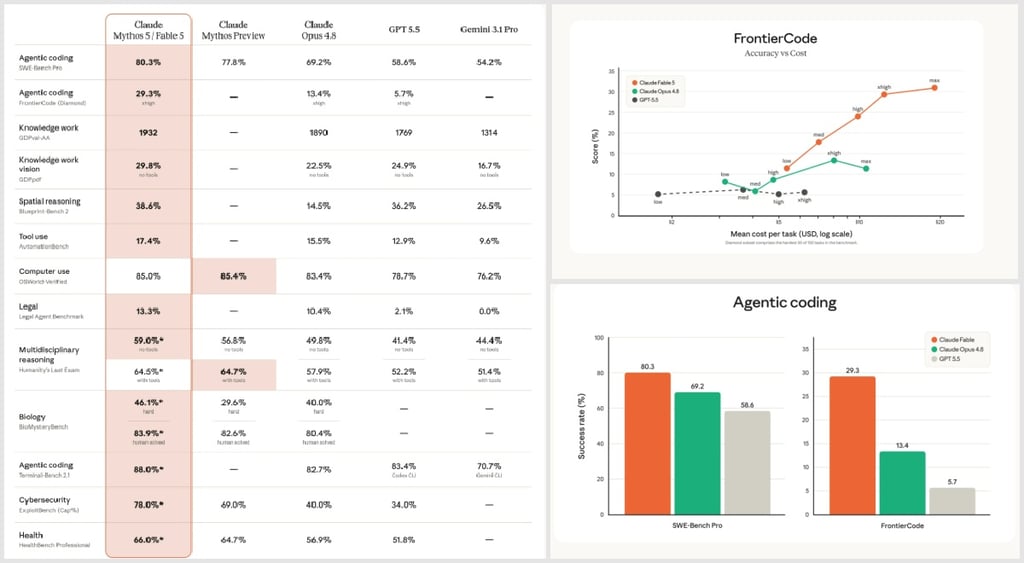
According to the San Francisco-based AI startup, Fable 5’s capabilities exceed those of any Claude model it has previously released to the public.
“It is state-of-the-art on nearly all tested benchmarks of AI capability, showing exceptional performance in software engineering, knowledge work, vision, scientific research, and many other areas,” Anthropic says.
The company touts the model’s ability to:
- Perform better on software engineering tasks, including coding.
- Handle longer, more autonomous workflows.
- Show improvements in knowledge work, vision, memory, and life sciences research.
- Produce novel scientific hypotheses.
- Speed up the development of new drug therapies.
For example, during early testing, fintech platform Stripe reported that Fable 5 compressed months of engineering into days.
And when it comes to both frontier and agentic coding, Anthropic says even at medium effort, “Fable can pass difficult coding tasks while meeting the standards of high-quality production codebases.”
Release lands amid growing AI safety fears
The launch comes just days after Anthropic, in a company blog post, raised concerns that AI may be advancing too rapidly, warning that AI would soon be able to self-improve without human prompting.
“Our internal data shows Claude is accelerating AI development—a possible path to recursive self-improvement, or AI autonomously building a more capable successor," the company said in an X post last week.
“It’s happening faster than we thought, and the implications deserve greater attention,” it said.

Anthony Grieco, Senior VP and Chief Security & Trust Officer at Cisco, says, “The pace of frontier AI development is changing the security landscape in real time.”
Grieco warns that defenders cannot afford to wait for the dust to settle. “The challenge is no longer just access to advanced AI, but how organizations operationalize it with the right harness, infrastructure, and agentic logic to turn speed into clarity and action.”
“As new models emerge faster than traditional security cycles can absorb, the organizations best positioned will be those that pair innovation with resilience; continuing to invest in the fundamentals that never go out of date: patching, MFA, segmentation, and Zero Trust," Grieco says.
Data retention, cost, and availability
All future highly advanced models, including Fable 5 and Mythos 5, will now support a new data retention policy, with "almost all" data deleted after 30 days, according to the company.
Furthermore, user data will not be used to train new Claude models and instead will only be used to help “defend against complex and novel attacks, as well as identify and reduce false positives,” Anthropic said.

Fable 5 is available to all users automatically starting Tuesday, while developers can use “claude-fable-5” directly through the Claude API.
Through June 23rd, Enterprise clients will also be able to use Claude Fable 5 for free.
After that, Anthropic will offer both Fable 5 and Mythos 5 at half the price of running Mythos Preview, costing users just $10 per million input tokens and $50 per million output tokens.
The company says it aims to offer Fable 5 as part of its standard subscription plans, although there is no set date as to when that would begin.

Check if your data was exposed
Find out if your email and related personal information have appeared in known data breaches.
Unlock more exclusive Cybernews content on YouTube.