Companies are doing this one thing with AI and it's making employees completely lose trust in leadership
It’s perhaps an interesting sign of the times that the latest Edelman Trust Barometer found that companies were actually the most trusted institutions of our age. A scarcely believable 78% of respondents said that they trust their employer. How does that level of trust square with an AI age in which so much of what we see and read is artificially generated?
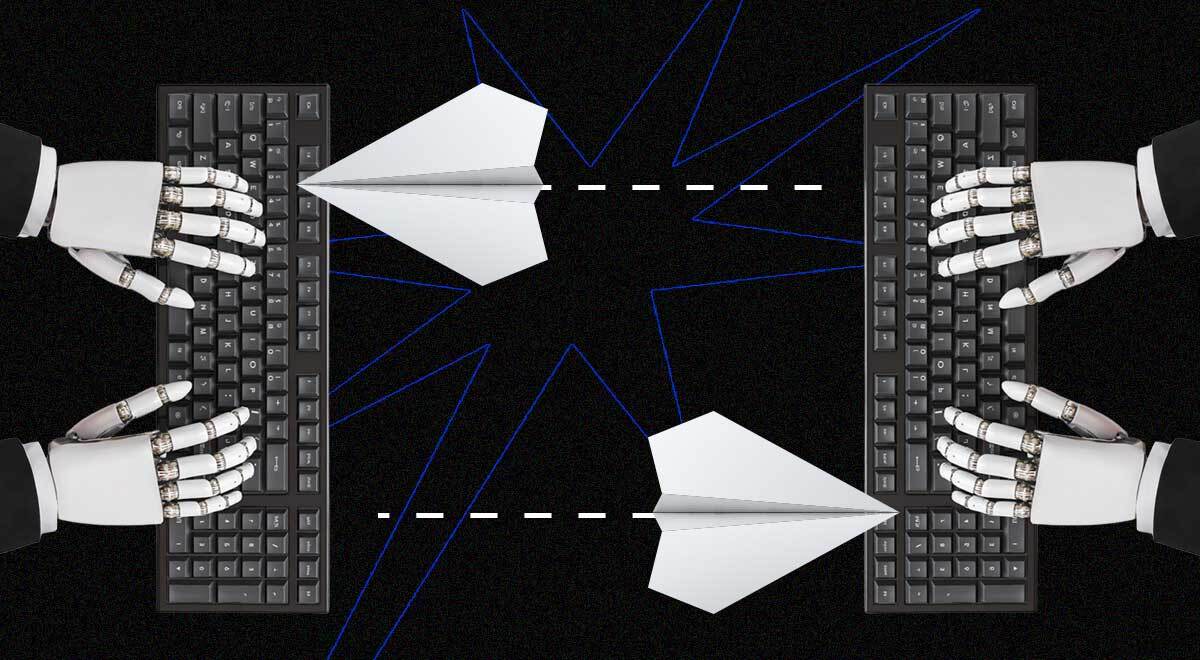
AI-message exchange between office workers. Image by Cybernews.

 Follow us
It’s perhaps an interesting sign of the times that the latest Edelman Trust Barometer found that companies were actually the most trusted institutions of our age. A scarcely believable 78% of respondents said that they trust their employer. How does that level of trust square with an AI age in which so much of what we see and read is artificially generated?
After all, we know from various studies that we tend to frown on colleagues using AI. Often this disquiet extends to a loss of trust in them, their authenticity, and their capabilities. This coincides with a recent survey showing that nearly all internal comms people are using AI to some extent, with over half using it extensively.
Can we retain the trust people seem to have in their employer when we’re using a technology that is known to sow distrust?
Saving time
That survey revealed the clear and obvious appeal of AI. It can draft earnings statements in seconds or generate a CEO message for an all-staff newsletter in minutes. In a crisis, it can churn out a response much faster than any human can. We’re in an era of ever leaner teams and extreme pressure to perform, so turning to a technology that promises to do what we need cheaply and efficiently makes a degree of sense.






This level of speed comes with a trade-off, however. Research has shown that readers generally can’t tell the difference between AI-generated content and that produced by humans, but when the genie is out of the bottle, and the AI author is revealed, your credibility and trustworthiness evaporate.
A study from the University of Kansas explored the use of AI in crisis communications, and the researchers found that when people discovered that AI had crafted the message, its effectiveness was reduced significantly. The crucial point is that this was in no way a reflection of either the tone or the quality of the message itself. It was purely a reflection of its origins.
Accountability matters
It’s not just a matter of perception either. Corporate communications, particularly in moments of crisis or change, serve a social function that transcends mere information transfer. For instance, when a company announces layoffs or explains a strategic pivot, relaying accurate words is often not enough. People want the authors to be accountable for what they say. They want to believe that a human being, preferably one in a position of authority, has wrestled with the decision and takes responsibility for it.

AI-generated messages, however polished, cannot bear this weight. As the Kansas researchers observed, the public cannot hold a machine responsible. This creates what might be called the authenticity trap: the more companies automate their communications to gain efficiency, the less authentic those communications appear to the very audiences they aim to persuade.
We’ve seen the consequences of this already, with Canadian transport agency Metrolinx heavily criticized for issuing an AI-generated apology after concertgoers suffered issues in Toronto.
People aren’t attacking the content as much as they are the method. After all, if a company can’t even be bothered to get a human to say sorry, how sorry are they really?
An empathy deficit
These examples provide salient lessons for those working in internal comms. While we’re perhaps not as good as we think at spotting AI-generated content, we are pretty good at spotting bullshit when we see it, and AI can still churn that out with gusto, with its trademark smooth but sterile, comprehensive but curiously devoid of genuine feeling style.






This matters enormously in an age when employee engagement and retention have become critical competitive advantages. When staff receive communications about restructuring, policy changes, or strategic initiatives, they are not simply processing information.
They’re gauging whether leadership is on the same wavelength, whether their contributions are valued, and whether their loyalty is deserved. No matter how well-crafted an AI-generated message is, it will struggle to convey these very human and very important signals.
Some companies have attempted to split the difference, using AI to draft messages that humans then personalize and approve. Even this approach isn’t without risk, as research shows that readers can view even hybrid human-AI writing as inauthentic. It’s a phenomenon known as “contamination by association,” and it’s when the very hint of AI involvement erodes trust in the author and the message.
The way forward
Does this mean that AI has no role in corporate comms? No. The technology is great at certain tasks, whether that’s summarizing lengthy documents, translating content across languages, identifying emerging issues from social media chatter, or drafting initial frameworks that human writers can refine. The key is to look at where efficiency matters the most and where authenticity is least important.

Check if your data was exposed
Find out if your email and related personal information have appeared in known data breaches.
When communication relies more heavily on the human touch, using AI will be a big mistake, as no system can reliably replicate the empathy required to show genuine concern or navigate the complex stakeholder dynamics. It certainly won’t provide the accountability that people demand.
As the technology becomes more capable, the temptation to turn to it to automate internal communications will grow. For instance, research has shown that AI is now pretty good at mimicking well-known authors and their tone of voice. Why not task it with mimicking the CEO, you might think? From an efficiency point of view, that might work, but from a credibility, accountability, and empathy point of view, the costs will outweigh any gains you might obtain.
This isn’t a case of further optimizing an approach that employees don’t really want. It’s about acknowledging those needs and not using a technology to try and meet them just because you can. The best companies will understand the fact that, at heart, internal comms is about a genuine human being putting their name to words and standing behind what they say. Don’t lose sight of that.
Unlock more exclusive Cybernews content on YouTube.