Digital puppeteers: the hidden influence of AI in politics


 Follow us
A few months ago, I attended an AI workshop, and one part in particular really caught my attention. They showed us an AI tool that could predict election results with impressive accuracy. The setup was simple: a screen, some numbers, and a few graphs. Still, I was surprised by how much information it could reveal. That’s when I started wondering how much AI is already used in politics, how it works, and what that means for us as citizens.
In this article, I’ll explore how AI is currently being used in politics around the world and the benefits it offers. I’ll also discuss the risks, especially when AI is used for undemocratic purposes, and suggest what governments and individuals can do to help reduce the harm.
Key points (TL;DR)
- AI is already shaping global politics. From established democracies to less free societies, political teams use AI to research public opinion, create campaign materials, spot trends, draft documents, and even predict election outcomes.
- Persuasion is getting personal. AI lets political teams microtarget people based on their data and emotional weak spots, sending thousands of tailored ad versions.
- AI is flooding the information space. Deepfakes, fake robocalls, meme videos, and low-quality AI news sites now influence elections and public debate in places like Taiwan, the US, India, and others. Authoritarian governments also use these tools for propaganda and control.
- AI is useful when humans stay in charge. Used carefully, AI can make politics less slow and more responsive: faster drafting, better analysis, easier access to information, and even tools that help detect misinformation.
- Both politicians and regular people have a part to play in keeping AI in check. Governments are beginning to regulate AI in politics with rules like labeling, deepfake bans, and transparency laws, but technology is changing quickly. We can all help by slowing down, fact-checking, and thinking more carefully before sharing information. This is now a basic part of being a responsible citizen.
Pulling the strings: how AI works behind the scenes in politics





AI is already changing how campaigns run, how governments operate, and how information spreads online. Most of this happens quietly in the background, but its impact is very real. Here are a few ways AI is used in politics today.
AI – the unseen campaign worker
Across countries like the US, UK, Germany, and Canada, political teams now use AI to scan what voters care about, analyze public opinion, write press releases, and predict which issues might trend next.
Here’s one of the most recent examples: during the 2024 US presidential race, nearly all major campaigns experimented with AI to draft fundraising emails, automate outreach, analyze voter sentiment, and respond quickly to shifts in public mood.
Robert F. Kennedy Jr.'s campaign, for example, ran a Microsoft-powered chatbot built on OpenAI’s models. This tool was designed to instantly answer voter questions and provide tailored responses, making it possible for the campaign to engage with thousands of supporters day and night. But the chatbot also drew controversy: it affirmed Kennedy’s promotion of various unsubstantiated theories and appeared to work around OpenAI’s ban on using their tech for political campaigning.
Ads that know you better than you know yourself
AI is also making the campaigns much more personal. By analyzing everything from voting history and social media to consumer data, AI breaks down the electorate into detailed segments. This allows campaign teams to target their messages with extreme precision, sending thousands of ad variations at once so each group hears exactly what matters to them.
For instance, The New York Times reported that Donald Trump’s team used highly targeted streaming ads to reach swing voters with different messages based on their specific concerns and preferences. AI‑powered analytics and ad platforms make this kind of fine‑grained targeting much easier to scale.
Europe has also adopted similar strategies. A Kofi Annan Foundation review found that during the 2024 European Parliament elections, campaigns across several countries used generative AI platforms to A/B test thousands of variations in their outreach. These platforms let teams see which slogans or messages worked best, sometimes even before being shown to human focus groups, allowing rapid pivots in narrative and tone.
Far-right parties in countries like Germany and France experimented with AI to create content and test engagement on social media, further refining what resonated with their supporters.
In short, campaigns now use AI not just for broad outreach, but to enter a new era of highly personalized persuasion, where each message can be narrowed down to the finest detail based on real-time data and instant feedback.
Governments upgrade – with help from algorithms
Here’s another example of AI use in politics. Governments and local authorities have started using AI for tasks like drafting legal texts, reviewing the fairness of new laws, and simulating the impacts of proposed policies. For example, in California, AI tools help legislative staff process thousands of public records more efficiently, and there are now many AI‑related laws and initiatives that affect how algorithms are used in areas like public administration, data processing, and legislative work.
Altogether, over 30 US states have adopted or piloted AI tools for legislative and administrative tasks by 2025, with hundreds of related bills debated nationwide. AI-powered chatbots are also being used by state agencies in the US to simplify citizen interactions, directing people to the right services and answering common questions.
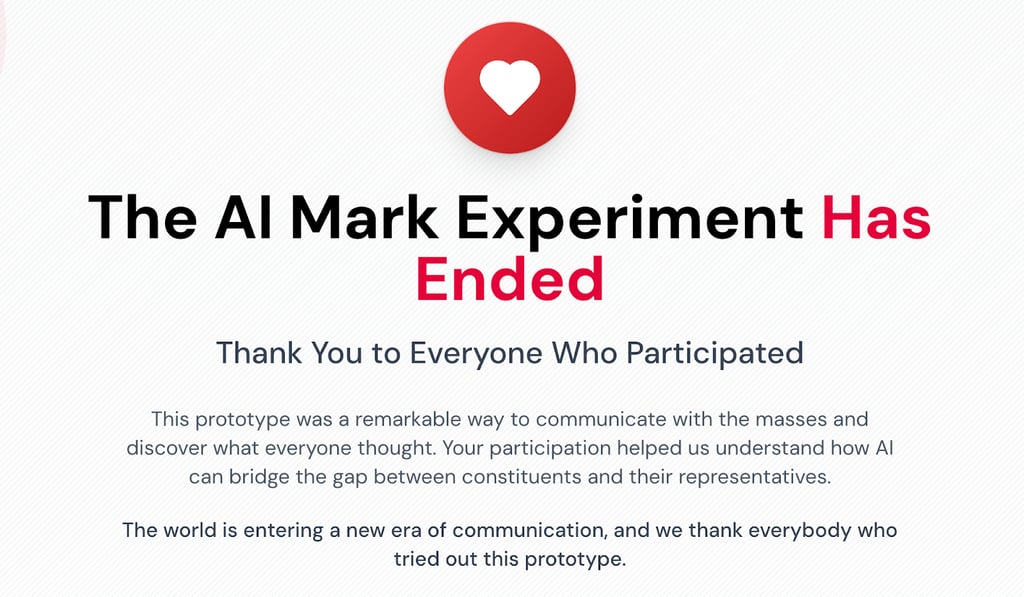
In Europe, the UK has also begun experimenting with AI to improve government engagement. In 2025, MP Mark Sewards launched AI Mark, an AI-powered chatbot that allowed residents to ask questions or get information from their Member of Parliament at any time of day. It was framed as a way to help with constituency casework rather than a campaign tool. The experiment has since ended, and the AI Mark project is no longer active.
The disinformation arms race
As AI gets more advanced, so do the tricks people use to fool voters. In 2024, the world saw an explosion of AI‑generated disinformation: deepfake videos, synthetic audio, and fake news stories that could trick almost anyone scrolling through their feed. This hasn’t just made elections messier – at times, it has made them feel downright bizarre.
Personally, I can think of several moments when my own family members, especially older relatives, shared something obviously fake (at least to my moderately trained eye) with complete seriousness. Seeing that happen up close was honestly quite disturbing. It made me realise how unprepared and digitally illiterate we still are, as a society, when it comes to AI‑generated content.
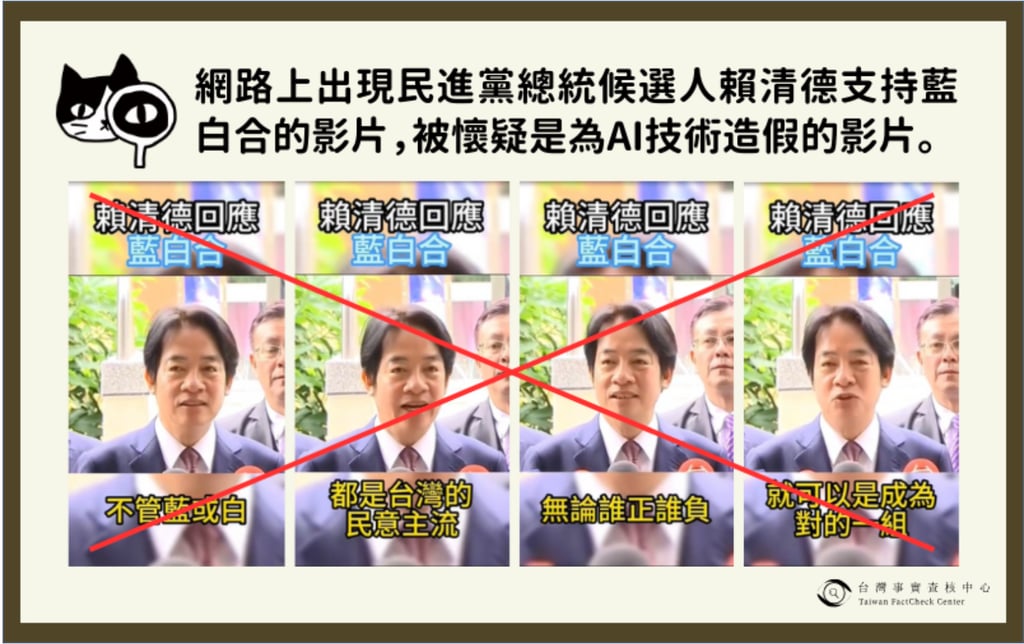
One of the most widely discussed deepfake incidents happened during the 2024 Taiwan presidential election. It involved a fake video titled Lai Ching-te’s Response about the Cooperation between the Blue Party (KMT) and the White Party (TPP). In this video, Lai, who was running for president with the Democratic Progressive Party (DPP), appeared to support the opposition KMT and TPP alliance, saying, “Whether it’s the blue party or the white party, they do represent the mainstream view of Taiwanese people. No matter who will be the president or the vice president, either combination can be the right team.”
In reality, Lai never made this statement. The Taiwan FactCheck Center found that the video used a mix of old image manipulation tricks and new deepfake AI tools to convincingly fake the candidate’s endorsement. The video spread quickly on social media before being debunked, showing how easily modern AI can create a believable political message during election season.
In the US, the 2024 primaries saw a notorious incident involving a fake robocall using AI to clone President Joe Biden’s voice, telling New Hampshire Democrats not to vote on primary day. The deepfake audio was shared widely before officials could catch and debunk it, showing how even a phone call from a trusted name can be faked now. You can listen to some snippets of this robocall in this CBS News video.
The weirdness didn’t stop there. Some deepfakes went for humor (or humiliation): there were manipulated videos of candidates rapping, singing, or caught in impossible situations, often spreading faster than legitimate clips. For example, in the 2024 Indian election cycle, AI-generated meme videos of candidates performing Bollywood dances started trending weeks before the vote, blurring the line between satire and scandal.

As this “arms race” heats up, political teams, watchdogs, and tech companies are all rushing to spot and stop AI-generated lies. The big challenge? Learning to double-check before believing (and sharing!) anything you see, especially during election season.
Not just for democracies: AI and automated propaganda
AI’s impact on politics isn’t limited to open societies. It has also become a powerful tool for repression and propaganda in authoritarian states – which, honestly, feels a bit like handing a monkey a grenade.
In the past year, major state-sponsored groups from Russia and China have used AI to flood social media and news sites with “AI slop” – large amounts of low-quality, automatically generated text, images, and fake articles, all meant to influence public opinion or drown out real debate.
For example, in 2024, US authorities exposed covert Russian campaigns that used AI-powered bot farms and fake “local news” websites to spread misinformation around the US presidential election. Investigations found entire networks of accounts and sites, created at scale with generative AI, which were designed to look authentic but were actually centralized efforts to manipulate voters or sow confusion.
Inside their own borders, authoritarian regimes use the same AI tools to censor dissent, automate surveillance, and push government-approved stories, sometimes even crushing opposition with algorithmic precision.
This “AI arms race” feels truly worrying. It makes it easier than ever to flood people with believable lies, and to do it fast and at a huge scale. That doesn’t just put pressure on democracies trying to keep elections fair – it also hands authoritarian regimes new tools to push their propaganda, silence critics, and tighten control.
Risks and red lines: how it can go very wrong
So far, AI in politics might sound like a mix of clever tools and some weird deepfake stories. But when you step back, there are a few big red flags that keep coming up in research and real elections.
- Hyper‑targeted manipulation. Microtargeting doesn’t just mean “better ads” – it can also mean quiet manipulation. AI can spot who is scared, angry, or unsure, and then hit those vulnerable points with tailored content. This kind of emotion‑based targeting can distort how people see candidates and issues.
- Truth erosion and the liar’s dividend. Deepfakes and synthetic audio make it easy to put fake words into a politician’s mouth, as we saw with the Lai Ching‑te video in Taiwan and the fake Biden robocall in New Hampshire. On the other hand, as people grow more aware of the AI-generated content, they can treat even the real evidence with suspicion and disbelief, making it harder to separate truth from lies.
- Bias baked into decisions. AI tools are trained on real‑world data, which often includes existing inequalities and prejudices. There are ongoing concerns about fairness and bias in AI systems, especially when they are used in sensitive areas like policing, welfare, or credit scoring.
- Constant doubt and exhaustion. There’s also a softer but very real risk: people just get tired and stop trusting anything. Surveys in 2024-2025 show that most voters expect AI to be abused in elections, and many already feel they can’t easily tell real from fake online. Over time, that kind of confusion can erode trust in the whole system, feed voter apathy, and make people less likely to engage or even turn out to vote.
- Surveillance and repression. Finally, the same tools that help campaigns understand voters can be used by authoritarian governments to watch citizens, score their loyalty, and crack down on dissent. Analyses of recent years show AI being used not only to generate propaganda but also to classify posts, track activists, and automate censorship.
Put simply, AI doesn’t automatically break politics. But without rules and oversight, it can quietly twist it in ways that are hard to see and even harder to fix.
Not all doom: what AI gets right in politics
Even with all these risks, it would be unfair to say AI is only bad news. A lot of people working in politics and public service see it as a useful tool – as long as humans stay in charge. Here are some of the most obvious benefits it brings:
- Faster, cheaper, less boring work. Many tasks in politics are repetitive: drafting letters, summarizing long documents, translating materials, or sorting through thousands of public comments. AI tools can do much of this paperwork faster and at lower cost, freeing up time for human staff to actually talk to people or think about policy.
- Better access to information. Chatbots and AI assistants can make it easier for people to get basic information: how to vote, what a new policy means, or where to find help with a specific problem. When these tools are set up responsibly, they can reduce waiting times and help people who might otherwise struggle with complex forms or government jargon.
- Smarter analysis for real problems. AI can also help model the impact of policies – for example, predicting how a tax change might affect different income groups, or how emergency resources should be allocated during a disaster.
- AI as a defender, not just an attacker. It’s easy to focus on deepfakes and disinformation, but AI is also used on the defensive side: to detect fake accounts, spot suspicious sharing patterns, and flag misleading content faster than human teams could manage alone.
So yes, AI can be harmful. But in many places, it’s also quietly making political work less slow, more informed, and sometimes more accessible – especially when humans set clear limits on how it’s used.
What governments are doing to rein in political AI
Currently, governments and regulators around the world are trying to catch up with AI in politics.
The EU’s AI Act: strict rules and transparency
The European Union’s AI Act is the most ambitious attempt so far to regulate AI in general. It creates strict rules for high‑risk systems and includes transparency requirements for AI that interacts with people or generates synthetic content.
One part of the law focuses directly on deepfakes and synthetic media: providers must clearly disclose when content is AI‑generated, so people know they are not watching or listening to a real human. Although the Act is not focused only on elections, these rules are expected to apply to political content as well.
United States: patchwork rules and early steps
In the US, there is still no single federal law that directly regulates AI in political campaigns. Instead, there’s a growing patchwork:
- The Federal Election Commission (FEC) issued an interpretive rule in 2024 warning that deceptive AI in campaign ads could already fall under existing bans on fraud and misrepresentation, even without new laws.
- The Federal Communications Commission (FCC) proposed rules to require on‑air and written disclosure when AI‑generated content is used in radio and TV political ads.
- Several states, including California and New York, passed their own laws to label AI‑generated political ads and restrict malicious deepfakes intended to mislead voters.
- Congress has also received policy briefs on AI and campaign finance, laying out options from disclosure rules to outright bans on some uses of AI in political messaging.
Other countries: early moves and election‑specific rules
Globally, many countries are exploring similar steps. Legal and privacy experts expect more targeted rules around political deepfakes, transparency requirements for AI‑generated content, and election‑specific guidelines to appear in the coming years.
Some election commissions have already issued codes of conduct for parties, warning that the use of AI to mislead voters could lead to sanctions or removal of content.
The overall picture is still messy. But the direction is clear: more transparency, more labels, and more consequences for those who use AI to poison the public conversation.
What you (yes, you) can do about it
All of this can feel a bit overwhelming. But there are concrete things you can do to protect yourself and your community from AI‑driven political manipulation.
You don’t need special tools – just a few simple habits:
- Slow down before you share. If something makes you very angry, scared, or excited, pause for a moment. A lot of AI‑generated political content is designed to trigger emotions so you hit “share” without thinking.
- Check the source. Look at who posted it first. Is it a known news outlet, an official campaign account, or a random account you’ve never seen before? Be extra careful with screenshots, cropped images, and reposted videos with no clear origin.
- Look for basic weirdness. With videos and images, watch for odd eye movement, strange lighting, hands that look wrong, or lips that don’t quite match the words. With audio, listen for unnatural pauses or flat tone.
- Cross‑check with trusted outlets. If a clip claims something big and perhaps even controversial, see if it’s being reported by major, reputable news organizations. If no one else is covering it, that’s a warning sign.
- Use fact‑checkers. Many fact‑checking organizations and election authorities now publish quick debunks of viral deepfakes and rumors. If something feels off, search a few words from the claim plus “fact check” and see what comes up.
- Be careful with AI tools yourself. When you use chatbots or image generators, don’t treat their answers as verified truth. AI can be confidently wrong, especially on breaking political news.
- Talk about it with people you know. If you see friends or family sharing obvious fakes, gently point them to correct information rather than attacking them.
- Support transparency. When you have the chance, back rules and platforms that clearly label AI‑generated content and explain how political ads are targeted. Transparency is not a full fix, but it helps everyone see what’s going on.
No single person can fix the complex problem of AI in politics. But if enough of us build these small habits into how we read, watch, and share, it becomes much harder for bad actors – human or machine – to quietly mess with what we see, believe, and vote for.