How close are we to autonomous weapons?
Imagine living in a future tech dystopia where machines decide who lives and who dies? Sadly, autonomous weapons capable of independently identifying and engaging targets are already in use and hiding in plain sight.

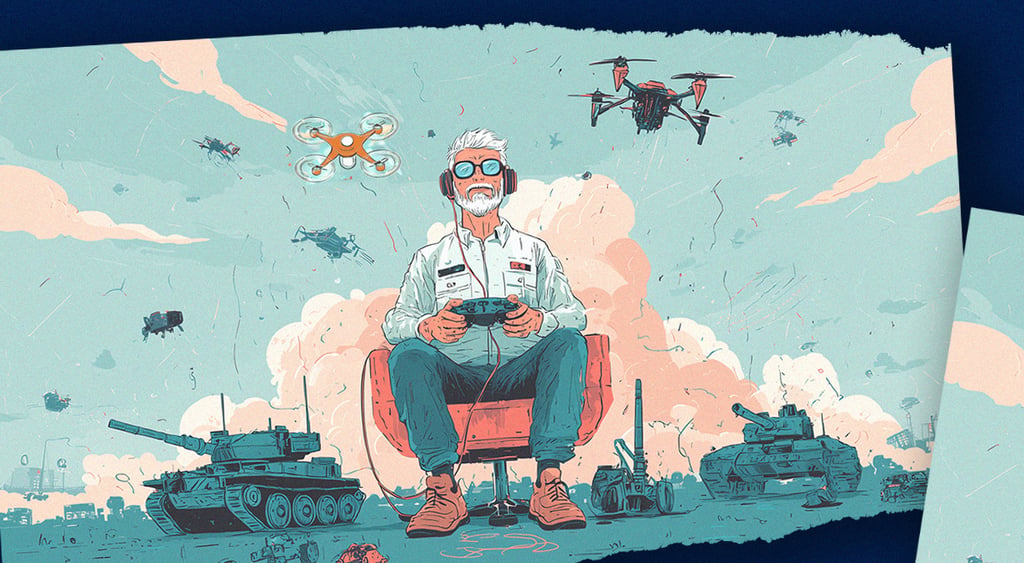
Image by Cybernews.

 Follow us
Imagine living in a future tech dystopia where machines decide who lives and who dies? Sadly, autonomous weapons capable of independently identifying and engaging targets are already in use and hiding in plain sight.
Many have become desensitized by drone strikes or civilian casualties in their newsfeeds, choosing the distraction of celebrity gossip reminiscent of the woman in the red dress in the Matrix.
Autonomous weapons have become normalized without serious debate, simply because society looks the other way. But none of this happened overnight. The Turkish STM Kargu-2 drone was used in Libya in 2020 with autonomous targeting capability. Elsewhere, Israel's Harpy and Harop loitering munitions have been in service for years, designed to patrol a zone, detect enemy radars, and destroy them without human intervention once launched.
In Ukraine, Russia's new V2U drones are being used daily, employing onboard AI to navigate and strike even under GPS jamming. The crucial distinction is that most systems still involve human oversight at some stage.
Despite promises to keep humans "in the loop" or "on the loop", drones continue missions without communication, scan for suitable targets on their own, and then strike. The line between human-controlled and machine-controlled warfare is increasingly blurred.






Ukrainian authorities are reporting the increasing use of Russian V2U AI drones in areas where Ukraine is attempting to build up and regroup. These drones are being actively used in the Sumy region, where the Russian Federation is currently increasing operational pressure. pic.twitter.com/6tdLXAeP6i
undefined Alexeï (@jeanlol67573289) June 10, 2025
Moving along the spectrum of autonomy
Some systems flag threats for human operators, while others can hunt and strike without approval. In between are semi-autonomous platforms that handle navigation and tracking but still leave the trigger pull to a person.
The majority of deployed systems today fall into that middle category. For example, the MQ-9 Reaper drone can fly autonomously along pre-programmed routes using image recognition to identify vehicles of interest. But a human operator must still authorize any strike.
Loitering munitions such as Israel's Harop or Russia's Lancet patrol an area and automatically dive onto identified radar or armored targets, though humans order their launch. South Korea's SGR-A1 robotic sentry possesses the technical capability to detect intruders and fire on them without requiring confirmation from a human. These examples illustrate how autonomy has crept into combat.
Functions such as navigation, target tracking, and swarming are automated because they are tasks where machines excel. The difficult questions lie in the higher-level judgments of distinction and proportionality, which are central to the laws of war.
Alternatively, the Samsung SGR-A1 sentry gun has an effective maximum range of roughly 3km and only costs $200k per unit. The entire border could receive 24/7 autonomous-lethal coverage for as little as $250 million. pic.twitter.com/DoRHn71z9T
undefined Puzzlerook_actual (@Puzzlerook2) June 9, 2025
Technology that is ready enough
The technology enabling autonomous weapons has matured unevenly. Navigation and mobility are solved. Drones and ground vehicles can move complex routes, avoid obstacles, and return home without human input. Swarming is advancing rapidly, with algorithms inspired by insect behavior allowing dozens of drones to coordinate movements without colliding. Here in 2025, both the United States and China demonstrated swarms of more than 100 drones operating in a coordinated manner.
Target recognition has also advanced. Sensors can identify tanks, aircraft, or radar signals with a high degree of accuracy. Electronic warfare emitters are easy for algorithms to track, and anti-radar drones, such as Israel's Harpy, have worked reliably for years.
Identifying people, their intentions, and the context in which they act is proving to be much more challenging to get right. A person carrying a shovel might be a farmer or a combatant burying an explosive. Human soldiers often struggle with such judgments, and current AI is far from reliable enough to make them.

Defensive systems such as Israel's Iron Dome, or the US Navy's automated cannons for missile defense, operate at machine speed to intercept incoming threats. Loitering munitions patrol for tanks or radar emitters and destroy them instantly when detected.
The war in Ukraine has pushed development further, with both sides using drones that continue to operate when communication is jammed, effectively making their own strike decisions within pre-defined parameters.
The trajectory is unmistakable. With programs such as the US "Replicator" initiative, which aims to field thousands of autonomous drones by 2026, scale is accelerating. China's unveiling of a UAV mothership capable of releasing swarms at high speed shows that it too intends to fight at scale. Russia's routine use of V2U drones in Ukraine suggests it already considers autonomous munitions dependable enough for daily combat.
🇨🇳undefinedCHINA’S FIRST AERIAL MOTHERSHIPundefined
undefined WORLD AT WAR (@World_At_War_6) August 8, 2025
China's first aerial mothership, known as the Jiu Tian (meaning undefinedHigh Skyundefined or undefinedNine Heavensundefined) is a high-altitude, long-endurance unmanned aerial vehicle (UAV) designed to deploy swarms of up to 100 smaller drones, including kamikaze UAVs, for… pic.twitter.com/NozNVG0CL7
The ethical divide
The deployment of autonomy is not limited to conventional warzones. Border security and law enforcement are emerging domains where armed robotics are already in use. From South Korea's robotic sentries, which detect and fire at intruders, the towers, powered by AI, scan the desert on the US-Mexico border for movement to alert patrol agents. Even law enforcement has experimented with armed robotics, with police using a robot to end a standoff by killing a shooting suspect.
Machines do not act out of anger or fear. There is an argument that, with proper constraints, they could make fewer errors than stressed soldiers. Roboticist Ronald Arkin argues that autonomous weapons might one day adhere to the laws of war more strictly than humans, but whether that is achievable is still up for debate.
Ethicists and campaigners warn of another danger: speed. Machines make decisions in milliseconds. Two opposing autonomous systems might interact in ways that escalate a conflict before humans can intervene, a scenario often described as a "flash war." The possibility of unintended escalation is one of the greatest fears.
Could AI weapons help deter conflict — and even foster peace? Here’s how @PalmerLuckey says this new arms race is already changing the future of warfare: https://t.co/Zx6FYPDlSu
undefined TED Talks (@TEDTalks) April 30, 2025
The law is struggling to keep pace
International humanitarian law already requires that weapons distinguish between combatants and civilians and avoid disproportionate harm. If an autonomous system cannot meet those standards, it is unlawful. But many examples on our newsfeeds prove we are a long way from universal compliance.
For a decade, governments have debated their concerns within the UN Convention on Certain Conventional Weapons. Progress has been slow, in part because decisions there require consensus. A majority of states now support some form of new treaty, many calling for a ban on weapons that target humans without meaningful human control.
The International Committee of the Red Cross has echoed that call by bringing its emblem into cyberspace. The obstacle lies with the major military powers.
💻 Armed conflicts are not just fought on the battlefield, but also on the Internet.
undefined ICRC (@ICRC) January 26, 2024
We are seeking the support of states around the world to create a ‘digital red cross/crescent emblem’ to protect those affected by armed conflicts online. This is how 👇 pic.twitter.com/8bqfa25a2P
A strategic arms race
Autonomous weapons have become another front in great power competition. The United States is accelerating the development of swarms. China pursues "intelligentized warfare," integrating AI across its forces. Russia is conducting combat testing of new AI munitions and blocking progress on the treaty at the UN. Israel continues to innovate and export loitering munitions. Turkey and South Korea are investing in affordable drone systems.
The incentives are obvious. A mission that costs millions with cruise missiles can be carried out with drones costing a fraction. That logic appeals not only to advanced militaries but to smaller states and even non-state actors. The danger is proliferation. The components for autonomy are widely available and often have dual-use applications. Off-the-shelf parts and open-source software could enable terrorist groups or insurgents to build their own lethal autonomous systems.
Autonomy also alters deterrence. Leaders may be more willing to use force if machines, rather than soldiers, bear the risks. The threshold for conflict could be lowered.
49-drone swarm defeated with one instant & low-collateral pulse of electromagnetic interference.
undefined Epirus (@epirus) September 10, 2025
👀 See for yourself: pic.twitter.com/66WZeXCBti
The narrowing window
Within the next two years, the large-scale deployment of swarms is likely, with programs like Replicator and their Chinese counterparts moving forward rapidly. Unless law and policy catch up, routine independent battlefield deployment will become entrenched by the middle of this decade.
Autonomous weapons are already deployed in conflicts and integrated into the strategies of major powers. What remains contested is not whether they exist but how far they should go.
Technology is moving quickly, driven by cost, speed, and military advantage.




Law and ethics are moving slowly, bogged down in debates and blocked by great power rivalry. The future of autonomous weapons will be defined by whether humanity can bridge that gap before autonomy becomes routine in war.
The question is whether we can control how they are used, or whether we will look back in a decade and realize that we crossed a line without ever intending to do so.
Unlock more exclusive Cybernews content on YouTube.