Palantir’s Sankar says the Iran war is the first major AI-powered conflict
Shyam Sankar, chief technology officer at Palantir Technologies, says the ongoing war in Iran will be remembered as the first major combat operation powered by artificial intelligence (AI).
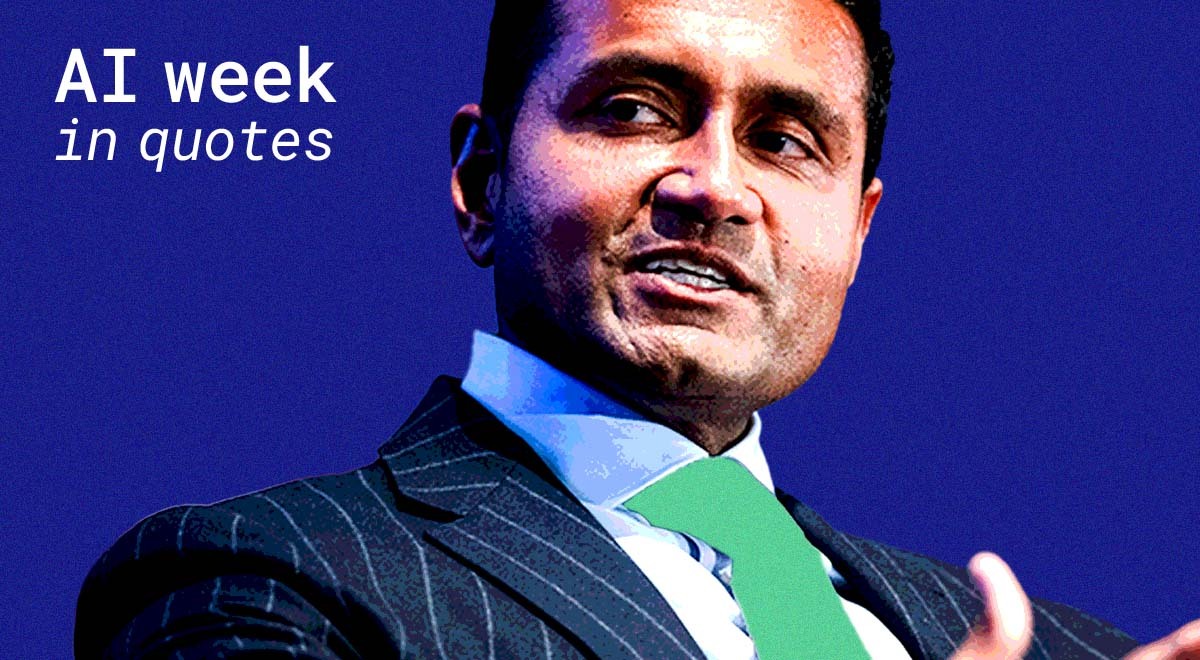
Shyam Sankar. Image by Cybernews

 Follow us
Shyam Sankar, chief technology officer at Palantir Technologies, says the ongoing war in Iran will be remembered as the first major combat operation powered by artificial intelligence (AI).
Meanwhile, Nvidia’s CEO announces the arrival of superintelligence, and the boss of Siemens suggests that Europe should put the brakes on its AI sovereignty.
This article is part of Cybernews’s weekly series, “AI week in quotes,” summarizing the most important developments in AI by quotes from the industry leaders, independent experts, and decision makers.






AGI is here, Huang says






Nvidia’s CEO Jensen Huang made the headlines this week for announcing that artificial general intelligence (AGI) has been achieved during an appearance on computer scientist Lex Friedman’s podcast.
I think we achieved AGI.Jensen Huang
AGI is a loosely defined term that usually refers to a superintelligence that matches or surpasses human capabilities. However, Friedman described it as a system “able to start, run, and grow a successful technology company that is worth more than a billion dollars.”
Despite declaring the arrival of AGI, Huang said none of the current AI systems would be able to create another Nvidia, which is the world’s most valuable company.
“First major AI-driven combat operation”
Palantir’s Sankar told Bloomberg TV that the ongoing war between the US, Israel, and Iran may be considered the first major conflict driven by AI.
Obviously, current operations are ongoing, but people will reflect back and say this is the first large-scale combat operation that was really driven, enhanced, and made substantially more productive with technology, with AI.Shyam Sankar
Palantir’s Maven Smart System, a digital mission control platform, is among the AI tools currently used by the US in the war.
In addition, Anthropic’s chatbot Claude is being used for intelligence analysis in the conflict, despite the Pentagon blacklisting the company after it refused to drop guardrails against its tools being used for powering autonomous weapons and domestic mass surveillance.
The “disaster” of Europe’s AI sovereignty
Siemens CEO Roland Busch warned of a “disaster” if the European Union (EU) prioritizes achieving AI sovereignty over using existing tools to boost economic growth.
You should not throttle your innovation speed for the sake of creating sovereignty. This would be a disaster.Roland Busch
Busch acknowledged that having more of its own AI infrastructure would make Europe “more resilient” over time, but cautioned against waiting for AI factories to be built in Europe “before we start tuning our models.”
As the EU strives to achieve digital sovereignty, including in AI, where it currently lags behind the US and China, the bloc is mulling simplifying its AI regulations, as proposed in the Digital Omnibus Package.
Mario Mariniello, a non-resident fellow at Bruegel, a Brussels-based think tank, writes that the legislation weakening tech users’ rights will not boost EU tech markets.
There is no convincing evidence that EU safeguarding of fundamental rights is behind the lukewarm performance of European AI markets.Mario Mariniello
He argues that the current state of EU tech is a result of past industrial choices, such as a relatively small global share of high-tech R&D expenditure and focus on mid-tech sectors, rather than the impacts of digital regulations.
Meanwhile, complex and strict Chinese AI regulations don’t prevent markets from thriving, while factors like energy costs or access to finance can play a more significant role.
AI to concentrate wealth among investors
Larry Fink, CEO of the world's largest asset manager, BlackRock, wrote in a letter to investors that the vast majority of wealth has flowed to people who own assets, not to people who earn most of their money by working.
Citing data that the US stock market has grown more than 15 times the value of a dollar tied to median wages since 1989, Fink predicted that AI will further exacerbate the trend.
Now AI threatens to repeat that pattern at an even larger scale – concentrating wealth among the companies and investors positioned to capture it.Larry Fink
Unlock more exclusive Cybernews content on YouTube.