The projects to keep astronauts healthy, millions of miles from Earth
AI-boosted developments in astronaut healthcare could benefit those on Earth, too.


 Follow us
AI-boosted developments in astronaut healthcare could benefit those on Earth, too.
Donald Trump recently made - and then deleted - a Truth Social post touting 'Medbeds': devices that can diagnose and cure virtually all diseases without the intervention of a doctor.
But while Medbeds are of course completely fictional, they have something in common with new technologies currently under development by NASA, Google, and other companies, in terms of their ability to diagnose and treat medical problems autonomously.
The health issues astronauts face
Supporting crew health through space-based medical care is becoming increasingly important as NASA missions venture deeper into space.





In low gravity, human bodies are vulnerable to a wide range of health problems that are rarer or less serious on Earth. Bones can lose density, and muscles weaken - including the heart, which has less work to do. Balance can become altered, eye shape can change, and even digestion can be affected.
Meanwhile, radiation can cause radiation sickness, central nervous system abnormalities, degenerative diseases, and an increased lifetime risk of cancer.
And all this, of course, comes on top of the normal risks of illness and injury.
But there isn't always a doctor on board a spacecraft, and communication with Earth may be limited - or very slow over great distances. And as NASA missions go further into space, there's a growing need for alternatives.
Google and NASA collaborate
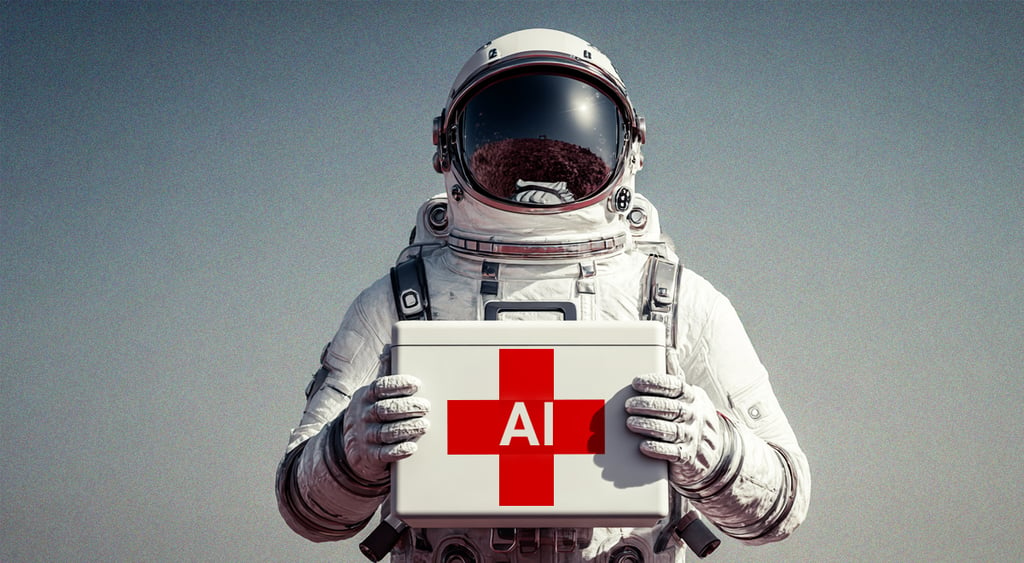
This is where the Crew Medical Officer Digital Assistant (CMO-DA) comes in. Under development by NASA and Google, this automated Clinical Decision Support System (CDSS) uses AI to help with medical care for astronauts.
The aim is to autonomously diagnose and treat symptoms when there’s no better alternative, or to support a designated crew medical officer or flight surgeon in keeping the crew healthy and making medical decisions.
Trained on existing spaceflight literature, the AI system uses cutting-edge natural language processing and machine learning techniques to provide real-time analyses of crew health and performance. Initial trials have shown promise in terms of diagnosis, with examples including an ankle injury, flank pain, and ear pain.
Google and NASA are now collaborating with medical doctors to test and refine the model, with plans to include more data sources, such as medical devices, in the future.
"This tool represents an important milestone for AI assisted medical care and our continued exploration of the cosmos," says Jim Kelly, vice president of federal sales at Google Public Sector.
And this isn't NASA's only effort to use AI to help monitor and improve astronaut health. In another project, the NASA-funded Translational Research Institute for Space Health (TRISH) is working with AI-powered eye-tracking platform HarmonEyes to measure and predict cognitive load and fatigue before it starts to cause problems during spaceflight.
Late this year, there are plans for a test of the Human State Monitoring and Readiness Tool (H-SMART) system in Antarctica to monitor and predict the participants' actual, rather than perceived, levels of cognitive load and fatigue in extreme environmental conditions.
"In the Antarctic we will demonstrate that H-SMART can offer superior prediction of astronaut's cognitive and fatigue states solely based on eye metrics," says Adam Gross, CEO and co-founder of HarmonEyes.
Canada is also working on automating astronaut healthcare. Late last year, four firms - Baüne, Lunar Medical, CardioComm Solutions and ResusMind - were awarded between $150,000 and $650,000 to develop Connected Care Medical Modules (C2M2s). These devices can quickly check up to 40 different health indicators, including blood pressure, pulse, and blood oxygen level, and then use AI to propose a diagnosis.
But all these developments hold promise for sick people on Earth, too.
"This innovative system isn't just about supporting space exploration; it's about pushing the boundaries of what's possible with AI to provide essential care in the most remote and demanding environments," says Kelly.
"It holds potential for advancing space missions and could also benefit people here on Earth by providing early access to quality medical care in remote areas."
This possibility is also one reason why Canada - with a widely-spread population - is so keen. There are also potential applications in war zones and following natural disasters.






Many technologies developed or improved for space flight, from the ballpoint pen to camera phones and even training shoes, have become widely used on Earth. And one space healthcare company, BioAstra, sees potential here. It has just launched a spin-off, medAstra, to market its technologies, which include health-monitoring wearables and imaging tools, to healthcare organizations on Earth.
"Medical systems that keep astronauts safe in orbit can, and should, raise the standard of care on Earth," says Savi Glowe, CEO and co-founder of medAstra.
"We built adherence tools to function in the chaos of microgravity. That same engineering discipline applies anywhere protocol failure isn't an option."
Unlock more exclusive Cybernews content on YouTube.