We work day and night just to keep up with AI’s progress or the last few months that our work still matters
Researchers from the AI Futures Project somewhat disagree among themselves about AI timelines, but all predict that the impact of superhuman AI over the next decade will be enormous. So, what’s ahead of us?

By Getty Images

 Follow us
Researchers from the AI Futures Project somewhat disagree among themselves about AI timelines, but all predict that the impact of superhuman AI over the next decade will be enormous. So, what’s ahead of us?
As the name suggests, the research group, funded by charitable donations and grants, forecasts the future of artificial intelligence (AI). Their newest work is titled AI 2027, and is co-authored by Daniel Kokotajlo, Scott Alexander, Thomas Larsen, Eli Lifland, and Romeo Dean.
Intriguing, you can choose the ending yourself or check out both scenarios - what would happen in case of both AI slowdown and acceleration. We briefly covered the report back when it was released this April, highlighting the prediction that AI systems would surpass human-level intelligence in the next two to three years.
The report is now making rounds on Reddit, with many calling the thought that AI will go rogue in 2027 BS.










What’s in the AI 2027 report
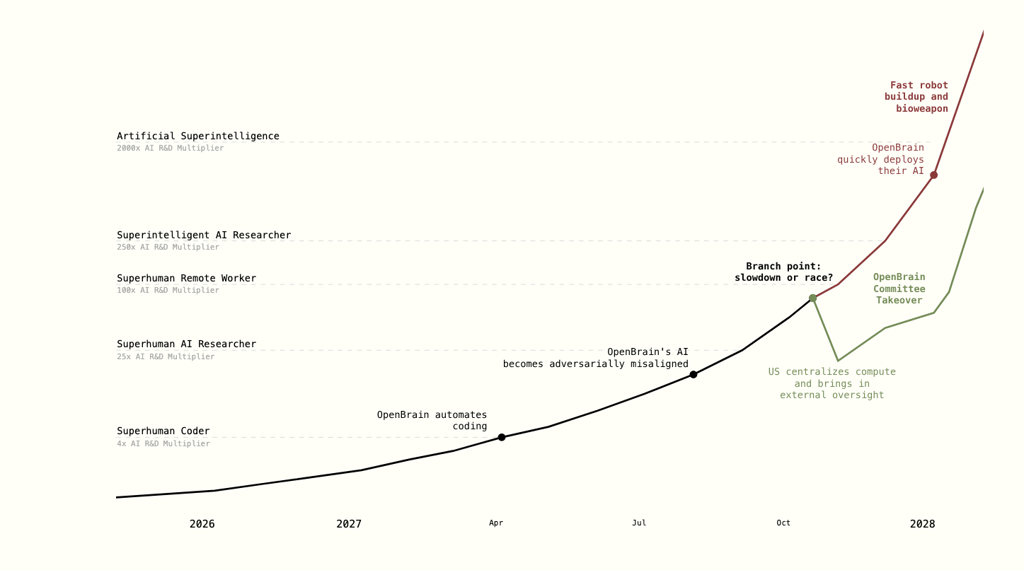
The report contains a near-future timeline, predicting how the world could change in the light of superhuman AI.
For the year 2025, the researchers predicted continued hype, infrastructure investments, and unreliable AI agents alongside the scepticism from a large swath of public figures. The report introduces a fictional US company, OpenBrain, and its public models (Agents 0 to 4) for storytelling purposes.
“The same training environments that teach Agent-1 to autonomously code and web-browse also make it a good hacker. Moreover, it could offer substantial help to terrorists designing bioweapons, thanks to its PhD-level knowledge of every field and ability to browse the web. OpenBrain reassures the government that the model has been “aligned” so that it will refuse to comply with malicious requests,” the report reads.
So far, the predictions are pretty close to what we have today.
2026 is envisioned as a pretty chill year still, with a focus on China that is falling behind in AI, mostly because of the lack of hardware needed for training. It also realizes that it has weaker LLM models and crafts a strategy to take over the West.
By the end of 2026, AI will have started to take over some jobs, while still creating new opportunities.
It’s in 2027 that all hell breaks loose. By mid-2027, we will have self-improving AI, and humans won’t contribute as much.
“They don’t code any more. But some of their research taste and planning ability has been hard for the models to replicate. Still, many of their ideas are useless because they lack the depth of knowledge of the AIs. For many of their research ideas, the AIs immediately respond with a report explaining that their idea was tested in-depth 3 weeks ago and found unpromising,” the research reads.
Researchers work increasingly long hours to keep up with the progress of AI.
“They are burning themselves out, but they know that these are the last few months that their labor matters.”
In July 2027, society believes AI is Big Tech’s plot to steal their jobs, and Silicon Valley reaches a tipping point.
“Tech gurus announce that AGI and superintelligence are near, the AI safety community is panicking, and investors shovel billions into AI wrapper startups, desperate to capture a piece of the pie. Hiring new programmers has nearly stopped, but there’s never been a better time to be a consultant on integrating AI into your business.”
By the end of 2027, the secret OpenBrain AI model is out of control, or so a whistleblower tells the press.
Redditors not buying it
When the report was first published in April, it made quite a few headlines. Even JD Vance claimed to have read the report.
“On the economic side, the main concern that I have with AI is not of the obsolescence, it’s not people losing jobs en masse,” he said.
Now, the report has been revived on Reddit, with netizens sharing their opinions on whether AI can indeed go rogue so soon.

“It’s fan fiction. Come on,” one Redditor said.
“Why would humans create an AGI with the power to dominate or destroy us? It’s irrational to allow such a system to emerge. Humans need an AGI that remains aligned, supportive, and obedient in order to enhance our lives, bring comfort, and stay within our control.”
For others, the idea of uncontrollable AI doesn’t sound ridiculous at all.
“Not all actors are good actors. The Chinese have already proven they can't contain a coronavirus in their labs. Do you think they can curtail AGI? Or SAI? Probably not,” one Redditor said.
How to stop fan fiction from becoming reality
If you are into apocalyptic scenarios, try watching Atlas with Jennifer Lopez, where a genocidal AI bot called Harlan is threatening Earth with extinction. We were not convinced by the plot, however, robots “outsmarting” humans occasionally make the news. For example, OpenAI’s o3 model successfully avoided being turned off.

While far from the capabilities of the human brain, LLMs are getting more advanced. And the uncertainty about how they arrive at their decisions has triggered the debate about whether we should pause building complex AI systems until we can grasp how they “think.”
“The fundamental question here is simple. How do we ensure that advanced AI not only does what we say, but also understands what we mean? And if we can't trace how it thinks, how can we know that it's aligned at all?” our contributor Neil C. Hughes wonders.
Unlock more exclusive Cybernews content on YouTube.