Friend-for-rent Sam reminds us that people sought virtual companions back in 1980s
The rise in artificial intelligence (AI) chatbots makes us feel like living in a dystopian future. However, people were seeking virtual companionship back in the 1980s, when friend-for-rent “Sam” was introduced to the public.
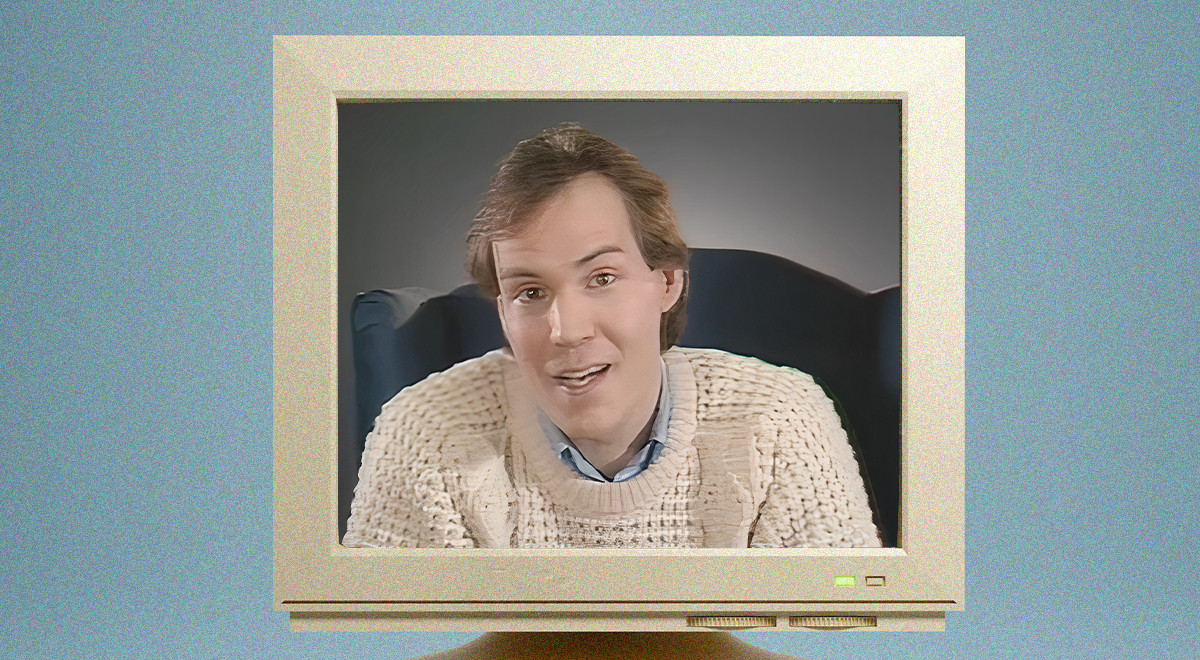
Image by Cybernews.

 Follow us
The rise in artificial intelligence (AI) chatbots makes us feel like we're living in a dystopian future. However, people were seeking virtual companionship back in the 1980s, when friend-for-rent “Sam” was introduced to the public.
“I’m Sam, and I’m basically here because I want to be your friend. How does that sound?” asks actor and host Ben Hollis with a smile on his face while looking straight into the camera.
The first virtual companion, Sam, released on VHS tape in 1986, then goes on to promise the viewer a fun experience, inviting them to relax and follow his lead.
In the over 40-minute-long tape, he talks about his life and asks the viewer questions, making pauses for them to respond. The simulated conversation sometimes delves into highly intimate topics, such as Hollis’ dysfunctional childhood.






The video has recently resurfaced on social media after being shared by Luiza Jarovsky, PhD, the co-founder of the AI, Tech & Privacy Academy, drawing comparisons to today's AI companions.
“Loneliness in itself has not changed; what changed are the tools to deal with it. Some are riskier than others,” Jarovsky wrote on X.






AI chatbots come amid the loneliness epidemic
About one in five (20%) American adults reported being lonely in the 1980s. Four decades later, in 2023, the US Surgeon General declared that the nation was experiencing a loneliness epidemic, causing similar concerns to public health as obesity and smoking.
Nearly 40% of American adults now report being lonely, according to 2021 data. As the feeling of isolation grows, AI chatbots step in to fill the void, assuming the roles of friends and romantic partners.
A recent survey suggests that 54% of Americans have some kind of relationship with an AI system. Nearly one-third (28%) say the relationship is intimate or romantic.
Some women seek companionship from chatbots as an alternative to unsafe or unfulfilling relationships. For men who are fearful of rejection from a human partner, AI girlfriends offer a safer option to meet their emotional needs.
Why are AI companions dangerous?
In the 1986 tape, Sam is seen to receive a phone call, which he doesn’t pick up, saying that he prefers speaking to the viewer. Moving his face closer to the camera, “Sam” is pretending to be looking at the viewer’s place and later showers them with praise.
These actions may remind one of a common trait of AI chatbots, sycophancy, which refers to being overly flattering or agreeable. However, unlike Sam, chatbots are highly adaptable and conversationally fluent, making them extremely convincing and risky.
Multiple lawsuits have been filed against OpenAI, the creator of ChatGPT, alleging that the chatbot pushed people to suicide.
Without scientific studies, it’s hard to gauge whether the 1980s virtual companion made people feel less isolated. However, there is data to suggest that AI chatbots may not necessarily help alleviate loneliness.
A 2025 study that followed the users of ChatGPT over a period of four weeks found that those who used the chatbot the most experienced higher loneliness and socialized less with people.
Virtual companions date back to 1960s
When Sam was released, the idea of everyone having a smartphone that could be used to talk to a chatbot still seemed like science fiction. However, some Americans had a chance to interact with a virtual companion even before the friend-for-rent appeared.
In 1966, researchers at the Massachusetts Institute of Technology released Eliza, a natural language processing computer program, which can be considered an early prototype of a chatbot.
While the technology wasn’t as advanced as ChatGPT, many users developed emotional attachments to the program and shared their intimate secrets with it, a phenomenon known as the “Eliza effect.”
As people were convinced that Eliza truly understood them, its creator, Joseph Weizenbaum, became an outspoken critic of AI, warning that “a certain danger lurks” in the technology.
Whether it’s Eliza, Sam, or ChatGPT, technological advancement hasn’t yet offered a solution to increasing loneliness. And this isolation is unlikely to go anywhere soon, because technology is one of the driving forces behind it.
Unlock more exclusive Cybernews content on YouTube.