UK worker productivity soars under shadow AI, but security threats still linger, Microsoft says
According to a new study from Microsoft, 71% of UK employees have at some point used so-called shadow AI tools at work, regardless of whether their management approves. Half continue to use them every week. How does this differ from what employees do in the USA?


 Follow us
According to a new study from Microsoft, 71% of UK employees have at some point used so-called shadow AI tools at work, regardless of whether their management approves. Half continue to use them every week. How does this differ from what employees do in the USA?
As companies draw clearer lines on what artificial intelligence (AI) can be used in the workplace, many employees in the UK use it without approval. That is what “shadow AI” entails – employees moving in the shadows by using AI tools and applications without their employer’s knowledge to be more productive at the price of privacy and security risks.
A new study commissioned by Microsoft and conducted by Censuswide reveals that 71% of UK employees have used shadow AI tools at some point, and 51% continue to use them every week.
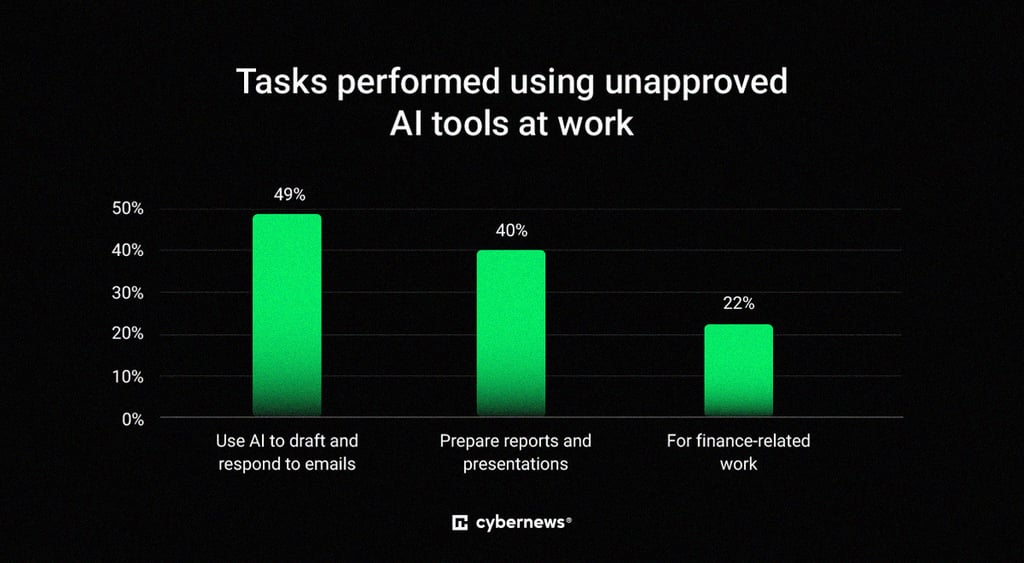
Employees use shadow AI for various reasons. The top three reasons are drafting and responding to emails (49%), preparing reports and presentations (40%), and finance-related work (22%).






Apart from saving time and increasing productivity, employees argue that they use shadow AI because they’re familiar with it from using it for personal use (41%) or because their company does not provide a safe, approved alternative (28%).
The same study has revealed that, on average, each employee has reported that shadow AI tools helped them save 7.75 hours per week. If the entire UK workforce does it, according to the research, this adds up to 12.1 billion hours a year, which Microsoft estimates is worth around £208 billion in workers’ time.
Is the situation in the USA that much different?
Not really. A recent Cybernews survey found that in the US, a similar pattern is emerging but on an even larger scale. Fifty-nine percent of the American workforce is using AI tools at work that have not been approved by their companies. Many employees claim to rely on tools such as ChatGPT, Claude, and Jasper. They most often assist humans in writing, research, and data analysis.

Similarly to employees in the UK, Americans justify their usage of unauthorized AI tools because, according to them, company-approved tools don’t meet their needs, or they prefer the tools they’re already familiar with from using them for their personal needs at home.
The research also shows that companies are not likely to emerge from this situation as winners, because even when they provide options for AI tools, many employees turn to personal ones regardless – 85% of US workers have done this in the past year.
This is where shadow AI becomes really problematic: three in four US employees who use unapproved AI tools have fed them with sensitive data such as customer details, legal or financial documents, and proprietary code.






According to Cybernews, nearly 90% of popular AI tools have faced data breaches, leaving companies exposed to leaks, phishing, and compliance failures.
Time is money, and AI saves both
Another important point is that workers' attitudes towards AI are much more positive than they were at the beginning of this year.
More than half of employees (57%) now describe themselves as optimistic, excited, or confident about AI, up from 34% in January 2025.
Also, fewer employees now say they “don’t know where to start with AI.” These people accounted for 44% in January, compared to 36% in October.
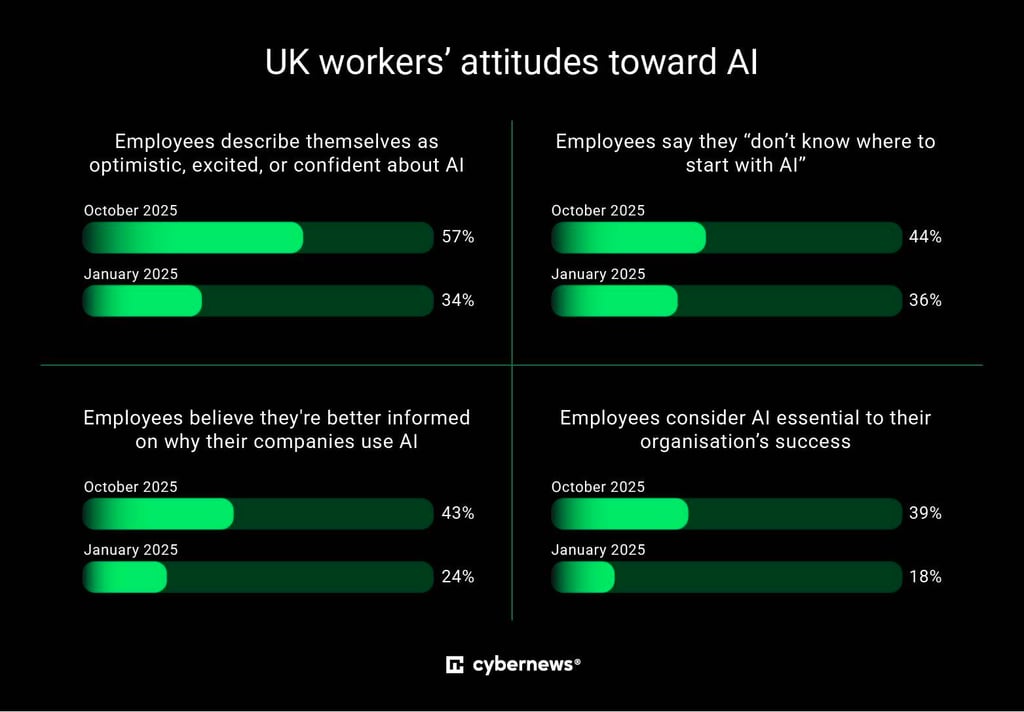
Employees also claim to be better informed about why their companies use AI: 43% now understand its purpose, up from 24% at the start of the year. Thirty-nine percent of employees consider AI essential to their organisation’s success. Nine months ago, only 18% of employees shared this belief.
The use of AI is also transforming the UK financial sector. According to Morgan McKinley’s London Employment Monitor reports cited by Reuters, job vacancies in London’s financial industry rose 9% year-on-year in the third quarter of 2025.
Fintech firms and a growing demand for workers with AI skills are driving this growth. However, the recruiting firm notes that graduate-level hiring is slowing as automation begins to replace some routine roles.
Unlock more exclusive Cybernews content on YouTube.