Utah community fights AI data center that would double state's energy consumption
Celebrity venture capitalist and Shark Tank investor Kevin O'Leary recently hit the headlines for all the wrong reasons after a proposal for a 9GW "hyperscale" data center spanning a 40,000-acre campus in Box Elder County, Utah, upset residents.
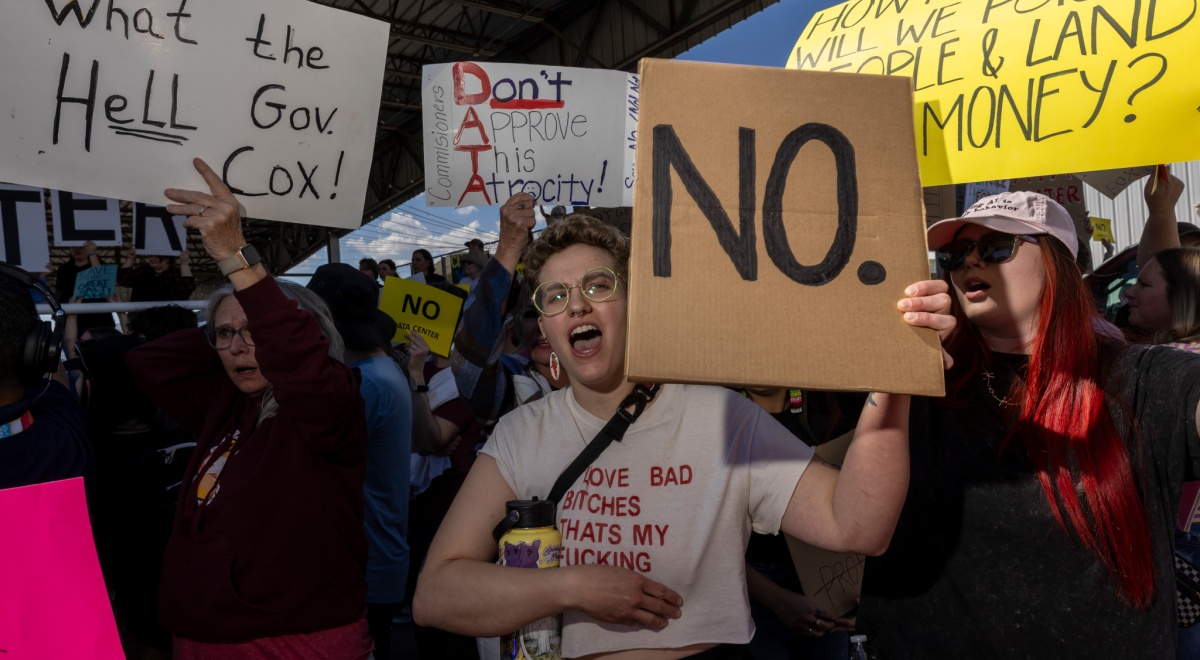
Alexa Chandler holds a sign protesting the construction of a data center. Natalie Behring/Getty.

 Follow us
Celebrity venture capitalist and Shark Tank investor Kevin O'Leary recently hit the headlines for all the wrong reasons after a proposal for a 9GW "hyperscale" data center spanning a 40,000-acre campus in Box Elder County, Utah, upset residents.
As details of the Stratos Project emerged, Robert Davies, a physics professor at Utah State University, warned that the proposal is effectively "a 16 gigawatt thermal load project," once the enormous volume of waste heat generated by the data center is included alongside its power consumption.
If that doesn't immediately conjure images of Dr. Emmett Brown shouting, "Great Scott!", he further described the impact as "the equivalent of powering 2,000 Walmart stores and about 23 atom bombs' worth of energy dumped into this local environment every single day."
Critics have warned that the Great Salt Lake is already shrinking and exposing toxic dust across the valley, and the data center will take even more water, while environmentalists warned that a data center of this magnitude would boost the entire state of Utah's CO2 emissions by 75%.






Backers dismissed the claims as overly dramatic and alarmist while insisting that the project will boost the local economy and create jobs. It's also being sold as crucial for national security, as the race to win the artificial intelligence race intensifies. But many are increasingly asking the true cost of winning yet another pissing contest.
Unsurprisingly, putting a 9-gigawatt data center capable of using double the energy the entire state of Utah consumes in a year would upset residents who are already being affected by rising electricity rates. With widespread reports of data center spikes blamed for rising electricity costs in areas like Maryland, tensions are understandably high.
Despite community members' best efforts, the Utah project was approved by Box Elder County commissioners. The decision was a big win for O'Leary, with developers hoping to begin early work on the site in the fall.
Without any hint of irony or self-awareness, the Canadian billionaire further rubbed salt into the wounds of the local community by claiming the opposition consisted of paid protestors bused in for the event.
There are plenty of warnings of why we need to fear a climate collapse. News of an AI arms race to build data centers that consume massive amounts of electricity and water not only feels off, but it’s also a massive contradiction. Can we realistically sustain both trajectories simultaneously?
The Data Center Map highlights Virginia as home to the world's largest data center cluster, while Texas and California are experiencing massive growth. But instead of cheering on the fast-tracking of planning permission to build more data centers, communities are pushing back.
Despite polarization across society, this could be the one issue that unites people, with many questioning how much electricity and water tech companies use in their neighborhoods.
According to Data Center Watch, the fightback is working, with $64 billion in US data center projects being blocked or delayed.
From climate villain to AI lifeline: nuclear's surprising return
Nuclear energy has traditionally been seen as too expensive and slow to build. But the explosion of AI infrastructure is changing the conversation. Even AI has an Achilles' heel, and the only viable solution is to find a scalable, carbon-light energy source that can support the next phase of the AI economy.
AI workloads do not care whether the wind is blowing or the sun is shining. Training large models and running inference at a global scale requires stable baseload power around the clock. It's this realization that is pushing the usual suspects in tech like Amazon, Google, Microsoft, and Meta toward nuclear energy partnerships.

Check if your data was exposed
Find out if your email and related personal information have appeared in known data breaches.
The global average construction timeline for even the smaller nuclear reactors is around 7 years in the West. But China and South Korea have already shown that reactors can be completed in 5 to 6 years.
Japan has further improved average build times to just 3-4 years per reactor. With so much at stake, the race is officially on, with Deloitte estimating that nuclear could provide up to 10% of data center electricity demand by 2035, while Goldman Sachs analysis suggests Big Tech may ultimately require up to 90 gigawatts of additional nuclear capacity to support AI infrastructure growth.
The US government has set an ambitious target to triple nuclear energy capacity by 2050. But there is still a big question mark over Small Modular Reactors (SMRs), which are largely unproven at utility scale. Infamous incidents at Fukushima and Chornobyl also weigh down any conversations about nuclear solutions with communities.
Even supporters acknowledge that scaling nuclear fast enough to meet AI demand will require regulatory reform, enormous capital investment, and an industrial mobilization that Western economies have ever seen. But there is an even bigger problem with going nuclear.
Is big tech betting on nuclear without securing the fuel?
Big tech companies are signing agreements for more than 10 gigawatts of new nuclear capacity, with delivery expected between 2028 and 2035. But the problem is that the uranium supply chain required to bring it all to life is already under immense strain.
Global uranium production is falling short of reactor demand. Kazakhstan is responsible for more than 40% of global uranium output, but it has reduced production targets, while Canada's Cameco continues to face operational delays.
With 95% of its uranium purchased from foreign sources, the US is looking vulnerable. The hype around nuclear as a silver bullet to power AI is outpacing the physical realities of mining, refining, and securing the materials needed to make that vision a reality.
When AI starts competing with society for electricity
Behind every chatbot response, generated image, or autonomous agent sits a vast and growing appetite for electricity, cooling, water, and compute capacity. But nuclear energy is moving from being viewed as a relic of the twentieth century to perhaps the only technology capable of sustaining the ambitions of the twenty-first.
While we wait to see if nuclear is the answer to our virtual AI prayers, we still have to deal with the very real problems caused by AI's demand on power grids. Behind the hyperbolic headlines about 2,000 Walmart stores and 23 atomic bombs is the very real concern that data center power demands are driving up energy bills. But carrying on with this trajectory means thatAI could soon consume more electricity than a region's total annual energy consumption.
Inevitably, this means that AI's insatiable appetite for electricity will directly compete with the needs of our critical infrastructure and homes. Without nuclear power, we are arguably sleepwalking into a future with no escape from technology.
Even if you are one of the lucky ones who has the self-awareness and discipline to escape the infinite scroll by wandering where the wi-fi is weak, your next hike could be accompanied by the soundtrack of the droning sounds from a data center near you.
Somewhere along the way, humanity may realize that in our rush to build machines that can do everything, we forgot to leave ourselves anywhere peaceful enough to be human.

Unlock more exclusive Cybernews content on YouTube.