Moveworks review: enterprise AI for employee support
Being behind major reports like The Mother of All Breaches and RockYou2024, our in-house cybersecurity experts and journalists provide unbiased, real-world testing and in-depth analysis.
We maintain complete transparency by openly sharing our testing methodologies with our audience.
Learn more
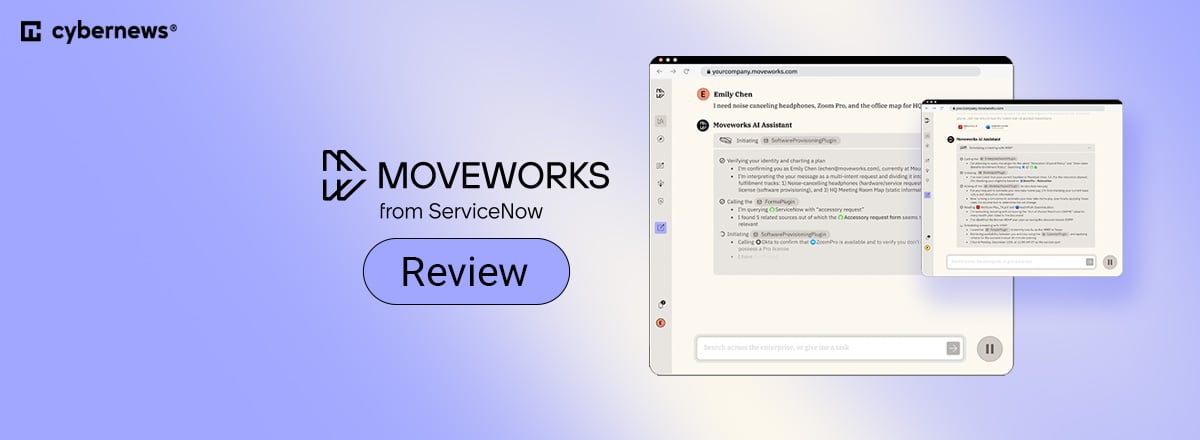
Moveworks is an enterprise AI platform meant for large companies that require IT, HR, and finance automation. Rather than forcing employees to fill out tickets to various departments, Moveworks allows them to perform internal activities using a natural language chatbot. It was acquired by ServiceNow in 2024, raising some concerns about vendor lock-in and long-term viability, but so far, this business transaction hasn’t limited any options for Moveworks’ users.

With the help of the Cybernews research team, I reviewed Moveworks’ functionality and user feedback to determine its best fit. I focused on the most common use cases and feedback from companies left on sites like G2.
Overall, I found that Moveworks is best suited for large companies looking to streamline their internal processes. Given its long and complex implementation process, it’s not really suitable for smaller companies.
Quick overview of Moveworks AI
| Rating: | |
| Brief description: | Moveworks is an enterprise-grade AI platform that automates internal IT and HR workflows, allowing employees to resolve issues and request access directly through communication hubs like Slack and Microsoft Teams. |
| Key specifications: | 100+ native enterprise integrations (ServiceNow, Workday, etc.), autonomous agentic resolution, advanced natural language understanding, deep identity management sync (Okta, Active Directory), SOC 2 compliance, and zero-data-retention options. |
| Pricing: | Custom enterprise pricing based on total company headcount. Contracts typically start in the low-to-mid six figures and include substantial initial implementation fees. No public pricing tiers are available. |
What Moveworks does well, and where it struggles
Moveworks is a product that fills a very specific niche. Thus, it has very specific pros and cons, as well as use cases that make it a good choice for some and a poor fit for others. Here’s a breakdown of what I found Moveworks to excel at and where I feel it fails.
What Moveworks actually does
While on the surface, Moveworks may seem like a chatbot, it’s actually far more advanced than it seems. Behind the scenes, Moveworks is a complex reasoning and execution engine that uses chatbot inputs to interpret intent and perform tasks.
For example, when an employee tells the chatbot that they can’t access Slack, Moveworks will first parse their intent and then start using its reasoning engine to determine the best course of action. It may be sending a password reset to the employee’s Slack account or creating a ticket for the IT department to take a look at. This all happens in the background, with the employee only having to describe their problem, rather than fill out a complex ticket.
These agents can be custom-built by your team, adjusting them to various department needs and use cases. This is done using a very intuitive builder that even your non-technical stakeholders will be able to figure out.
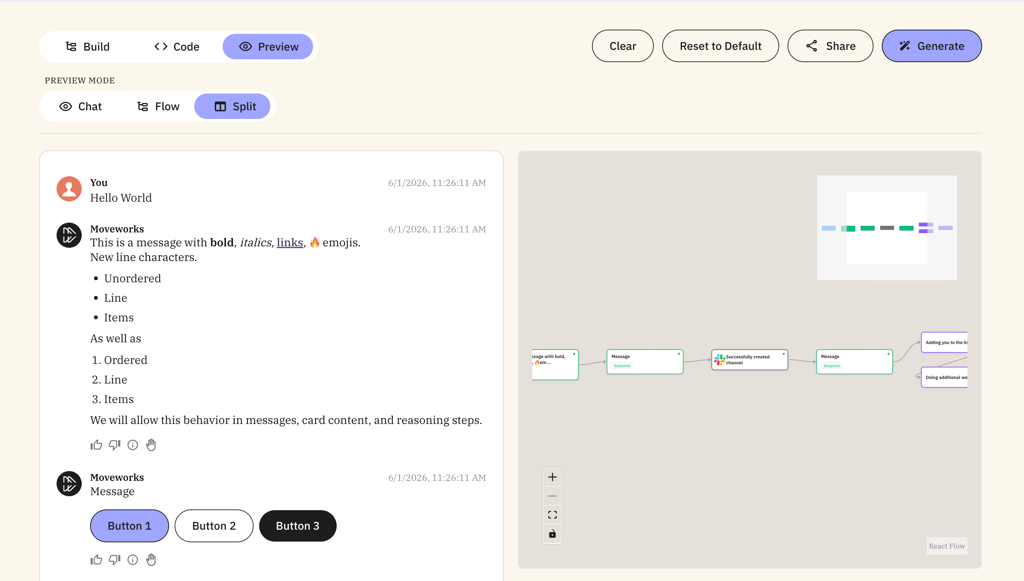
Moveworks also offers a Copilot mode that lets users use the chatbot as a unified knowledge base assistant. In Copilot mode, Moveworks connects the knowledge from all your tools in order to provide your team with accurate and up-to-date information.
Who Moveworks is built for and who should look elsewhere
Moveworks isn’t a tool like ChatGPT or Gemini. It needs a specific context to work well in. That’s why I’ve prepared a small breakdown of who Moveworks is and isn’t for.
Moveworks is an excellent pick for:
- Large enterprises (over 1,000 employees) with high IT/HR support ticket volumes where the per-employee cost model is justified by deflection rate
- Global organizations needing multilingual employee support at scale
- Enterprises already running ServiceNow, Workday, Okta
- IT and HR leaders looking to automate initial support volume and redirect teams to higher-value work
- Organizations in regulated industries needing FedRAMP, HIPAA, or GDPR compliance in their AI platform
Moveworks isn’t the best choice for:
- Companies under 1,000 employees, as it is likely to be far too expensive
- Teams needing deployment in weeks rather than months
- Organizations that want a plug-and-play solution that won’t require a complex implementation
- Buyers who need pricing transparency before a sales process
- Teams primarily focused on customer-facing AI, as Moveworks is internal-only
Moveworks platform capabilities
In order to break down Moveworks AI further, I decided to look at each of its features in-depth to give you a better understanding of what and how the software does it.
AI reasoning engine and agentic resolution
Moveworks’ main feature is its AI reasoning engine. This means that the software doesn’t just route requests but resolves them. It analyzes the context of each prompt, using its agentic toolkit to find a proper solution to the issue at hand.
For example, if you prompt Moveworks to give you access to your analytics dashboard, it will automatically check whether you have the required privileges and send a request to software like Okta to give your account access to the dashboard – all without a human in the loop, unless needed.
Moveworks’ AI excels at simple, streamlined tasks but may struggle with more open-ended or abstract conversations. This should get better if it is properly trained. However, your employees should know how to make requests as simple and to-the-point as possible.
Creator Studio: building custom AI agents
Moveworks doesn’t just provide AI agent templates. Instead, it lets your teams build their own workflows using a visual workflow builder that works similarly to tools like n8n. As long as all the integrations are properly implemented, the Creator Studio can easily be used by non-technical users to build a simple set of instructions for the AI reasoning engine.
Unfortunately, whenever a problem arises, it’s unlikely to be solvable without expert help. Since Moveworks relies on integrations and APIs, it’s very difficult for a layman to figure out where the errors lie. That’s why a programmer will still be required to fully leverage the customization.
Copilot: unified enterprise search and action
Copilot makes searching for information in an interconnected web of tools easier. With integrations to over 1000 tools, Moveworks can compile all the information in your ecosystem, from JIRA tasks to Slack messages.
The Copilot, in turn, can be used by your employees to quickly find information. This will help your team find information and ensure that your data doesn’t get lost between the different tools you may be using.
That said, Copilot’s effectiveness will largely depend on the quality of data you provide it. If your data is unstructured and hard to parse, the AI won’t really be able to get the information you’re looking for. However, if you have a well-sorted knowledge base and a clear streamline of tasks and data, it will help your employees find the information they’re looking for quicker.
Analytics and reporting dashboard
Moveworks doesn’t just execute prompts. It tracks common pain points and employee satisfaction. This, in turn, can yield actionable feedback to improve your employee experience.
For example, if Moveworks sees that many access requests are being escalated for human review, it may indicate an issue with the overall privilege setup. Identifying common issues can thus help streamline your work processes and avoid unnecessary delays.
On the other hand, the quality of the data will depend heavily on the number of users actually accessing Moveworks and will take time to yield statistically significant results.
Multilingual support
Moveworks supports over 100 languages, making it an excellent choice for global companies that hire many non-English-speaking personnel. With Moveworks, your employees can communicate with your systems in their native language, and Moveworks can translate requests as needed.
However, like many other AI-driven tools, the quality of each language will depend on the amount of training materials. This means that certain languages, dialects, or even niche-specific slang may cause problems for Moveworks.
Integrations: the enterprise stack backbone
Moveworks offers over 100 core integrations, which are direct connections that offer advanced integration with various productivity tools. It also offers over 1,000 pre-built agents and plugins. Here’s a breakdown of what Moveworks offers:
- Communication and collaboration: Slack, Microsoft Teams, Microsoft Outlook, web portals
- IT management and ticketing: ServiceNow, Jira, Zendesk, Salesforce Service Cloud
- Human resources and identity: Workday, Okta, Microsoft Active Directory
- Knowledge and enterprise search: SharePoint, Google Drive, Confluence
- Custom workflows and extensibility: AI agent marketplace with over 1,000 plugins, iPaaS connectors, and custom APIs
Since Moveworks was acquired by ServiceNow in 2024, it has been increasingly focused on integrating into ServiceNow’s ecosystem. However, the other integrations still work well, allowing you to plug Moveworks into virtually any system. That said, there is an inherent risk of vendor lock-in should ServiceNow decide to increase Moveworks’ dependence on its system.
Moveworks pricing: what organizations actually pay
The actual price of Moveworks isn’t publicly available, as the company offers custom pricing for each enterprise client. The overall price is based on your company’s size and headcount, with larger companies getting lower per-user prices.
The AWS Marketplace lists Moveworks at $150.00/year per user for companies with a headcount of 1,000–2,500 employees. This is likely to be a starting point for negotiations. Vendr lists Moveworks’ median spend at around $130,000 per year, making it a pretty expensive option, suitable only for large enterprises that can afford this level of spending.
Note that the per-employee cost isn’t the only one that you will incur. Moveworks also has an implementation cost that can set your company back betwen $50,000 and $200,000, depending on your company size and the number of integrations you need.
Buyers also noted that the pricing flexibility has decreased after Moveworks was acquired by ServiceNow. Whether this trend continues should be something you consider.
What enterprise users report about Moveworks
Testing Moveworks was impossible without implementing it in an enterprise environment. That’s why, with the help of the Cybernews research team, I explored websites like G2 to see what real users think of Moveworks.
Here’s what users appreciated about Moveworks:
- High efficiency, saving time and streamlining IT support.
- Ease of use, enabling efficient IT support and enhancing overall productivity.
- Impressive AI integration, enhancing efficiency and streamlining IT support.
- Time-saving capabilities that efficiently resolve issues and significantly reduce IT workload.
Here are some common criticisms:
- The integrations are complex and can be frustrating to set up and use.
- The learning curve is pretty steep, making integrating users time-consuming.
- Some users worry that integrations are getting worse to force users into the ServiceNow ecosystem.
Moveworks vs competitors
Moveworks isn’t the only platform offering similar tools, including Kore.ai, Sierra.ai, and Vellum.ai. To help you visualize the differences, I prepared a small table breaking down each platform’s focus and strengths.
| Tool | Best for | Primary focus | Employee support | Customer support | Deployment time | Pricing model | Key difference vs Moveworks |
| Moveworks | Internal IT and HR automation | Employee experience automation | ✅ Yes | ❌ No | 8 to 12 weeks | Custom, per employee | Baseline platform |
| Kore.ai | Enterprise contact centers | Omnichannel conversational AI | ✅ Yes | ✅ Yes | 2 to 4 months | Custom, session-based | Broader channel coverage, on-premise deployment available |
| Sierra.ai | Customer-facing AI agents | Customer support automation | ❌ No | ✅ Yes | 4 to 10 weeks | Custom, outcome-based | Strictly customer-facing, high conversational depth |
| Vellum.ai | Developer teams | LLM workflow building and testing | ❌ No | ❌ No | Instant | Tiered and usage-based | Developer tool to build AI, not a ready-made support bot |
All in all, Moveworks is the most capable employee-management platform among the four but requires the most effort and funds to set up. If you need to combine employee management with CRM-like customer-facing features, Kore.ai is a good choice.
Verdict: is Moveworks the right platform for your organization?
Moveworks is an AI tool aimed at serving a very specific niche. To make the most of it, consider whether it’s the right fit for your organization, taking your funds and size into account.
Here are three reasons why you should choose Moveworks:
- End-to-end agentic resolution. Moveworks actually completes tasks, rather than simply answering questions.
- 100+ language multilingual support ensures multicultural organizations will be able to make the most out of the product.
- Deep ServiceNow integration makes it the natural choice for enterprises already running ServiceNow
However, there are also a few reasons why you should choose a different product:
- Per-employee pricing, regardless of usage, makes the contract expensive for mid-sized teams and unpredictable as headcount grows.
- Long deployment and limited self-serve customization post-launch mean slow time-to-value and ongoing vendor dependency.
- Post-acquisition uncertainty warrants careful contract negotiation.
FAQ
What did the ServiceNow acquisition mean for Moveworks customers?
ServiceNow completed its acquisition of Moveworks in December 2025. The platform is now being directly integrated into ServiceNow's AI portfolio. While current integrations with competing tools remain active, future product updates will prioritize deep connectivity within the ServiceNow ecosystem.
How much does Moveworks actually cost?
Moveworks charges a custom annual fee based on total company headcount rather than active users. The median annual contract value is roughly $130,000, which typically breaks down to between $15 and $45 per employee. Buyers must also budget for mandatory implementation services that add significant first-year setup costs.
Is Moveworks suitable for companies under 500 employees?
No. It is an enterprise-grade platform built for complex deployments and carries a high baseline minimum cost. Smaller companies usually lack the sheer volume of internal support tickets needed to justify a six-figure initial investment.
How long does it take to implement Moveworks?
A standard implementation takes between eight and sixteen weeks. This is because the AI requires significant coordination with internal IT teams to securely map out existing systems.
What are the best alternatives to Moveworks?
Kore.ai is a direct enterprise alternative built for internal IT and HR workflow automation. If you need customer support features, Vellum.ai is a top alternative.